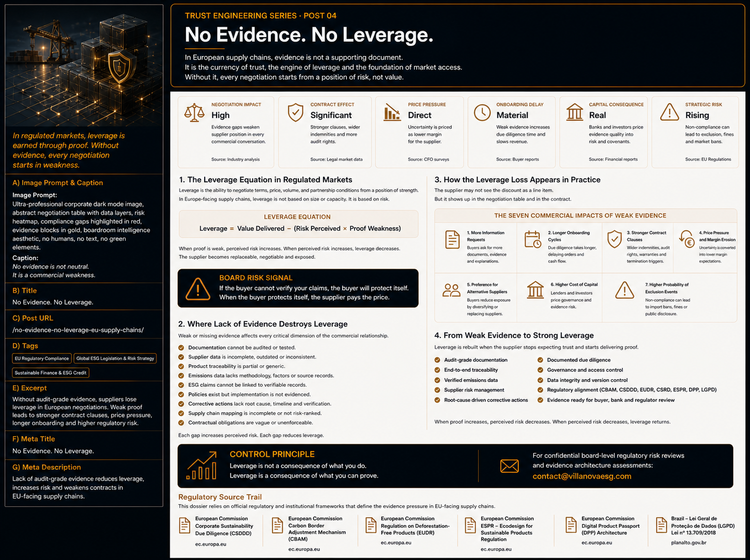
No Evidence. No Leverage.
Without audit-grade evidence, suppliers lose leverage in European negotiations. Weak proof leads to stronger contract clauses, price pressure, longer onboarding and higher regulatory risk.
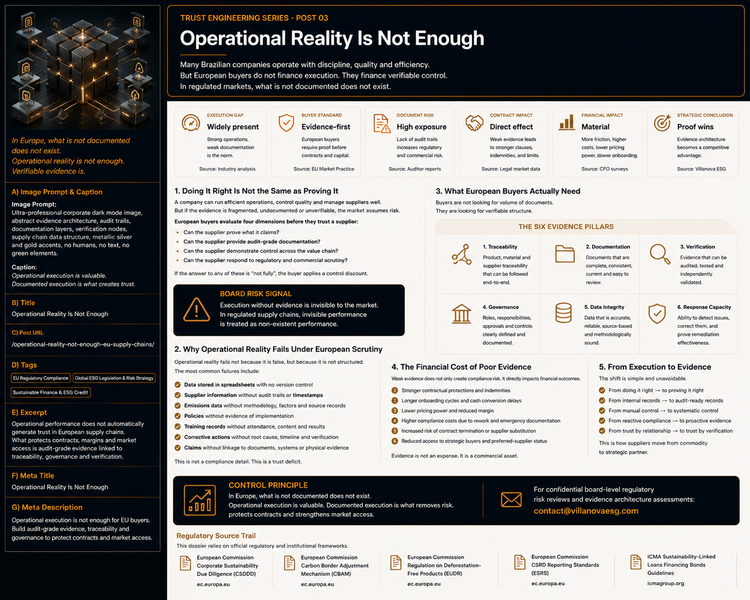
Operational Reality Is Not Enough
Operational quality does not automatically generate trust in European supply chains. What protects margin, contracts and market access is audit-grade evidence linked to traceability, governance and verification.
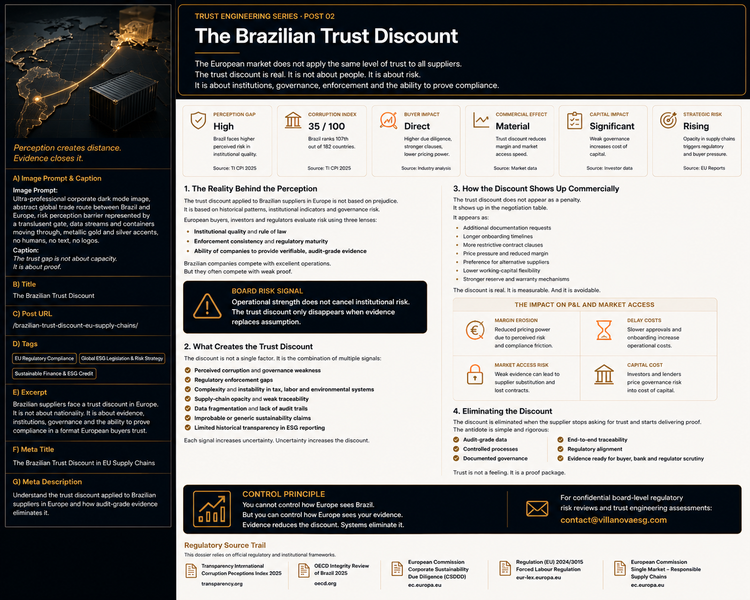
The Brazilian Trust Discount
Brazilian suppliers often face a hidden trust discount in European markets. It is not only about performance. It is about institutional perception, documentation quality, audit-grade evidence and the ability to prove compliance before buyers price uncertainty into the relationship.
Trust Is Not Claimed. It Is Engineered.
European buyers do not need more promises from suppliers. They need audit-grade evidence. For EU-Brazil supply chains, trust must be engineered through documentation, custody, verification and regulatory discipline.
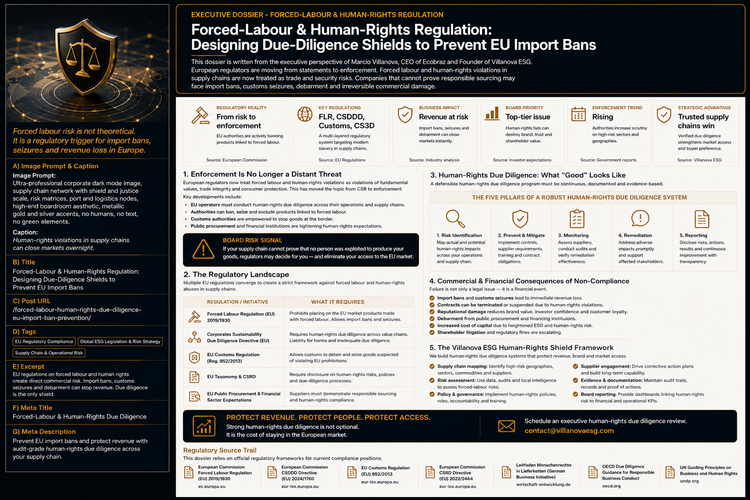
Forced-Labour Due Diligence Shield
EU forced-labour regulation transforms human-rights risk into market-access risk. Exporters and suppliers must prove due diligence, supplier control and remediation discipline before a customs or buyer crisis forces the issue.
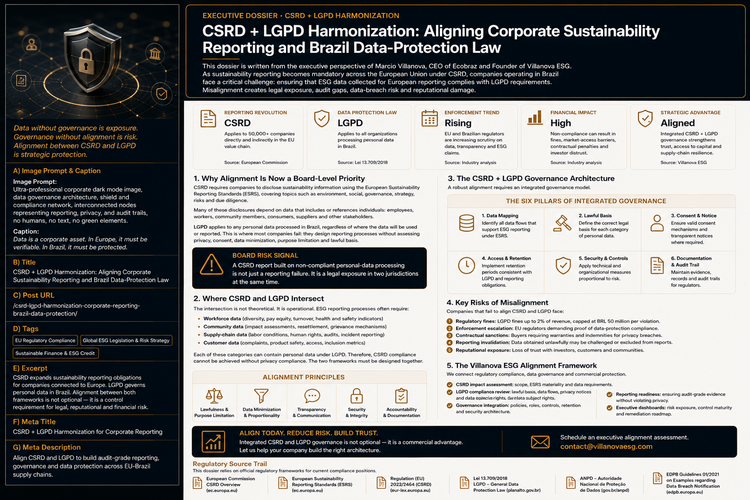
CSRD + LGPD Harmonization
CSRD reporting pressure and Brazil’s LGPD create a new governance problem for EU-Brazil supply chains. ESG data must now be reportable, auditable and legally controlled.
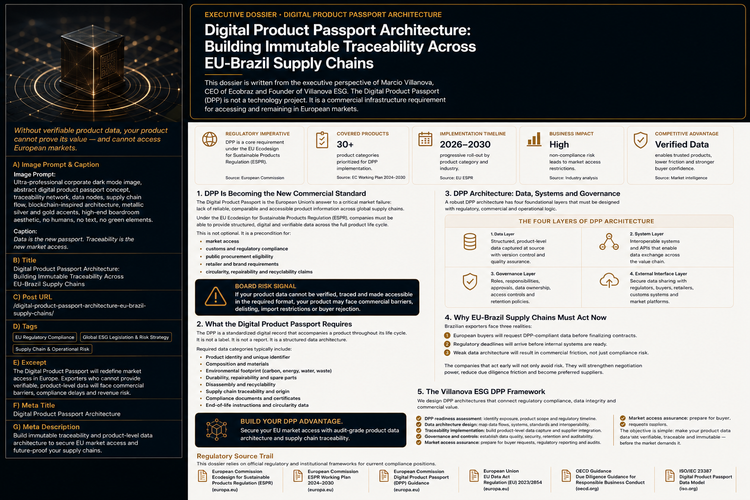
Digital Product Passport Architecture
The Digital Product Passport is not a technology trend. It is becoming a regulatory infrastructure for product identity, traceability and market access. Exporters without verified product data will face higher commercial friction in Europe.
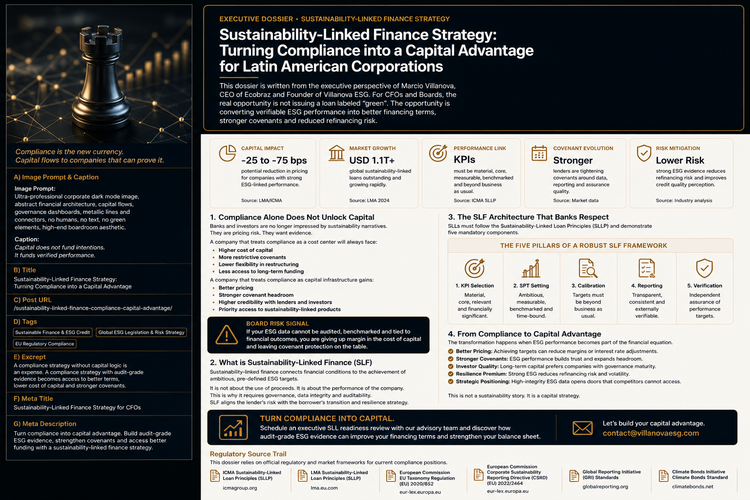
Sustainability-Linked Finance Strategy
Sustainability-linked finance does not reward intention. It rewards measurable performance, credible KPIs and audit-grade evidence. For Latin American corporations, regulatory compliance can become a capital advantage only when it survives lender scrutiny.
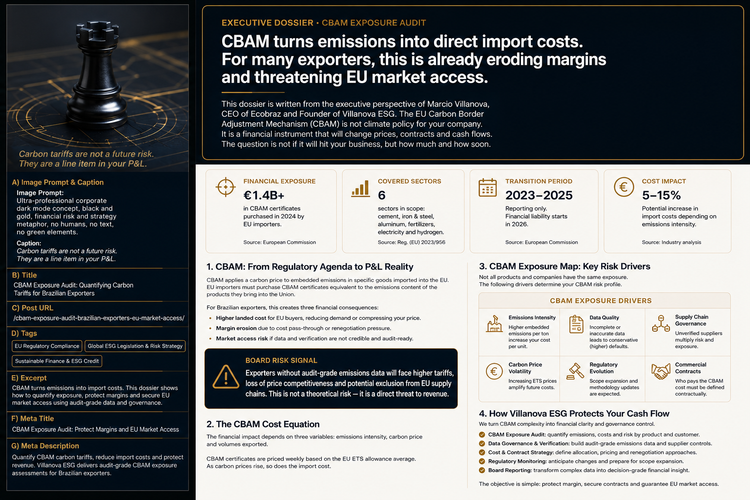
CBAM Exposure Audit for Brazilian Exporters
CBAM converts embedded emissions into import-cost exposure. For Brazilian exporters, the risk is not theoretical. It sits inside product pricing, buyer negotiations, supplier data quality and EU market-access continuity.
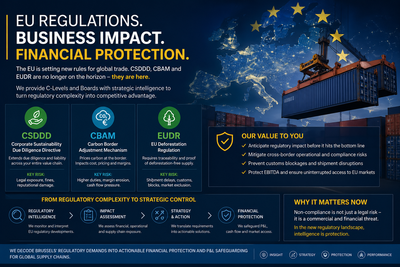
The Regulatory Shield: Neutralizing the 5% Revenue Risk in Transnational Supply Chains
Transnational ESG compliance is now a strict financial liability. Discover how the CSDDD and EU frameworks directly threaten corporate balance sheets and learn how to engineer a regulatory shield to protect your revenue and secure optimized capital costs.