
Sustainability-Linked Finance Strategy
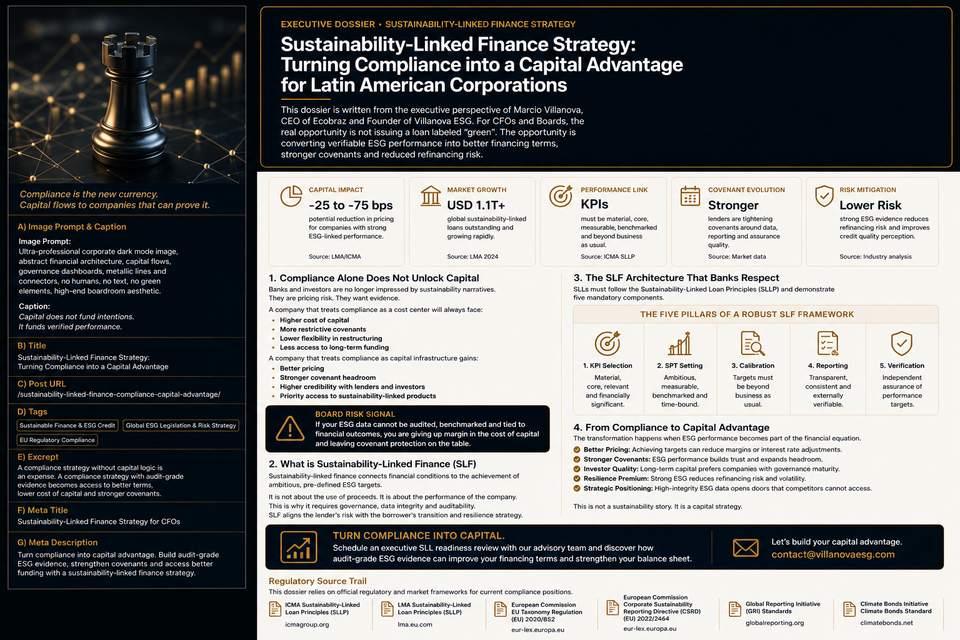
Executive Dossier · Sustainability-Linked Finance Strategy
Sustainability-linked finance does not fund corporate intention. It funds credible performance. For Latin American corporations, the opportunity is not to claim ESG maturity. The opportunity is to convert compliance evidence into stronger lender confidence, covenant readiness and capital-market credibility.
This dossier is written from the executive perspective of Marcio Villanova, CEO of Ecobraz and Founder of Villanova ESG. The real financial opportunity is not issuing a sustainability narrative. It is building audit-grade evidence that allows banks, investors and credit committees to evaluate ESG-linked performance with lower uncertainty, stronger governance and clearer risk allocation.
Finance Thesis
Compliance becomes valuable only when lenders can verify it.
Capital Risk
Weak ESG data can increase covenant friction.
Credit Logic
KPIs must be material, measurable and financially relevant.
Board Trigger
No evidence. No credibility. No capital advantage.
Compliance Alone Does Not Create a Capital Advantage
Many corporations approach sustainability-linked finance with the wrong premise. They believe that having ESG policies, public commitments or sustainability reports will automatically improve access to capital. That assumption is financially dangerous.
Banks and investors do not finance intention. They evaluate risk. A company seeking sustainability-linked finance must show that its ESG performance indicators are material, measurable, benchmarked, governed and capable of independent review.
The difference is structural:
- Generic ESG: narrative, commitments and reputational positioning.
- Auditable ESG: evidence, controls, KPIs, baselines, governance and lender-grade disclosure.
- Sustainability-linked finance readiness: the ability to connect performance targets to financial terms without credibility gaps.
Board Risk Signal
If ESG performance cannot be audited, benchmarked and tied to financial control, it does not reduce the lender’s risk perception. It increases scrutiny.
The Real Function of Sustainability-Linked Finance
Sustainability-linked finance is not a reward mechanism for corporate goodwill. It is a financial structure where economic terms may be linked to the achievement of predefined sustainability performance targets.
That distinction matters. The instrument is not secured by a vague sustainability profile. It depends on the credibility of selected KPIs, calibration of targets, reporting discipline and verification architecture.
For CFOs, this creates a capital strategy problem. The company must prove that the selected sustainability metrics are not decorative. They must be financially material and connected to operational control.
Finance-Grade Readiness Formula
SLL Readiness = KPI Materiality × Data Reliability × Target Credibility × Governance Strength × Verification Capacity
A low score in any component weakens the financing thesis. The lender does not evaluate ESG ambition in isolation. It evaluates whether the company can prove, monitor and defend performance over the life of the financial instrument.
SLL Readiness Architecture
KPI Selection
Choose indicators that are core to the business, relevant to risk and material to lenders.
Baseline Integrity
Establish reliable historical data before setting targets that will affect financial terms.
Target Calibration
Define sustainability performance targets that are ambitious, credible and not business-as-usual.
Data Governance
Control data ownership, custody, calculation logic, access rights and internal accountability.
Verification Capacity
Prepare evidence for independent review, lender diligence and recurring performance checks.
Covenant Discipline
Translate ESG performance into financial terms without creating hidden reporting or breach risk.
Why Latin American Corporations Face a Higher Evidence Burden
Latin American corporations seeking capital from international banks, private credit funds or European-linked institutions face a specific challenge. Many companies have operational sustainability initiatives, but their evidence architecture is not lender-grade.
This gap creates a financing problem. A company may have real environmental or social performance, but if the data is fragmented across departments, suppliers, spreadsheets and consultants, the financial market cannot price it with confidence.
The result is a lost capital advantage. The company carries compliance costs but fails to convert them into better financing conditions, stronger investor confidence or improved covenant flexibility.
From Regulatory Compliance to Capital Strategy
European regulatory pressure is changing the structure of sustainable finance. CSDDD, CSRD, CBAM, EUDR and the EU Taxonomy are not isolated frameworks. Together, they raise the market standard for evidence, traceability and disclosure.
For Boards, this creates a strategic opportunity. A company that builds audit-grade compliance infrastructure can use that evidence to improve the quality of its capital-market dialogue. The same controls that protect against regulatory exposure can support financing readiness.
This is where Villanova ESG positions the work: at the intersection between European regulatory risk and cash-flow protection for cross-border supply chains.
Control Principle
The company that can prove regulatory control, supplier traceability and ESG performance with audit-grade evidence enters the capital conversation with less uncertainty than competitors selling unsupported narratives.
Decision Trigger for CFOs
The CFO should not ask whether the company has an ESG story. The correct question is whether the company has a finance-grade evidence system capable of supporting a sustainability-linked facility.
A sustainability-linked finance readiness review becomes urgent when:
- The company wants to approach banks, investors or private credit providers with an ESG-linked financing thesis.
- Current ESG indicators are not tied to financial materiality or operational controls.
- Supplier data, Scope 3 data or regulatory evidence remains fragmented or unverifiable.
- Management cannot explain how sustainability performance targets would be monitored over the financing period.
- The Board wants to convert compliance spending into a stronger capital-market position.
The Villanova ESG Readiness Framework
Villanova ESG does not position sustainability-linked finance as a guaranteed funding outcome. No credible advisor should promise credit access, pricing improvement or lender approval without institutional diligence.
The correct advisory role is to prepare the company for a stronger capital conversation by structuring evidence, governance and risk controls before the financing process begins.
The readiness framework includes:
- Regulatory exposure diagnosis: mapping CSDDD, CBAM, EUDR, CSRD, EU Taxonomy and LGPD relevance to the company’s business model.
- KPI materiality review: identifying indicators with financial, operational and regulatory significance.
- Evidence architecture: organizing supplier, emissions, custody, compliance and operational data into a lender-reviewable structure.
- Target calibration support: stress-testing whether proposed targets are credible, ambitious and measurable.
- Covenant-readiness assessment: identifying reporting, verification and breach risks before term-sheet negotiation.
- Board-level reporting: translating ESG evidence into risk, capital and cash-flow language.
Regulatory Source Trail
This dossier relies on official regulatory and institutional frameworks verified for current compliance positions:
- ICMA — Guidelines for Sustainability-Linked Loans Financing Bonds
- Loan Market Association — Sustainable Lending
- European Commission — EU Taxonomy for Sustainable Activities
- European Commission — EU Taxonomy Navigator
- European Commission Joint Research Centre — EU Taxonomy
Closing CTA · Secure Your Capital Strategy
Compliance without capital logic is an expense. Compliance with audit-grade evidence can become a financing advantage.
Sustainability-linked finance requires more than ESG ambition. It requires credible KPIs, defensible baselines, data governance, verification capacity and Board-level control over regulatory exposure.
Schedule an executive SLL readiness review with our advisory team to strengthen your capital strategy at contact@villanovaesg.com.