
Forced-Labour Due Diligence Shield
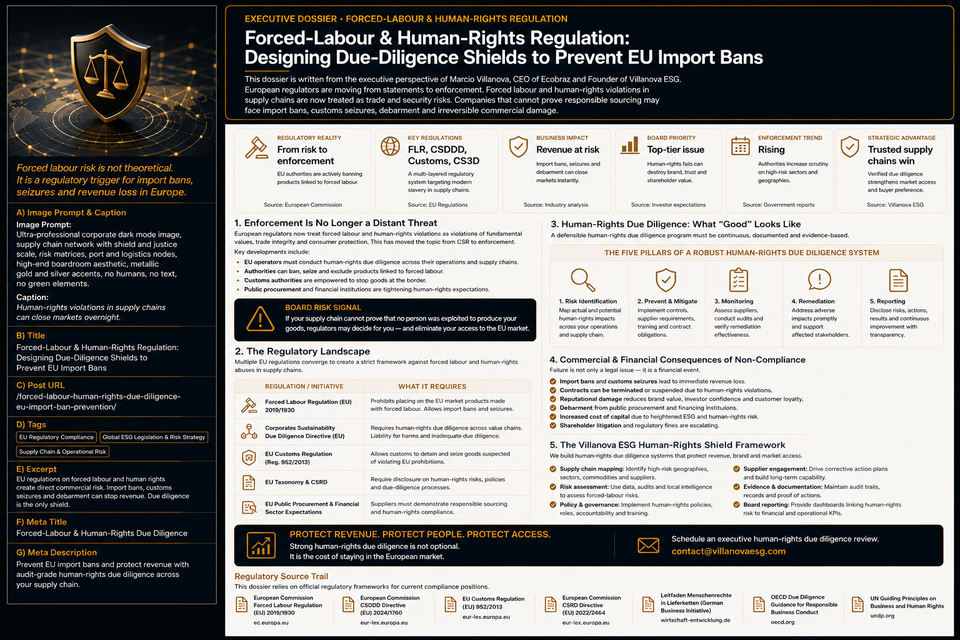
Executive Dossier · Forced-Labour & Human-Rights Regulation
Forced-labour exposure is moving from reputation to enforcement. For EU-facing supply chains, the risk is no longer limited to public criticism. It can become product detention, import prohibition, buyer exit and direct revenue interruption.
This dossier is written from the executive perspective of Marcio Villanova, CEO of Ecobraz and Founder of Villanova ESG. Human-rights due diligence is now a financial-control requirement for cross-border operators. Companies connected to European buyers must prove supplier risk identification, evidence custody, remediation discipline and escalation control before enforcement pressure reaches customs, contracts or lenders.
EU Ban
Products made with forced labour will be prohibited in the EU market.
Application Date
Rules start to apply on 14 December 2027.
CSDDD Link
Human-rights due diligence becomes a value-chain control issue.
Board Risk
Supplier opacity can become an import-ban trigger.
Human-Rights Risk Is Becoming a Market-Access Risk
For years, many Boards treated forced-labour exposure as a reputational or corporate-responsibility issue. That view is now commercially obsolete. The European regulatory direction is clear: products connected to forced labour can be removed from the market-access equation.
The Forced Labour Regulation introduces a direct commercial consequence. If a product is found to be made with forced labour, it may be prohibited from being placed or made available on the Union market, and from being exported from the Union market.
For exporters, suppliers and multinational buyers, the financial exposure is direct:
- Loss of EU market access for affected products.
- Customs disruption and product-flow interruption.
- Contract termination or suspension by European buyers.
- Higher due-diligence costs under emergency conditions.
- Lender and investor scrutiny over supply-chain governance.
Board Risk Signal
A supplier chain that cannot prove the absence of forced-labour exposure is not merely incomplete. It is commercially vulnerable to product exclusion from Europe.
The Import-Ban Logic Behind the Regulation
The regulatory logic is enforcement-driven. The objective is not to require companies to publish better human-rights language. The objective is to prevent products made with forced labour from circulating in the EU market.
This changes the role of due diligence. It is no longer only a governance expectation. It becomes a defensive evidence system that allows companies to identify risks, document controls, support remediation and respond to competent-authority or buyer scrutiny.
For Brazil-connected chains, the risk can emerge indirectly. A Brazilian supplier may not be the direct EU importer, but its products, materials or components can sit inside a European buyer’s value chain. That buyer will transfer risk pressure upstream.
Import-Ban Exposure Formula
Forced-Labour Exposure = Supplier Risk × Product Criticality × Evidence Weakness × Geography Risk × Remediation Failure
This formula requires internal company data. A defensible exposure model depends on supplier mapping, product-flow traceability, country and sector indicators, contract controls, audit evidence, grievance data and remediation records.
Human-Rights Due-Diligence Shield Map
Supplier Mapping
Identify direct and indirect suppliers, subcontractors, labour brokers, high-risk regions and critical product inputs.
Risk Identification
Assess forced-labour indicators by sector, geography, recruitment practice, employment condition and production model.
Evidence Custody
Maintain traceable documentation showing policies, audits, corrective actions, supplier declarations and escalation records.
Contract Controls
Insert supplier obligations, access rights, audit clauses, remediation duties and termination triggers into commercial contracts.
Remediation Discipline
Define corrective actions, worker-protection safeguards, timelines, monitoring and responsible disengagement criteria.
Board Escalation
Translate forced-labour indicators into revenue exposure, buyer risk, import-ban probability and remediation cost.
CSDDD Raises the Governance Standard
The Forced Labour Regulation and the Corporate Sustainability Due Diligence Directive are not identical instruments. They operate differently. But commercially, they point in the same direction: companies connected to European markets need stronger control over human-rights and environmental risks in their value chains.
The CSDDD establishes a corporate due-diligence duty focused on identifying and addressing potential and actual adverse human-rights and environmental impacts in a company’s own operations, subsidiaries and business partners in the relevant value chain.
That means supplier governance cannot remain informal. Boards need documented processes, not verbal assurances. Procurement teams need evidence, not policies sitting in a folder. CFOs need to know where revenue is exposed if a critical supplier fails.
Control Principle
Human-rights due diligence is not complete when a supplier signs a declaration. It is complete only when risk identification, verification, remediation and escalation can be proven.
The Commercial Damage of Late Preparation
The application date of the Forced Labour Regulation creates a preparation window. It does not create a reason to wait. By the time an EU buyer requests evidence, the supplier has already been risk-scored.
Late preparation creates commercial damage before formal enforcement occurs. Buyers may demand additional warranties, suspend onboarding, reduce order volumes, request alternative suppliers or shift procurement away from opaque chains.
The most exposed companies are those that cannot answer basic control questions:
- Which suppliers use subcontracted labour or labour intermediaries?
- Which product lines depend on high-risk geographies or sectors?
- Which contracts give the company audit and remediation rights?
- Which records prove that risks were identified and addressed?
- Which buyer relationships would be financially damaged by an import-ban concern?
Decision Trigger for CFOs
The CFO should intervene when human-rights risk can interrupt revenue, increase working-capital friction, delay shipments or weaken buyer confidence.
A human-rights due-diligence shield assessment becomes urgent when:
- The company exports to Europe or supplies a European buyer.
- Critical suppliers operate in high-risk sectors, geographies or informal labour environments.
- Supplier declarations are not supported by audit trails, worker-grievance mechanisms or remediation evidence.
- Contracts lack clear audit rights, corrective-action obligations and termination triggers.
- Procurement cannot produce a risk-ranked supplier map.
- The Board cannot quantify revenue exposure if a product line faces buyer rejection or import-ban scrutiny.
The Villanova ESG Human-Rights Shield Framework
Villanova ESG treats forced-labour and human-rights due diligence as a market-access and cash-flow protection system. The objective is not to produce a polished policy. The objective is to build a defensible shield before product, supplier or buyer exposure becomes a crisis.
The advisory framework includes:
- Supply-chain risk mapping: identify suppliers, subcontractors, labour brokers, geographies, sectors and product dependencies.
- Forced-labour indicator assessment: evaluate operational signals using structured risk categories and documentary evidence.
- Contract and procurement review: align supplier obligations, audit rights, corrective actions, termination rights and evidence duties.
- Evidence architecture: build custody records, audit trails, grievance documentation, remediation files and Board-ready dashboards.
- Import-ban exposure modelling: connect supplier risk to product flow, buyer dependency, revenue concentration and market-access exposure.
- Executive escalation system: define when human-rights risk moves from procurement control to Board decision.
Regulatory Source Trail
This dossier relies on official regulatory frameworks verified for current compliance positions:
- European Commission — Forced Labour Regulation
- Regulation (EU) 2024/3015 — Prohibiting Products Made with Forced Labour on the Union Market
- European Commission — Corporate Sustainability Due Diligence
- Directive (EU) 2024/1760 — Corporate Sustainability Due Diligence Directive
- European Commission — EU Due Diligence Navigator: CSDDD
Closing CTA · Secure Your Supply Chain
Forced-labour risk can remove products from the European commercial equation.
The preparation window is open. Companies that wait for buyer pressure, customs scrutiny or public allegations will pay a higher remediation cost and negotiate from weakness. Human-rights due diligence must become a revenue-protection system.
Schedule an executive human-rights due-diligence shield assessment with our advisory team to protect your EU-facing supply chain at contact@villanovaesg.com.