
The Brazilian Trust Discount
Executive Dossier · Trust Engineering Series
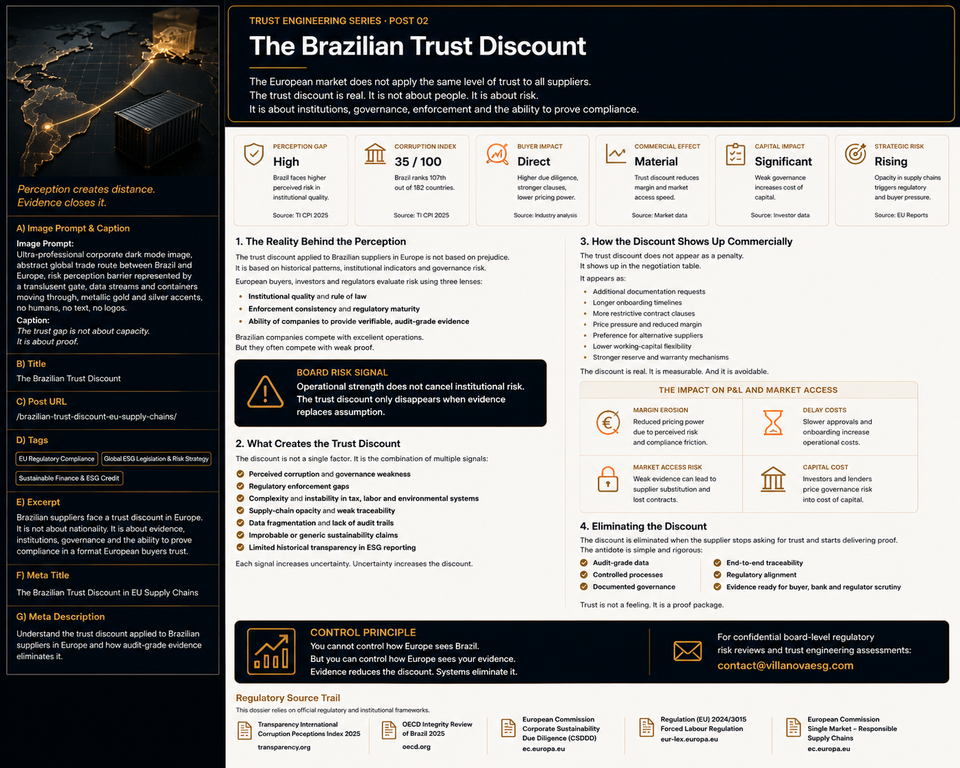
Brazilian suppliers do not compete in Europe on operational performance alone. They also compete against a trust discount created by institutional perception, governance risk, evidence weakness and buyer uncertainty.
This dossier is written from the executive perspective of Marcio Villanova, CEO of Ecobraz and Founder of Villanova ESG. The Brazilian trust discount is not solved by defending Brazil emotionally. It is reduced by converting operational reality into audit-grade evidence that European buyers, banks, auditors and Boards can verify.
Core Problem
European buyers price uncertainty into supplier relationships.
Brazil Signal
Brazil scores 35/100 in the 2025 Corruption Perceptions Index.
Commercial Effect
Trust gaps reduce leverage before contracts are signed.
Control Standard
Evidence removes uncertainty. Systems remove discount.
The Trust Discount Is Real
European markets do not apply the same level of trust to all suppliers. This is not always explicit. It does not usually appear in a procurement memo. It appears in the negotiation process.
It appears in additional documentation requests. Longer onboarding. Stronger contractual protections. More restrictive warranties. Lower tolerance for uncertainty. More buyer pressure on price, traceability and compliance.
Brazilian companies may operate with discipline and still face skepticism because the buyer is not evaluating only the company. The buyer is also evaluating country perception, institutional risk, enforcement maturity and the supplier’s ability to prove compliance.
Board Risk Signal
Operational strength does not eliminate institutional perception risk. The trust discount disappears only when evidence replaces assumption.
What Creates the Brazilian Trust Discount
The discount is not created by a single factor. It is the result of multiple risk signals that European buyers, banks and investors interpret together.
These signals include:
- perceived corruption and governance weakness;
- regulatory enforcement gaps;
- complexity and instability in tax, labour and environmental systems;
- supply-chain opacity and weak traceability;
- fragmented data and missing audit trails;
- generic sustainability claims without evidence;
- limited historical transparency in ESG reporting.
None of these factors proves that a specific Brazilian supplier is unreliable. That is the point. The buyer does not know. In the absence of proof, uncertainty becomes a commercial discount.
Trust Discount Formula
Trust Discount = Country Perception Risk × Evidence Weakness × Supplier Opacity × Regulatory Exposure × Buyer Liability
This formula requires internal company data and buyer-specific context. A real score depends on export flows, buyer exposure, documentation maturity, supplier controls, audit trails, product category and applicable EU regulatory frameworks.
How the Discount Shows Up Commercially
The trust discount rarely appears as a formal penalty. It shows up as friction.
Friction increases cost. Friction delays revenue. Friction weakens negotiation power.
For Brazilian suppliers and EU-facing corporations, the commercial effects may include:
- longer due-diligence cycles before onboarding;
- additional buyer questionnaires and evidence requests;
- contract clauses shifting regulatory risk upstream;
- stronger indemnities, warranties and audit rights;
- price pressure justified by compliance uncertainty;
- higher probability of supplier substitution;
- weaker access to strategic European buyers;
- more scrutiny from lenders and investors.
P&L Impact Map
Margin Compression
Buyers use perceived risk and documentation weakness to demand lower prices or stronger protections.
Revenue Delay
Slow onboarding, supplier reviews and repeated evidence requests delay contract execution and revenue recognition.
Contract Exposure
Risk is pushed upstream through warranties, audit rights, termination clauses and indemnity obligations.
Market Access Risk
Opaque suppliers become easier to replace when European buyers face CBAM, CSDDD, EUDR, CSRD or forced-labour pressure.
Capital Cost
Banks and investors price governance weakness into risk perception, diligence intensity and covenant expectations.
Board Liability
If leadership cannot prove supplier controls, risk becomes a governance issue, not a sustainability issue.
The Wrong Response: Defending Brazil
The worst response to the trust discount is emotional defence.
European buyers do not need speeches about Brazilian potential. They need evidence that reduces their exposure. They need documentation that survives audit. They need data that can be traced. They need supplier controls that are not improvised after a crisis.
The correct response is not to ask Europe to trust Brazil. The correct response is to make the specific supplier impossible to dismiss as opaque.
Control Principle
You cannot control how Europe sees Brazil. But you can control how Europe sees your evidence.
How to Reduce the Trust Discount
The discount is reduced when uncertainty is reduced. Uncertainty is reduced when the company stops selling confidence and starts delivering proof.
A serious evidence architecture should include:
- product-level traceability;
- supplier risk mapping;
- documented chain of custody;
- emissions-data control;
- forced-labour and human-rights due-diligence records;
- deforestation and land-use evidence where relevant;
- contractual allocation of regulatory obligations;
- governance over ESG and compliance data;
- audit trails that can be reviewed by buyers, banks and regulators.
This is not communication. This is infrastructure.
Decision Trigger for CFOs
The CFO should act when European revenue depends on buyer confidence but the company cannot prove its controls with audit-grade evidence.
A Brazilian trust-discount review becomes urgent when:
- European buyers request more documentation than expected.
- Commercial teams report slower onboarding or repeated compliance objections.
- Contracts transfer CBAM, CSDDD, EUDR, forced-labour or data-governance exposure upstream.
- Supplier evidence is fragmented across departments, consultants and spreadsheets.
- The company cannot quantify which product lines or buyers are most exposed to regulatory distrust.
- The Board wants to protect pricing power and market access in Europe.
The Villanova ESG Trust-Discount Reduction Framework
Villanova ESG operates at the intersection between European regulatory risk and cash-flow protection for cross-border supply chains.
The role is not to defend Brazil through narrative. The role is to convert Brazilian operational reality into European-grade evidence.
The framework includes:
- Trust-discount diagnosis: identify where European buyers may perceive risk in the company’s supply chain, documentation and governance.
- Evidence maturity assessment: evaluate whether claims can be proven with records, traceability and audit trails.
- Regulatory exposure mapping: connect buyer pressure to CBAM, CSDDD, EUDR, CSRD, ESPR, forced-labour regulation and LGPD.
- Supplier control architecture: structure procurement evidence, risk ranking, contract obligations and remediation files.
- Commercial-risk translation: quantify how trust gaps affect margin, onboarding time, contract terms and buyer retention.
- Board dashboard: convert perception risk into decision-grade exposure, control priorities and remediation sequencing.
Regulatory Source Trail
This dossier relies on official and institutional frameworks that explain the regulatory and perception pressure behind EU-facing supply chains:
- Transparency International — Brazil Country Profile, Corruption Perceptions Index
- Transparência Internacional Brasil — Índice de Percepção da Corrupção 2025
- European Commission — Corporate Sustainability Due Diligence
- European Commission — Carbon Border Adjustment Mechanism
- European Commission — EU Due Diligence Navigator: CSDDD
Closing CTA · Reduce the Trust Discount
Brazilian suppliers do not need softer storytelling. They need harder evidence.
European buyers price uncertainty. Companies that cannot prove traceability, supplier control, emissions data, human-rights due diligence and governance maturity will negotiate from weakness. The discount is real. It is measurable. And it can be reduced through evidence architecture.
Schedule a confidential trust-discount and regulatory evidence review with our advisory team at contact@villanovaesg.com.