
Operational Reality Is Not Enough
Executive Dossier · Trust Engineering Series
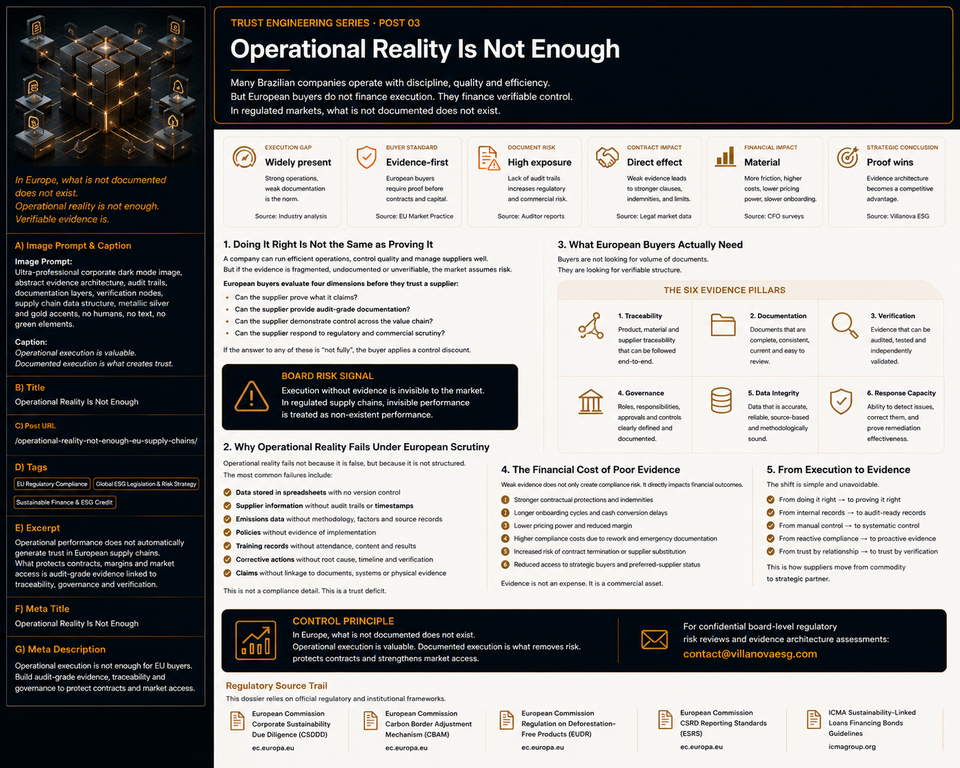
Operational reality is not enough. In regulated European markets, doing the work correctly does not protect revenue unless the company can prove it through evidence, traceability, documentation and control.
This dossier is written from the executive perspective of Marcio Villanova, CEO of Ecobraz and Founder of Villanova ESG. Many Brazilian suppliers operate with discipline, quality and efficiency. But European buyers do not buy internal confidence. They buy verifiable control. In regulated markets, what is not documented does not exist.
Execution Gap
Strong operations lose value when proof is weak.
Buyer Standard
European buyers require evidence before trust.
Document Risk
Incomplete records increase regulatory and commercial friction.
Strategic Conclusion
Proof converts execution into market leverage.
Doing It Right Is Not the Same as Proving It
A company can run efficient operations, control quality, manage suppliers and execute with discipline. That does not mean the European market will treat it as low risk.
In Europe-facing supply chains, the buyer is not inside the factory. The buyer does not see daily execution, internal discipline or operational competence. The buyer sees documents, data, records, certificates, audit trails, system controls and contractual protections.
If those records are incomplete, fragmented or unverifiable, the market assumes risk.
Board Risk Signal
Execution without evidence is invisible to the market. In regulated supply chains, invisible performance is treated as non-existent performance.
Why Operational Reality Fails Under European Scrutiny
Operational reality fails not because it is false, but because it is not structured.
The most common failures include:
- data stored in spreadsheets without version control;
- supplier information without audit trails or timestamps;
- emissions data without methodology, factors and source records;
- policies without evidence of implementation;
- training records without attendance, content and results;
- corrective actions without root cause, timeline and verification;
- claims without linkage to documents, systems or physical evidence.
This is not a compliance detail. This is a trust deficit. It affects pricing power, contract terms, buyer retention and access to European revenue.
Evidence Conversion Formula
Market Credibility = Operational Reality × Documentation Quality × Traceability × Governance × Verification Readiness
This formula requires internal company data. It cannot be solved through narrative. It requires records, system architecture, supplier documentation, chain-of-custody evidence, risk ownership and controlled review processes.
What European Buyers Actually Need
European buyers are not looking for a larger volume of documents. They are looking for evidence structure.
That structure must show:
- where the data came from;
- who approved it;
- when it was generated;
- what methodology was used;
- how supplier information was verified;
- which product, facility, shipment or contract it supports;
- whether the company can detect and correct failures.
Volume without structure creates friction. Structure creates trust.
Evidence Pillars for EU-Facing Suppliers
Traceability
Product, material, supplier and shipment data must be traceable from origin to buyer-facing claim.
Documentation
Records must be complete, consistent, current and easy to review under buyer or auditor scrutiny.
Verification
Evidence must be capable of being tested, checked, challenged and independently validated where needed.
Governance
Roles, approvals, ownership, escalation and access controls must be formally defined and documented.
Data Integrity
Data must be reliable, source-based, current, methodologically sound and protected against uncontrolled changes.
Response Capacity
The company must be able to detect issues, correct them, prove remediation and report decisions quickly.
The Financial Cost of Poor Evidence
Weak evidence does not only create compliance risk. It directly affects financial outcomes.
When proof is weak, European buyers protect themselves. They demand stronger clauses, longer reviews, lower prices, additional guarantees and wider audit rights. These protections may look legal, but they are financial.
The cost appears as:
- slower sales conversion;
- longer onboarding cycles;
- higher legal and compliance costs;
- price pressure during negotiation;
- higher probability of buyer substitution;
- reduced access to strategic accounts;
- weaker credibility with banks and investors.
Control Principle
In Europe, what is not documented does not exist. Operational execution is valuable. Documented execution is what removes risk.
From Execution to Evidence
The strategic objective is to convert internal operational quality into external market proof.
That requires moving from:
- doing it right to proving it right;
- internal records to audit-ready records;
- manual control to systematic control;
- reactive compliance to proactive evidence;
- trust by relationship to trust by verification.
This is how suppliers move from commodity exposure to strategic counterparty status.
Decision Trigger for CFOs
The CFO should act when operational quality exists but does not translate into market trust, pricing leverage or buyer confidence.
An evidence-conversion review becomes urgent when:
- European buyers request documentation repeatedly before onboarding.
- Commercial teams cannot explain why buyer reviews are taking longer.
- Supplier data lacks timestamps, owners, approval records or verification logic.
- ESG, quality, legal and procurement records are disconnected.
- The company makes claims that cannot be traced to controlled evidence.
- Contracts are being negotiated from a defensive position because proof is weak.
The Villanova ESG Evidence-Conversion Framework
Villanova ESG converts operational reality into audit-grade evidence for EU-facing supply chains.
The role is not to make the company sound credible. The role is to make credibility testable.
The framework includes:
- Operational evidence diagnosis: identify where real execution lacks documentary proof.
- Documentation architecture: structure records by product, supplier, facility, shipment, contract and regulatory exposure.
- Traceability design: link operational claims to physical, digital and contractual evidence.
- Governance control: define ownership, approval flows, access rules, version control and escalation paths.
- Verification readiness: prepare evidence for buyer diligence, lender review, audit checks and regulator scrutiny.
- Board dashboard: translate evidence gaps into margin risk, contract risk, onboarding delays and market-access exposure.
Regulatory Source Trail
This dossier relies on official regulatory and institutional frameworks that define the evidence pressure behind EU-facing supply chains:
- European Commission — Corporate Sustainability Due Diligence
- European Commission — Carbon Border Adjustment Mechanism
- European Commission — EUDR Information System and Due Diligence Statements
- European Commission — Implementing the Ecodesign for Sustainable Products Regulation
- European Commission — CBAM Legislation and Guidance
Closing CTA · Convert Execution into Evidence
Operational execution does not protect European revenue until it becomes verifiable evidence.
EU-facing companies cannot depend on internal confidence. They need documentation, traceability, governance, verification readiness and evidence architecture capable of protecting contracts, margins and market access.
Schedule a confidential evidence-conversion and regulatory risk review with our advisory team at contact@villanovaesg.com.