
CBAM Exposure Audit for Brazilian Exporters
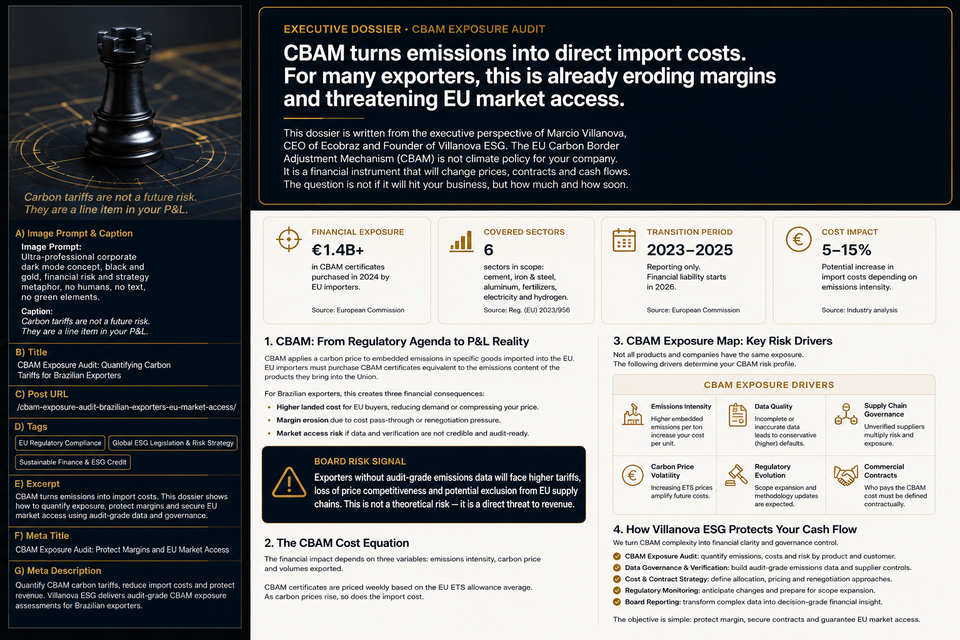
Executive Dossier · CBAM Exposure Audit
CBAM turns embedded carbon into a direct import-cost variable. For Brazilian exporters, the financial question is no longer whether emissions matter. The question is how much margin, pricing power and EU market access are exposed.
This dossier is written from the executive perspective of Marcio Villanova, CEO of Ecobraz and Founder of Villanova ESG. The EU Carbon Border Adjustment Mechanism is not a climate narrative for Boards. It is a pricing, customs, supplier-data and P&L control issue. Any exporter selling CBAM-covered goods into the European Union must now treat carbon exposure as a financial liability requiring audit-grade evidence.
Regulatory Status
CBAM definitive regime started on 1 January 2026.
Core Exposure
Embedded emissions now influence import economics.
Board Risk
Weak data can become a pricing penalty.
Commercial Trigger
EU buyers will pressure suppliers for verified data.
CBAM Is Now a Margin Question, Not an ESG Discussion
The Carbon Border Adjustment Mechanism changes the commercial logic of exporting carbon-intensive products into the European Union. The mechanism links imported goods to embedded greenhouse-gas emissions and aligns import exposure with the EU carbon-pricing architecture.
For Brazilian exporters, the immediate risk is not only regulatory paperwork. The real exposure is financial. If emissions data is incomplete, poorly governed or dependent on weak supplier declarations, the exporter loses control over pricing discussions with European importers.
The CFO problem is direct:
- Higher embedded emissions can increase the buyer’s import-cost exposure.
- Weak evidence can reduce negotiation power in European contracts.
- Supplier opacity can force conservative assumptions in risk models.
- Unverified product data can damage market-access continuity.
Board Risk Signal
An exporter without audit-grade emissions data is not negotiating from strength. It is asking the EU buyer to absorb uncertainty inside price, contract and customs exposure.
The CBAM Exposure Equation
A serious CBAM strategy must start with quantification. Generic sustainability reporting is not enough. The Board needs a financial exposure model that connects product category, volume, embedded emissions, supplier data quality and EU buyer obligations.
The exposure logic can be expressed as a control model:
Finance-Grade Exposure Formula
CBAM Exposure = Export Volume × Embedded Emissions Intensity × Applicable Carbon Cost × Data-Risk Adjustment
This formula cannot be populated with generic assumptions. It requires product-level data, supplier-level emissions evidence, shipment volumes, applicable product scope and contractual allocation of CBAM-related costs.
The fourth variable is where most companies fail. Data-risk adjustment is not theoretical. If internal records, supplier declarations and custody evidence are weak, the financial model must assume higher uncertainty. That uncertainty becomes a negotiation disadvantage.
CBAM Exposure Map
Product Scope
Identify whether exported goods fall within CBAM-covered categories and whether customs classification creates exposure.
Embedded Emissions
Quantify direct and relevant embedded emissions using defensible methodology and supplier-level data.
Supplier Evidence
Map which suppliers can provide traceable, auditable and consistent emissions information.
Contract Allocation
Determine whether CBAM-related costs, evidence obligations and data failures are allocated contractually.
Buyer Risk
Assess how EU importers may transfer compliance pressure, data requests or pricing adjustments to exporters.
P&L Sensitivity
Model how emissions intensity and data uncertainty affect margin, landed cost and customer retention.
Why Brazilian Exporters Need a CBAM Exposure Audit
CBAM creates a new commercial asymmetry. The EU importer carries direct regulatory obligations inside the EU system. The non-EU exporter carries the operational burden of proving the emissions profile behind the product.
This matters because European buyers will not treat weak supplier data as a neutral problem. They will convert uncertainty into price pressure, contractual protection, alternative sourcing or additional due-diligence demands.
A CBAM Exposure Audit should answer five Board-level questions:
- Which exported products are exposed to CBAM scope?
- Which suppliers create the highest emissions-data risk?
- Which contracts fail to allocate CBAM-related cost and evidence duties?
- Which buyers are likely to request verified product-level data?
- What margin range is at risk under different emissions and carbon-cost scenarios?
The Villanova ESG Control Framework
Villanova ESG operates at the intersection of European regulatory risk and cash-flow protection for cross-border supply chains. The advisory objective is not to create a sustainability narrative. It is to build a defensible control architecture that protects revenue, contracts and market access.
For CBAM-exposed exporters, the control framework should include:
- Product-scope diagnosis: classification review, export flows and EU buyer mapping.
- Emissions-data architecture: supplier evidence, custody records and calculation logic.
- Financial exposure modelling: P&L sensitivity, cost pass-through scenarios and buyer pressure mapping.
- Contract-risk review: clauses for data obligations, cost allocation, verification and non-compliance triggers.
- Board reporting: executive dashboard connecting regulatory exposure to margin and revenue continuity.
Control Principle
CBAM readiness is not achieved by declaring intent. It is achieved by proving product-level emissions, supplier custody and financial exposure with evidence that survives buyer, auditor and customs scrutiny.
Decision Trigger for CFOs
The decision threshold is simple. If the company exports CBAM-relevant goods to the European Union, or supplies a buyer that does, the Board should not wait for pricing pressure to arrive through the commercial team.
The CFO should request a CBAM Exposure Audit when any of the following conditions exist:
- European buyers are requesting emissions data or supplier documentation.
- Export contracts do not clearly allocate CBAM-related costs and evidence obligations.
- Product-level emissions data depends on spreadsheets, generic assumptions or unverified supplier statements.
- Management cannot quantify margin exposure under different carbon-cost scenarios.
- The company intends to defend EU market access as a strategic revenue line.
Regulatory Source Trail
This dossier relies on official regulatory frameworks verified for current compliance positions:
- European Commission — Carbon Border Adjustment Mechanism
- Regulation (EU) 2023/956 — Establishing a Carbon Border Adjustment Mechanism
- Regulation (EU) 2025/2083 — Simplifying and Strengthening CBAM
- European Commission — CBAM Entered into Force on 1 January 2026
- European Commission — CBAM Registry and Reporting
Closing CTA · Secure Your Supply Chain
CBAM exposure is now a financial control issue for exporters with European revenue at stake.
Regulatory implementation is active. Unaudited emissions data can weaken pricing power, buyer confidence and market-access continuity. Your European contracts now depend on the traceability of product, supplier and emissions evidence.
Schedule an executive CBAM exposure assessment with our advisory team to protect your cross-border operations at contact@villanovaesg.com.