
When Procurement Needs Legal, ESG and Finance in the Same Room
Procurement & Risk Memo
When Procurement Needs Legal, ESG and Finance in the Same Room
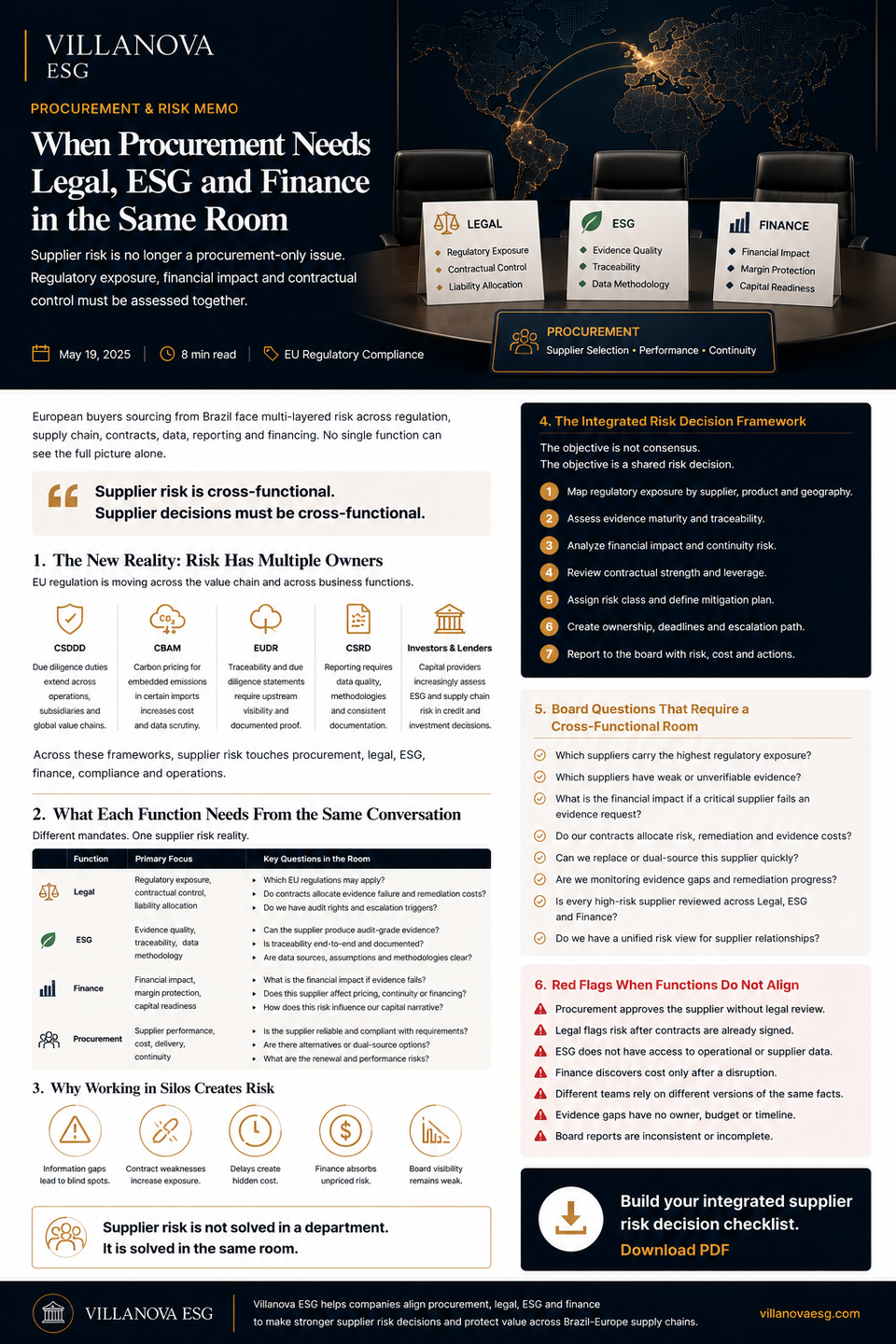
Supplier risk is no longer a procurement-only issue. Regulatory exposure, contractual liability, evidence quality and financial impact must be assessed together.
Decision Model
Cross-Functional Risk
CFO Exposure
Unpriced Liability
Board Output
Unified Risk View
Executive Thesis
Procurement sees price, delivery, supplier performance and commercial availability.
Legal sees contractual exposure, liability allocation, audit rights and enforcement limits.
ESG sees evidence quality, traceability, data methodology and reporting implications.
Finance sees margin, cash flow, remediation cost, supplier dependency, financing impact and capital readiness.
Supplier risk is cross-functional. Supplier decisions must be cross-functional.
In Brazil-Europe supply chains, no single department sees the full risk picture alone. When procurement makes supplier decisions without legal, ESG and finance in the same room, the company may approve cost, contract and evidence exposure without knowing it.
Why Risk Has Multiple Owners
The Corporate Sustainability Due Diligence Directive entered into force on 25 July 2024. The European Commission states that the directive aims to foster responsible corporate behaviour across companies’ own operations, subsidiaries and global value chains. This makes supplier risk relevant to governance, compliance, procurement and board oversight for companies in scope.
CBAM adds financial and data relevance to covered imports because the mechanism is designed to confirm that a carbon price has been paid for embedded emissions generated in the production of certain goods imported into the EU.
CSRD increases the importance of consistent reporting information because companies subject to the directive must report according to European Sustainability Reporting Standards.
OECD due diligence guidance reinforces that companies should map operations, suppliers and business relationships relevant to prioritized risk. This is not a procurement-only exercise. It requires legal, operational, financial and governance alignment.
What Each Function Must Bring to the Room
The goal is not bureaucracy. The goal is a shared risk decision.
| Function | Primary Focus | Key Questions in the Room |
|---|---|---|
| Procurement | Supplier performance, availability, cost, delivery and continuity. | Is the supplier reliable? Are there alternatives? What are the renewal and performance risks? |
| Legal | Regulatory exposure, contract control, liability allocation and enforcement rights. | Which EU rules may apply? Do contracts allocate evidence failure and remediation costs? |
| ESG / Compliance | Evidence quality, traceability, data methodology and reporting consistency. | Can the supplier produce audit-grade evidence? Are data sources and assumptions documented? |
| Finance | Margin protection, remediation cost, capital readiness and supplier dependency. | What is the financial impact if evidence fails? Does this supplier affect pricing, continuity or financing? |
| Operations | Traceability reality, process control, data generation and implementation feasibility. | Can the supplier actually produce the required evidence from operations, not only from declarations? |
Why Working in Silos Creates Risk
1. Procurement May Approve Price Without Evidence
A commercially attractive supplier may still create regulatory, reporting or documentation exposure.
2. Legal May Draft Clauses Without Operational Reality
Contract language is weak if the supplier cannot produce the evidence required by the clause.
3. ESG May Identify Gaps Without Pricing Impact
Evidence gaps become stronger risk signals when linked to margin, continuity, financing or customer exposure.
4. Finance May Discover Cost Too Late
Remediation, replacement, delay and customer loss costs often appear after supplier risk was already approved.
5. Boards May Receive Incomplete Reporting
Supplier risk dashboards fail when procurement, legal, ESG and finance use different definitions of exposure.
6. Lenders and Buyers May See the Gap First
External stakeholders often expose internal misalignment through questionnaires, audits and due diligence requests.
CFO Formula for Cross-Functional Supplier Risk
Supplier risk should be measured as the interaction between exposure, evidence, contracts and financial impact.
Cross-Functional Risk = Regulatory Exposure × Evidence Gap × Contract Weakness × Financial Impact
This calculation requires internal data. Inputs include supplier dependency, margin exposure, contract rights, evidence maturity, regulatory category, replacement lead time, customer dependency and financing sensitivity.
Decision Quality = Shared Risk View + Evidence Quality + Contract Control + Financial Quantification
If these variables are assessed separately, the company does not have a supplier risk decision. It has departmental fragments.
The Integrated Risk Decision Framework
The objective is not consensus for its own sake. The objective is a defensible shared decision.
- Map regulatory exposure by supplier, product, geography, commodity and buyer dependency.
- Assess evidence maturity using traceability, documentation quality and data methodology.
- Review contract strength through evidence obligations, audit rights, cost allocation and escalation mechanisms.
- Quantify financial impact across delay cost, remediation cost, supplier replacement and margin exposure.
- Assign supplier risk class and determine whether to approve, renew, remediate, reprice or exit.
- Create ownership with deadlines, escalation triggers and board visibility for critical suppliers.
- Report to the board with risk, cost, evidence maturity and action plan in the same dashboard.
Red Flags When Functions Do Not Align
- Procurement approves the supplier without legal review.
- Legal flags risk after contracts are already signed.
- ESG does not have access to operational or supplier data.
- Finance discovers remediation cost only after disruption.
- Different departments rely on different versions of the same supplier facts.
- Evidence gaps have no owner, budget or timeline.
- Board reports are inconsistent, incomplete or not linked to financial exposure.
- Supplier risk is discussed only when a buyer, lender or regulator asks questions.
Decision Trigger for CFOs
Do not let procurement carry supplier risk alone.
Bring procurement, legal, ESG and finance into the same decision before supplier exposure becomes contract cost, margin leakage or board escalation.
The CFO should force supplier decisions into one shared risk model. If the company cannot align evidence, contract control and financial impact, it is not ready to defend the supplier relationship.
Villanova ESG Position
Villanova ESG helps companies align procurement, legal, ESG and finance around supplier risk decisions in Brazil-Europe supply chains.
The objective is not to create more meetings or generic compliance bureaucracy. The objective is to build a unified decision model that connects supplier evidence, regulatory exposure, contract control and financial impact.
Supplier risk is not solved in a department. It is solved in the same room.
Regulatory Source Trail
- European Commission — Corporate Sustainability Due Diligence Directive: Directive 2024/1760 entered into force on 25 July 2024 and aims to foster responsible corporate behaviour across companies’ own operations, subsidiaries and global value chains.
- European Commission — Carbon Border Adjustment Mechanism: CBAM is designed to confirm that a carbon price has been paid for embedded emissions generated in the production of certain goods imported into the EU.
- European Commission — Corporate Sustainability Reporting: companies subject to CSRD must report according to European Sustainability Reporting Standards.
- OECD — Due Diligence Guidance for Responsible Business Conduct: companies are expected to map operations, suppliers and business relationships relevant to prioritized risk and catalogue applicable standards, laws and frameworks.
Executive Review
Align supplier risk before the exposure reaches the board.
Villanova ESG supports companies with cross-functional supplier risk frameworks, regulatory evidence architecture and board-level decision support for Brazil-Europe supply chains.
For private board-level briefings: contact@villanovaesg.com