
How European Buyers Should Classify Brazilian Supplier Risk
Procurement & Risk Memo
How European Buyers Should Classify Brazilian Supplier Risk
Not all Brazilian suppliers carry the same risk. European buyers need a structured classification model that separates low exposure from strategic dependency, weak evidence and regulatory pressure.
Risk Tool
Supplier Classification
CFO Exposure
Priority Allocation
Board Output
Risk Visibility
Executive Thesis
European buyers sourcing from Brazil often treat supplier risk as a binary issue: approved or not approved. That is not sufficient for a regulated value chain.
Supplier risk should be classified, scored and reviewed based on exposure, evidence maturity, operational criticality and contractual control.
Classify the risk before you price the contract. You cannot manage what you do not segment.
A structured classification model allows buyers to focus diligence resources, improve contract strategy, protect margin and create board-level visibility over supplier exposure.
Why Supplier Classification Is Now Essential
The Corporate Sustainability Due Diligence Directive entered into force on 25 July 2024. The European Commission states that the directive aims to foster responsible corporate behaviour across companies’ own operations, subsidiaries and global value chains. That makes supplier risk segmentation relevant for companies in scope.
CBAM creates evidence and data pressure for covered imports because it is designed to confirm that a carbon price has been paid for embedded emissions generated in the production of certain goods imported into the EU.
EUDR reinforces traceability and due diligence discipline. Operators can view and manage Due Diligence Statements in the EU Information System, and large operators may manage statements in bulk through an API.
CSRD increases the reporting relevance of value-chain information because companies subject to the directive must report according to European Sustainability Reporting Standards. This means supplier classification is not only procurement logic. It supports risk governance, reporting discipline and financing readiness.
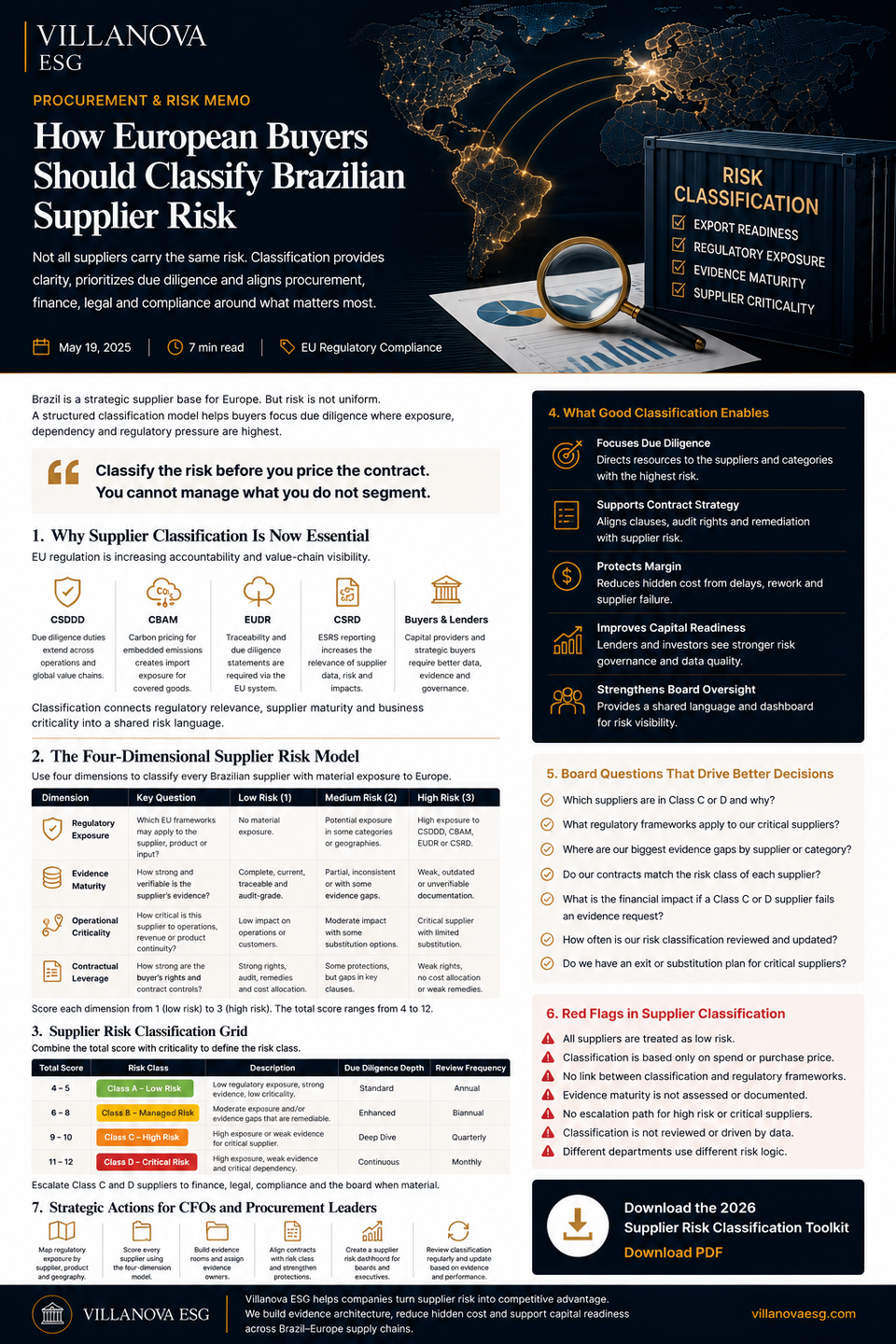
The Four-Dimensional Supplier Risk Model
European buyers should classify Brazilian suppliers using four dimensions.
| Dimension | Key Question | Low Risk | Medium Risk | High Risk |
|---|---|---|---|---|
| Regulatory Exposure | Which EU frameworks may apply? | No material exposure. | Potential exposure in some categories. | High exposure to CSDDD, CBAM, EUDR, CSRD or sector rules. |
| Evidence Maturity | How strong and verifiable is the supplier’s evidence? | Current, complete, traceable and audit-grade. | Partial, inconsistent or with some evidence gaps. | Weak, outdated, unverifiable or self-declared. |
| Operational Criticality | How critical is the supplier to operations, revenue or product continuity? | Low operational dependency. | Moderate dependency with alternatives. | Critical supplier with limited substitution. |
| Contractual Leverage | How strong are the buyer’s rights and contract controls? | Strong evidence clauses, audit rights and cost allocation. | Some protections but gaps in key clauses. | Weak rights, no cost allocation or limited remediation control. |
Supplier Risk Classes
The classification should convert supplier analysis into a practical decision model.
| Risk Class | Profile | Due Diligence Depth | Review Frequency | Governance Response |
|---|---|---|---|---|
| Class A — Low Risk | Low exposure, strong evidence, low criticality. | Standard review. | Annual. | Maintain controls and monitor changes. |
| Class B — Managed Risk | Moderate exposure or evidence gaps with manageable impact. | Enhanced review. | Semiannual. | Track gaps and assign remediation owners. |
| Class C — High Risk | High exposure, weak evidence or critical supplier dependency. | Deep-dive review. | Quarterly. | Escalate to CFO, legal, procurement and compliance. |
| Class D — Critical Risk | High exposure, unverifiable evidence and serious continuity risk. | Continuous monitoring. | Monthly or event-driven. | Board visibility, remediation plan, contract action or replacement scenario. |
CFO Formula for Supplier Risk Scoring
Supplier classification should translate risk into decision priority.
Supplier Risk Score = Regulatory Exposure × Evidence Gap × Business Criticality × Financial Impact
This model requires internal buyer data. Inputs include supplier spend, revenue exposure, product category, regulatory relevance, evidence maturity, replacement lead time, contract control and margin dependency.
Review Priority = Risk Score × Supplier Dependency × Time to Remediate
The higher the priority score, the faster the supplier should move into evidence remediation, contract review or replacement planning.
What Good Classification Enables
1. Focused Due Diligence
Resources are directed to suppliers and categories with the highest exposure, not spread evenly across low-risk relationships.
2. Better Contract Strategy
Evidence obligations, audit rights, remediation costs and suspension triggers can match the supplier risk class.
3. Margin Protection
Hidden cost from delays, rework, documentation failure and supplier replacement can be identified earlier.
4. Capital Readiness
Lenders and investors can review a clearer risk governance file when supplier exposure is classified.
5. Board Visibility
Boards can monitor high-risk suppliers through a shared language, dashboard and escalation path.
6. Faster Remediation
Evidence gaps can be assigned to owners with deadlines, priorities and financial implications.
Red Flags in Supplier Classification
- All suppliers are treated as low risk.
- Classification is based only on spend or purchase price.
- There is no link between supplier class and regulatory framework exposure.
- Evidence maturity is not assessed or documented.
- Supplier concentration is not monitored.
- Contracts do not reflect the supplier risk level.
- No remediation plan exists for Class C or Class D suppliers.
- Different departments use different supplier risk logic.
Decision Trigger for CFOs and Procurement Leaders
Do not manage Brazilian suppliers as one risk category.
Segment exposure, classify supplier maturity, align contract controls and escalate the relationships that can affect margin, continuity or financing readiness.
The CFO’s role is to ensure that supplier classification reflects financial exposure. Procurement may own the relationship, but finance must understand the cost of evidence failure.
Villanova ESG Position
Villanova ESG helps European buyers and Brazilian suppliers classify risk, structure evidence and convert supplier exposure into board-visible decision logic.
The objective is not to guarantee compliance or eliminate risk. The objective is to create a disciplined classification model that supports buyer-readiness, supplier continuity, contract strategy and regulatory defensibility.
In Brazil-Europe supply chains, supplier risk is not managed by instinct. It is managed by classification.
Regulatory Source Trail
- European Commission — Corporate Sustainability Due Diligence Directive: Directive 2024/1760 entered into force on 25 July 2024 and aims to foster responsible corporate behaviour across companies’ own operations, subsidiaries and global value chains.
- European Commission — Carbon Border Adjustment Mechanism: CBAM is designed to confirm that a carbon price has been paid for embedded emissions generated in the production of certain goods imported into the EU.
- European Commission — EUDR Information System: operators can view and manage Due Diligence Statements in the dashboard and large operators may manage statements in bulk through an API.
- European Commission — Corporate Sustainability Reporting: companies subject to CSRD must report according to European Sustainability Reporting Standards.
Executive Review
Classify supplier risk before it becomes supplier exposure.
Villanova ESG supports European buyers and Brazilian suppliers with supplier risk classification, evidence architecture and regulatory defensibility frameworks for cross-border supply chains.
For private board-level briefings: contact@villanovaesg.com