
The Evidence Clause: What EU Buyers May Start Expecting From Suppliers
Legal & Contract Risk Memo
The Evidence Clause: What EU Buyers May Start Expecting From Suppliers
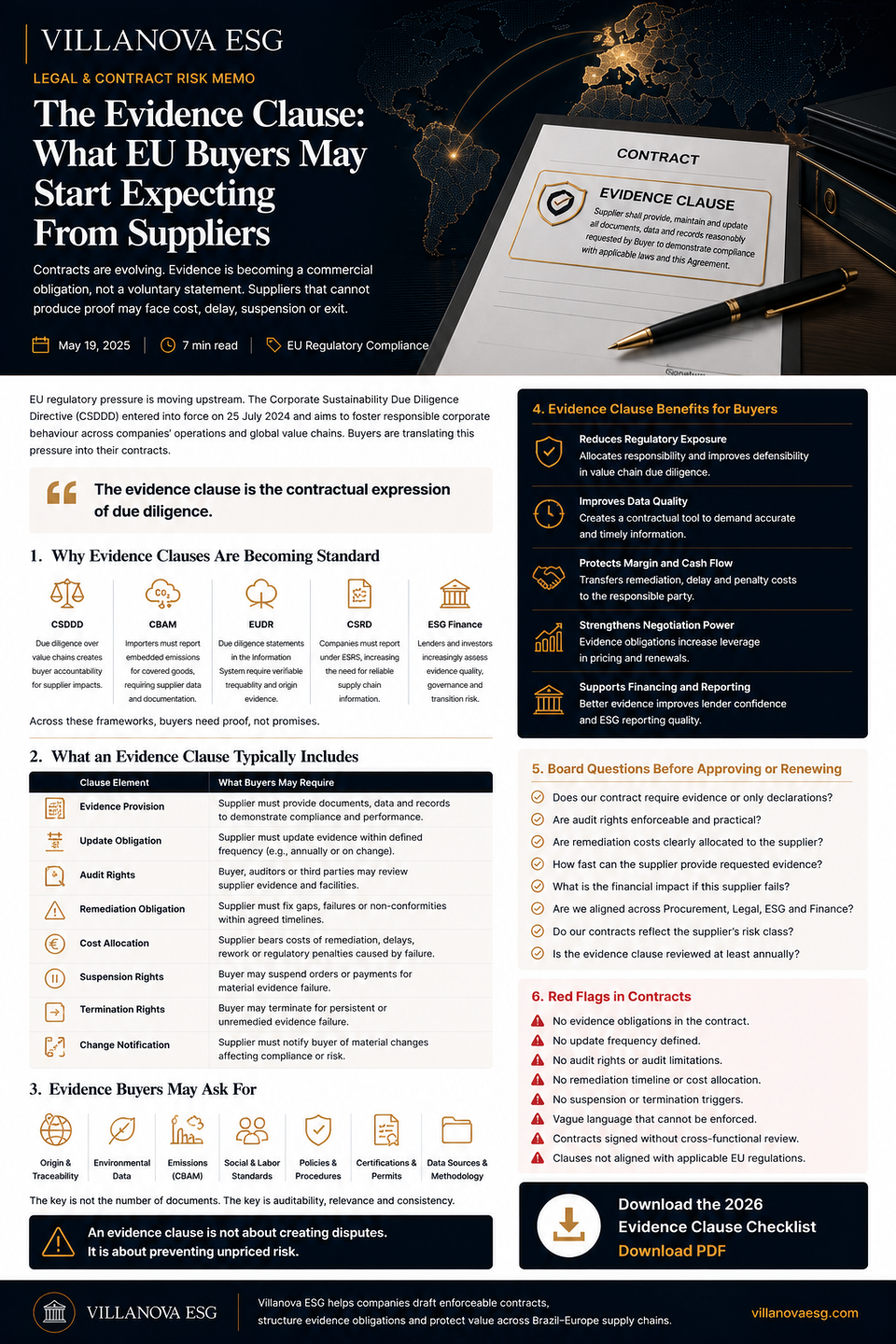
Contracts are evolving. Evidence is becoming a commercial obligation, not a voluntary statement. Suppliers that cannot produce proof may face cost, delay, suspension or exit.
Contract Tool
Evidence Clause
CFO Exposure
Cost Allocation
Supplier Impact
Buyer-Readiness
Executive Thesis
EU buyers are under increasing pressure to understand, document and manage supplier risk. That pressure will not remain only inside compliance departments. It will move into contracts.
For Brazilian suppliers connected to European value chains, this matters. Supplier relationships may begin to include evidence obligations as standard commercial terms.
The evidence clause is the contractual expression of due diligence.
It is not enough for a supplier to declare that it is compliant, responsible or aligned. The buyer may require documentation, updates, audit rights, remediation commitments and cost allocation mechanisms.
Why Evidence Clauses Are Becoming More Relevant
The Corporate Sustainability Due Diligence Directive entered into force on 25 July 2024. The European Commission states that the directive aims to foster responsible corporate behaviour across companies’ own operations, subsidiaries and global value chains, with companies in scope identifying and addressing adverse human rights and environmental impacts. That creates a commercial need for buyer access to supplier evidence.
CBAM creates another evidence pressure point. The European Commission describes CBAM as a system to confirm that a carbon price has been paid for embedded emissions generated in the production of certain goods imported into the EU. Covered imports can therefore require emissions-related data and documentation discipline.
EUDR also reinforces traceability obligations for relevant commodities and products. The EU Information System is a registry of due diligence statements that supports the creation and management of due diligence statements within supply chains.
CSRD adds reporting pressure for companies in scope because they must report according to European Sustainability Reporting Standards. Value-chain information quality can become relevant to disclosures, assurance, lender review and investor confidence.
What an Evidence Clause Typically Covers
The exact legal wording must be drafted by counsel. From a risk architecture perspective, the clause usually targets the following commercial controls.
| Clause Element | What Buyers May Require | Financial Purpose |
|---|---|---|
| Evidence Provision | Supplier must provide documents, data and records supporting relevant regulatory, product, environmental or traceability claims. | Reduces uncertainty and avoids emergency remediation cost. |
| Update Obligation | Supplier must update evidence on a defined cycle or when material facts change. | Prevents stale documents from creating hidden exposure. |
| Audit and Review Rights | Buyer, auditor or authorized reviewer may assess relevant records within agreed boundaries. | Improves defensibility and reduces reliance on declarations. |
| Remediation Duty | Supplier must correct evidence gaps, inconsistencies or non-conformities within agreed timelines. | Controls delay cost, rework and customer escalation. |
| Cost Allocation | Costs caused by evidence failure, delay, rework or remediation are allocated to the responsible party. | Prevents the buyer from absorbing all hidden cost by default. |
| Suspension Rights | Buyer may suspend orders, payments or expansion if material evidence failure creates exposure. | Protects working capital, customer commitments and risk position. |
| Termination Rights | Buyer may terminate persistent or material evidence failure after defined process. | Preserves continuity options and board defensibility. |
Evidence EU Buyers May Ask For
1. Origin and Traceability
Chain-of-custody records, source documentation, logistics records, geolocation data where relevant and upstream supplier visibility.
2. Environmental Data
Emissions information, waste records, water data, land-use exposure, deforestation-relevance and methodology notes where material.
3. Product and Material Information
Product composition, category classification, input origin, commodity exposure and technical specifications.
4. Policies and Procedures
Governance policies, due diligence procedures, supplier controls, grievance mechanisms and escalation protocols.
5. Certifications and Permits
Licenses, permits, certifications, audit reports and third-party reviews, when real, current and relevant to the claim.
6. Data Sources and Methodology
Clear explanation of whether data is measured, estimated, self-declared, third-party verified or based on assumptions.
CFO Formula for Evidence Clause Value
Evidence clauses are not legal decoration. They are financial risk controls.
Clause Value = Reduced Evidence Failure Cost + Cost Recovery Rights + Lower Continuity Risk + Faster Remediation
This requires internal data. CFOs need supplier criticality, contract value, revenue dependency, remediation cost, delay cost, replacement lead time, evidence maturity and buyer exposure.
Unprotected Exposure = Evidence Gap × Supplier Dependency × Remediation Cost × Contract Weakness
If the contract does not allocate evidence failure, the buyer may carry the cost silently.
Board Questions Before Approving or Renewing
- Does the contract require evidence or only declarations?
- Are audit and review rights enforceable, proportionate and practical?
- How often must the supplier update evidence?
- Who pays for remediation when evidence fails?
- Can the buyer suspend, reprice or exit if material evidence is missing?
- Are evidence duties connected to applicable regulations and buyer exposure?
- Do procurement, legal, ESG and finance agree on the supplier’s risk class?
- Can the supplier actually produce the evidence required by the clause?
Red Flags in Supplier Contracts
- No evidence obligations in the contract.
- No update frequency or trigger for material changes.
- No audit or review rights for relevant evidence.
- No remediation timeline or cost allocation.
- No suspension or termination triggers linked to material evidence failure.
- Vague language that cannot be operationalized or enforced.
- Contracts signed without cross-functional review.
- Clauses not aligned with the supplier’s regulatory exposure and risk class.
Decision Trigger for CFOs and Legal Teams
Do not let supplier evidence remain outside the contract.
If evidence failure can create cost, delay, financing friction or regulatory exposure, the contract must define evidence duties, update cycles, remediation and cost allocation.
The CFO does not need to draft the clause. The CFO must ensure that the financial consequences of weak evidence are not left unallocated.
Villanova ESG Position
Villanova ESG helps companies translate supplier risk into evidence architecture and contract-ready risk logic for Brazil-Europe supply chains.
The objective is not to provide legal advice, draft final contract wording or guarantee compliance. The objective is to help procurement, legal, ESG and finance define the evidence obligations that should be assessed before counsel finalizes contractual language.
In regulated supply chains, a contract without evidence obligations is a contract with hidden risk.
Regulatory Source Trail
- European Commission — Corporate Sustainability Due Diligence Directive: Directive 2024/1760 entered into force on 25 July 2024 and aims to foster responsible corporate behaviour across companies’ own operations, subsidiaries and global value chains.
- European Commission — Carbon Border Adjustment Mechanism: CBAM is designed to confirm that a carbon price has been paid for embedded emissions generated in the production of certain goods imported into the EU.
- European Commission — EUDR Information System: the Information System is a registry of due diligence statements that supports the creation and management of statements within supply chains.
- European Commission — Corporate Sustainability Reporting: companies subject to CSRD must report according to European Sustainability Reporting Standards.
Executive Review
Move supplier evidence from declaration to contract control.
Villanova ESG supports companies with supplier evidence architecture, contract-risk logic and board-level documentation for Brazil-Europe supply chains.
For private board-level briefings: contact@villanovaesg.com