
Supplier Exit Risk: When Documentation Failure Forces Commercial Replacement
Supply Chain Risk Memo
Supplier Exit Risk: When Documentation Failure Forces Commercial Replacement
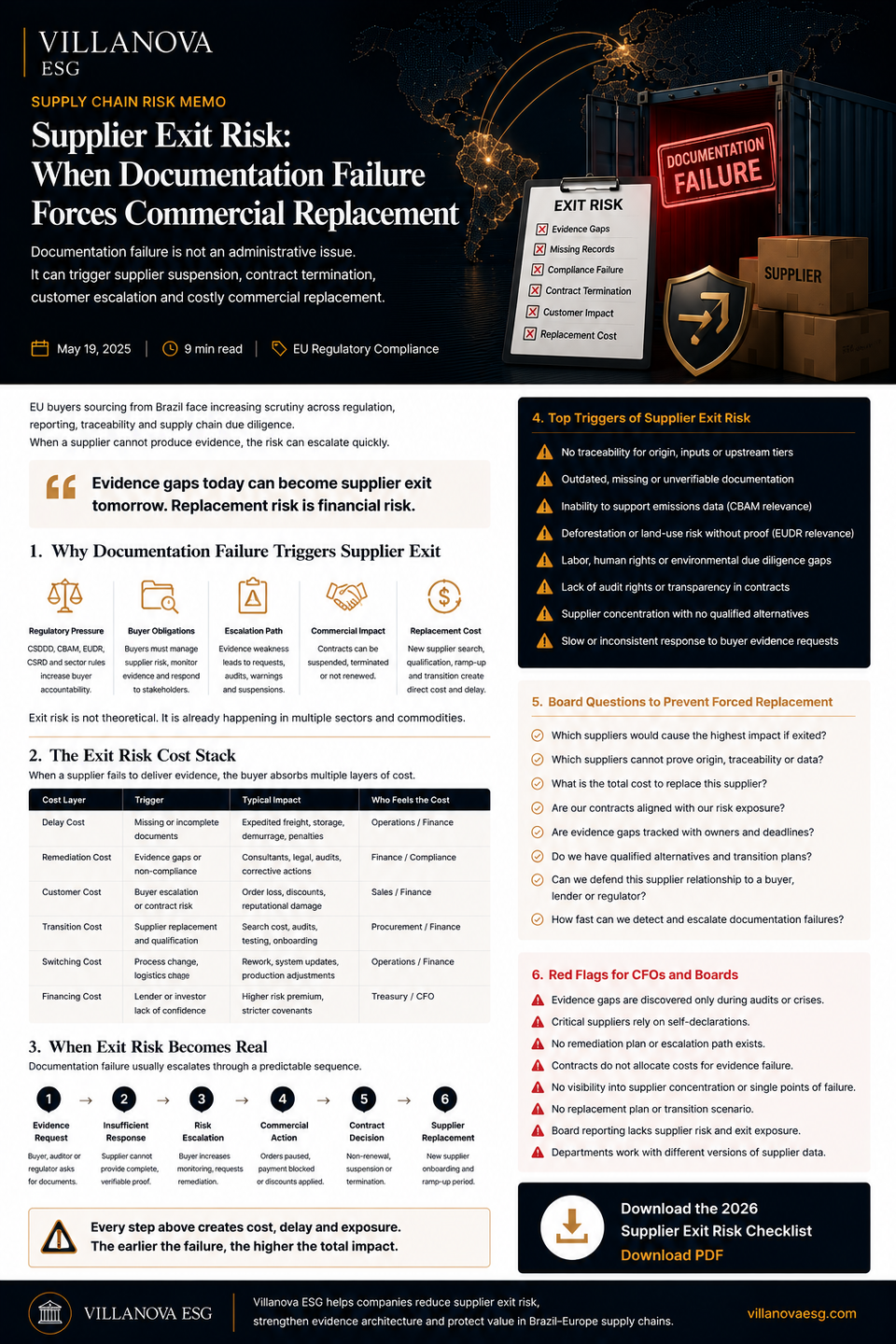
Supplier exit is no longer driven only by price, quality or delivery failure. In regulated supply chains, documentation failure can force suspension, non-renewal or commercial replacement.
Risk Trigger
Documentation Failure
CFO Exposure
Replacement Cost
Board Question
Remediate or Exit
Executive Thesis
Supplier replacement used to be triggered mainly by commercial failure: poor quality, missed delivery, price escalation or breach of service expectations.
That model is now incomplete.
In Brazil-Europe supply chains, a supplier may perform operationally but still become commercially replaceable if it cannot produce evidence, traceability, data quality and documentation required by buyers, lenders, auditors or regulators.
Evidence gaps today can become supplier exit tomorrow.
For CFOs, this is not an administrative problem. Supplier exit risk creates transition cost, working-capital stress, customer exposure, contract friction and potential margin loss.
Why Documentation Failure Can Trigger Supplier Exit
The Corporate Sustainability Due Diligence Directive entered into force on 25 July 2024 and aims to foster responsible corporate behaviour across companies’ own operations, subsidiaries and global value chains. Companies in scope are expected to identify and address adverse human rights and environmental impacts inside and outside Europe. This creates a stronger need for supplier-level evidence and documentation.
CBAM also creates data pressure for covered imports. The European Commission describes CBAM as a system to confirm that a price has been paid for embedded carbon emissions generated in the production of certain goods imported into the EU. Where suppliers cannot support emissions-related information, commercial friction can increase.
The EUDR Information System acts as the repository of due diligence statements submitted by operators and traders. For relevant commodities and products, inability to support traceability and due diligence documentation can become a market-access issue.
CSRD also raises the importance of value-chain information quality because companies subject to the directive must report according to European Sustainability Reporting Standards. Weak supplier evidence can therefore affect reporting discipline, lender review and investor confidence.
The Exit Risk Cost Stack
When a supplier fails evidence requirements, the buyer absorbs multiple layers of cost unless the contract and continuity plan are already prepared.
| Cost Layer | Trigger | Typical Impact | Who Feels the Cost |
|---|---|---|---|
| Delay Cost | Missing, incomplete or inconsistent supplier documents. | Expedited freight, storage, demurrage, penalties and disrupted delivery windows. | Operations / Finance |
| Remediation Cost | Evidence gaps, weak traceability or unsupported declarations. | Consultants, legal review, supplier audits, corrective actions and internal labor. | Finance / Compliance |
| Customer Cost | Buyer escalation, tender risk or customer evidence request failure. | Order loss, discounts, reputational damage and reduced renewal probability. | Sales / Finance |
| Transition Cost | Supplier replacement, qualification and onboarding. | Search cost, audits, testing, onboarding, price resets and supply instability. | Procurement / Finance |
| Switching Cost | Process change, system updates and logistics changes. | Rework, operational learning curve, quality risk and inventory disruption. | Operations / Finance |
| Financing Cost | Lender or investor concern about supply-chain controls. | Higher diligence burden, reduced confidence and weaker financing narrative. | Treasury / CFO |
Top Triggers of Supplier Exit Risk
- No traceability for origin, inputs, materials or upstream tiers.
- Outdated, missing, inconsistent or unverifiable documentation.
- Inability to support emissions data where CBAM relevance exists.
- Deforestation or land-use exposure without sufficient proof where EUDR relevance exists.
- Labor, human rights or environmental due diligence gaps that cannot be remediated quickly.
- Lack of audit rights, access rights or transparency obligations in contracts.
- Supplier concentration with no qualified alternatives.
- Slow, evasive or inconsistent responses to buyer evidence requests.
CFO Formula for Supplier Exit Risk
Supplier exit risk should be quantified before documentation failure forces a replacement decision.
Supplier Exit Risk = Documentation Failure Probability × Supplier Criticality × Replacement Cost × Transition Time
This model requires internal company data. Inputs include supplier dependency, replacement lead time, qualification cost, contract value, margin exposure, customer dependency, inventory buffer and evidence maturity.
Exit Cost = Remediation Cost + Transition Cost + Switching Cost + Customer Impact + Financing Friction
If the company cannot calculate exit cost, it is not managing supplier continuity. It is assuming it.
When Exit Risk Becomes Real
Documentation failure usually escalates through a predictable sequence.
| Stage | Event | Commercial Consequence |
|---|---|---|
| 1 | Buyer, lender, auditor or regulator requests evidence. | Supplier response time becomes visible. |
| 2 | Supplier cannot provide complete, current or verifiable proof. | Buyer increases monitoring, requests remediation or applies pressure. |
| 3 | Evidence gap remains unresolved or becomes material. | Orders may be delayed, paused or restricted. |
| 4 | Contract rights, renewal conditions or suspension triggers are activated. | Supplier loses commercial leverage. |
| 5 | Replacement or dual-sourcing process begins. | Transition cost and continuity risk move into the CFO agenda. |
Red Flags for CFOs and Boards
- Evidence gaps are discovered only during audits, buyer escalation or crises.
- Critical suppliers rely on self-declarations.
- No remediation plan or escalation path exists.
- Contracts do not allocate costs for evidence failure.
- No visibility exists into supplier concentration or single points of failure.
- No replacement plan or transition scenario exists.
- Board reporting lacks supplier risk and exit exposure.
- Departments work with different versions of supplier data.
Decision Trigger for CFOs
Do not wait until documentation failure forces supplier replacement.
Identify critical suppliers, test their evidence, price replacement cost and define remediation paths before exit becomes the only option.
The CFO’s role is to convert supplier exit risk from an operational surprise into a quantified continuity scenario.
Villanova ESG Position
Villanova ESG helps companies reduce supplier exit risk by structuring regulatory evidence architecture, supplier readiness diagnostics and continuity-risk analysis for Brazil-Europe supply chains.
The objective is not to guarantee compliance, eliminate risk or replace legal counsel. The objective is to help CFOs, Boards, procurement, legal and compliance teams understand which supplier evidence gaps could force commercial replacement.
In regulated supply chains, replacement risk begins when evidence fails.
Regulatory Source Trail
- European Commission — Corporate Sustainability Due Diligence Directive: Directive 2024/1760 entered into force on 25 July 2024 and aims to foster responsible corporate behaviour across operations, subsidiaries and global value chains.
- European Commission — Carbon Border Adjustment Mechanism: CBAM is designed to confirm that a price has been paid for embedded carbon emissions generated in the production of certain goods imported into the EU.
- European Commission — EUDR Information System: the system acts as the repository of due diligence statements submitted by operators and traders.
- European Commission — Corporate Sustainability Reporting: companies subject to CSRD have to report according to European Sustainability Reporting Standards.
Executive Review
Identify supplier exit risk before documentation failure forces replacement.
Villanova ESG supports CFOs, Boards and procurement teams with supplier exit-risk analysis, evidence architecture and continuity documentation for Brazil-Europe supply chains.
For private board-level briefings: contact@villanovaesg.com