
The Brazil-Europe Supply Chain Risk Memo for 2026
Strategic Risk Memo
The Brazil-Europe Supply Chain Risk Memo for 2026
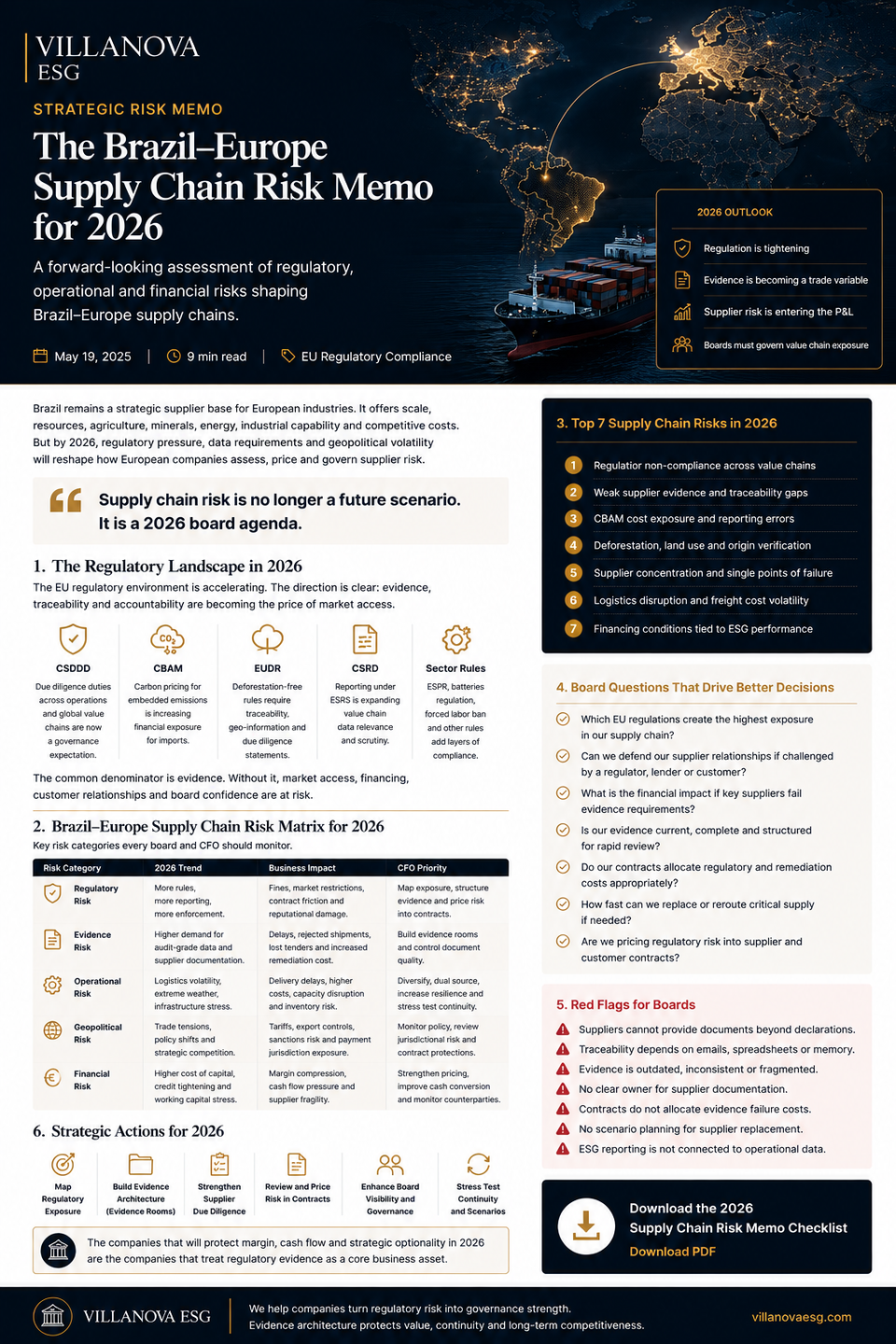
Brazil remains a strategic supplier base for Europe. But in 2026, the question is no longer only whether Brazil can supply. The question is whether the evidence behind that supply can withstand European scrutiny.
2026 Risk Theme
Evidence Pressure
CFO Exposure
Margin + Continuity
Board Priority
Govern Supplier Risk
Executive Thesis
Brazil will remain a relevant supplier base for European companies because of its agricultural scale, industrial capacity, mineral resources, energy profile, logistics relevance and cost competitiveness.
But commercial attractiveness is no longer enough.
Supply-chain risk in 2026 will be priced through evidence, not intention.
EU buyers, investors, lenders and regulators will increasingly evaluate whether supplier relationships can be supported by traceability, documentation quality, regulatory mapping and defensible governance.
For CFOs and Boards, this means Brazil-Europe supply-chain strategy must be treated as a financial risk architecture, not a sustainability narrative.
The 2026 Regulatory Landscape
The Corporate Sustainability Due Diligence Directive entered into force on 25 July 2024. The European Commission states that the directive aims to foster sustainable and responsible corporate behaviour across companies’ own operations, subsidiaries and global value chains. This keeps value-chain due diligence as a central board and governance issue for companies in scope.
CBAM continues to reshape import economics for covered goods by linking imports to embedded emissions and carbon pricing logic. The European Commission describes CBAM as a system to confirm that a carbon price has been paid for embedded emissions generated in the production of certain goods imported into the EU.
EUDR implementation reinforces the operational importance of traceability and due diligence statements. The EU Information System allows operators to view and manage Due Diligence Statements, including bulk management through API for large operators.
CSRD remains a reporting pressure point for companies in scope. The European Commission states that companies subject to CSRD must report according to European Sustainability Reporting Standards.
The Brazil-Europe Risk Matrix for 2026
| Risk Category | 2026 Trend | Business Impact | CFO Priority |
|---|---|---|---|
| Regulatory Risk | More due diligence, reporting and customer evidence requests. | Contract friction, buyer escalation, remediation cost and supplier review. | Map exposure by supplier, product, geography and contract. |
| Evidence Risk | Higher demand for audit-grade documentation and traceability. | Delayed shipments, rejected questionnaires, lender scrutiny and lost renewal leverage. | Build evidence rooms and assign document owners. |
| Operational Risk | Logistics volatility, supplier concentration and documentation gaps. | Supply interruption, inventory stress and working-capital pressure. | Stress-test continuity, replacement lead time and dependency ratio. |
| Financial Risk | Evidence quality increasingly affects credit, financing, valuation and risk premiums. | Margin compression, higher cost of capital and weaker lender confidence. | Connect supplier evidence to capital readiness and risk pricing. |
| Governance Risk | Boards must show oversight of value-chain exposure. | Poor accountability, slow response and inconsistent disclosures. | Create board-level supplier risk dashboards and escalation paths. |
Seven Risks Boards Should Monitor in 2026
1. Supplier Evidence Failure
Supplier documentation is incomplete, outdated, inconsistent or not linked to actual operations.
2. Traceability Gaps
Origin, custody, subcontracting, logistics or upstream exposure cannot be verified with discipline.
3. Carbon Data Weakness
Emissions data is estimated, unstructured or unable to support CBAM-related review for covered categories.
4. Deforestation and Land-Use Exposure
Relevant commodities or derived products lack sufficient origin, geolocation or due diligence support.
5. Contract Misalignment
Supplier contracts do not allocate evidence obligations, remediation costs, audit rights or suspension triggers.
6. Supplier Concentration
Critical suppliers create single points of failure and weaken buyer leverage during regulatory pressure.
7. Financing Friction
Weak evidence can reduce lender confidence, increase due diligence burden and weaken sustainability-linked positioning.
8. Board Blind Spots
Value-chain risk is discussed operationally but not converted into board-visible financial exposure.
CFO Formula for 2026 Supply-Chain Exposure
Brazil-Europe supplier risk should be priced as a financial exposure, not handled as a compliance afterthought.
2026 Supply-Chain Exposure = Regulatory Pressure × Evidence Gap × Supplier Dependency × Financial Impact
This equation requires internal company data. The CFO needs supplier dependency ratios, category exposure, margin contribution, replacement lead time, contract leverage, documentation maturity, customer dependency and financing sensitivity.
Board Readiness = Evidence Quality + Traceability + Contract Control + Continuity Plan − Exposure Gaps
If these variables are not measured, the company is not governing supply-chain risk. It is reacting to it.
Board Questions for 2026
- Which Brazil-linked suppliers create the highest regulatory exposure for our European business?
- Which suppliers can produce audit-grade evidence within 48 hours?
- Which product categories may trigger CBAM, EUDR, CSRD or sector-specific evidence requests?
- Which contracts fail to allocate evidence obligations and remediation costs?
- Which suppliers represent single points of failure?
- What is the financial impact if a critical supplier fails an evidence request?
- Can our lender, investor or strategic buyer understand our supplier risk position from structured documentation?
- Do we have an evidence room or only fragmented files?
Strategic Actions for CFOs and Boards
- Map regulatory exposure: classify suppliers, products and categories by applicable EU risk.
- Build evidence rooms: organize supplier documentation by decision use, not by internal folder habit.
- Review contracts: add evidence obligations, audit rights, cost allocation, update cycles and escalation mechanisms.
- Stress-test continuity: model supplier replacement time, margin exposure and customer dependency.
- Connect finance and compliance: translate evidence gaps into P&L, cash-flow and financing implications.
- Create board visibility: turn supplier risk into a dashboard, not an informal procurement discussion.
Decision Trigger for CFOs
Do not wait for a buyer, lender or regulator to discover the evidence gap first.
Map exposure now, structure evidence now and price supplier risk before 2026 turns weak documentation into financial pressure.
The companies that will protect margin, market access and optionality in 2026 are the companies that treat regulatory evidence as a core business asset.
Villanova ESG Position
Villanova ESG supports companies exposed to Brazil-Europe supply chains with regulatory risk mapping, evidence architecture, supplier documentation frameworks and board-level risk memos.
The objective is not to promise legal certainty, guarantee compliance or eliminate risk. The objective is to make supply-chain exposure visible, measurable and defensible for CFOs, Boards, procurement, legal and compliance teams.
In 2026, the companies with the strongest evidence will have the strongest negotiating position.
Regulatory Source Trail
- European Commission — Corporate Sustainability Due Diligence Directive: Directive 2024/1760 entered into force on 25 July 2024 and aims to foster responsible corporate behaviour across operations, subsidiaries and global value chains.
- European Commission — Carbon Border Adjustment Mechanism: CBAM is designed to confirm that a carbon price has been paid for embedded emissions generated in the production of certain goods imported into the EU.
- European Commission — EUDR Information System: operators can view and manage Due Diligence Statements through the system, including bulk management through API for large operators.
- European Commission — Corporate Sustainability Reporting: companies subject to CSRD must report according to European Sustainability Reporting Standards.
- European Commission — EUDR Implementation: official materials cover registration in the Information System and submission of due diligence statements or simplified declarations.
Executive Review
Turn Brazil-Europe supply-chain risk into board-visible evidence.
Villanova ESG supports companies with supplier risk mapping, evidence architecture and CFO-grade regulatory defensibility for Brazil-Europe supply chains.
For private board-level briefings: contact@villanovaesg.com