
How Regulatory Evidence Protects Margin in Cross-Border Supply Chains
Financial Risk Memo
How Regulatory Evidence Protects Margin in Cross-Border Supply Chains
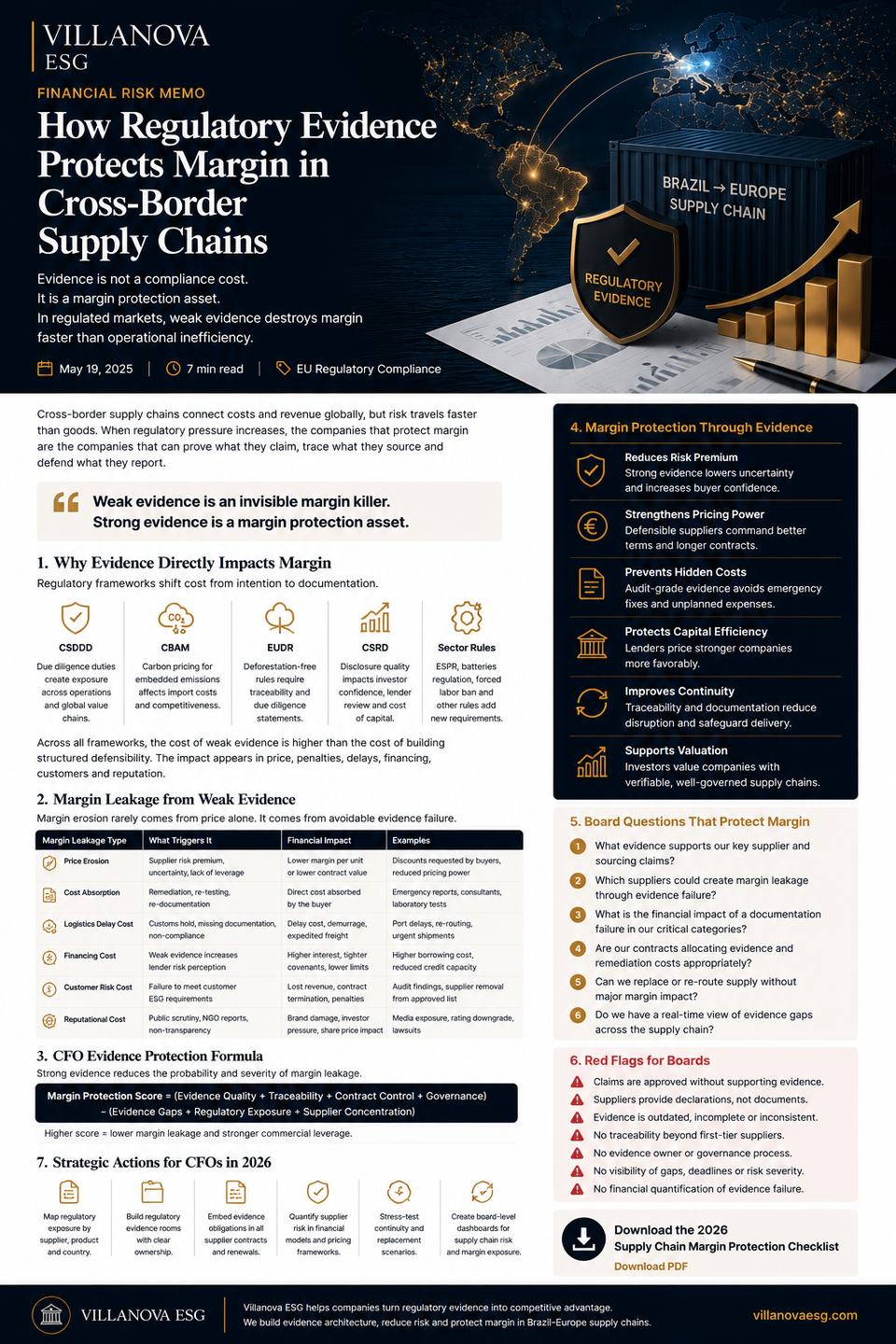
Regulatory evidence is not a compliance expense. In cross-border supply chains, it is a margin protection asset that reduces uncertainty, delay, remediation cost and commercial friction.
CFO Variable
Margin Leakage
Control Layer
Evidence Architecture
Board Result
Defensible Margin
Executive Thesis
Margin erosion in regulated supply chains rarely appears as one visible line item. It accumulates through delays, supplier remediation, documentation failure, contract renegotiation, customer escalation, audit response and financing pressure.
Weak regulatory evidence makes every one of those costs more likely.
Weak evidence is an invisible margin killer. Strong evidence is a margin protection asset.
For European companies sourcing from Brazil, regulatory evidence should therefore be treated as part of gross margin protection, not as a back-office compliance burden.
Why Evidence Directly Affects Margin
The Corporate Sustainability Due Diligence Directive entered into force on 25 July 2024. The European Commission states that the directive aims to foster sustainable and responsible corporate behaviour across companies’ own operations, subsidiaries and global value chains. For companies in scope, supplier documentation quality becomes part of due diligence readiness and governance control. :contentReference[oaicite:0]{index=0}
CBAM adds a cost and data dimension to covered imports. The European Commission defines CBAM as a system to confirm that a carbon price has been paid for embedded carbon emissions generated in the production of certain goods imported into the EU. Poor emissions data or weak supplier documentation can therefore create commercial friction and pricing uncertainty. :contentReference[oaicite:1]{index=1}
CSRD increases the need for consistent sustainability information because companies subject to the directive must report under European Sustainability Reporting Standards. Value-chain information quality can affect reporting discipline, lender review and investor confidence. :contentReference[oaicite:2]{index=2}
OECD due diligence guidance also reinforces the operational logic: companies should map operations, suppliers and business relationships relevant to prioritized risk and catalogue applicable standards, laws and frameworks. This is directly connected to evidence management and margin protection. :contentReference[oaicite:3]{index=3}
Margin Leakage From Weak Evidence
Weak supplier evidence creates financial leakage in multiple forms.
| Leakage Type | Trigger | Financial Impact | CFO Control |
|---|---|---|---|
| Pricing Pressure | Buyer uncertainty, weak documentation or unpriced regulatory exposure. | Discount requests, lower contract value or reduced renewal leverage. | Evidence package, risk memo and buyer-ready supplier file. |
| Remediation Cost | Missing, inconsistent, outdated or unverifiable documents. | Emergency consultants, legal review, audit support and internal labor cost. | Evidence room, gap register and assigned document owners. |
| Logistics Delay Cost | Documentation failure, customs friction, buyer holds or unresolved data requests. | Demurrage, expedited freight, lost delivery windows and working-capital stress. | Pre-shipment evidence review and supplier documentation checklist. |
| Financing Cost | Lender doubts about data quality, governance or supply-chain controls. | Higher diligence burden, weaker credit signal or reduced access to favorable terms. | Audit-grade evidence architecture and lender-ready documentation. |
| Customer Risk | Failure to answer buyer questionnaires or evidence requests. | Lost renewal, contract friction, reduced order volume or supplier replacement. | Buyer response file and evidence response SLA. |
How Evidence Protects Margin
1. Reduces Risk Premium
Strong evidence reduces uncertainty for buyers, lenders, auditors and strategic partners.
2. Protects Pricing Power
Defensible suppliers are better positioned to resist discounts based on perceived regulatory weakness.
3. Prevents Emergency Remediation
Evidence rooms reduce the need to reconstruct documentation under pressure.
4. Improves Contract Leverage
Strong documentation supports clearer evidence obligations, cost allocation and renewal discussions.
5. Supports Financing Readiness
Lenders and investors can review stronger companies faster when evidence is structured and governed.
6. Reduces Continuity Risk
Traceability and evidence discipline reduce disruption risk across sourcing, logistics and customer delivery.
CFO Formula for Margin Protection
Margin protection can be modeled through evidence strength and exposure reduction.
Margin at Risk = Revenue Exposure × Evidence Failure Probability × Financial Impact per Failure
This formula requires internal data: revenue exposed to EU buyers, supplier dependency, average contract margin, failure rate, remediation cost, delay cost, customer retention risk and financing sensitivity.
Margin Protection Score = Evidence Quality + Traceability + Contract Control + Governance − Evidence Gaps
A higher score does not guarantee compliance or eliminate risk. It improves the company’s ability to defend pricing, reduce friction and prevent avoidable leakage.
Board Questions That Protect Margin
- Which supplier relationships create the greatest margin exposure if evidence fails?
- Which buyers or contracts require the fastest evidence response?
- What is the average cost of emergency documentation remediation?
- Which product categories face the highest regulatory evidence burden?
- Do our contracts allocate evidence failure and remediation costs appropriately?
- How much revenue depends on suppliers with weak traceability?
- Can we quantify delay cost, replacement cost and customer escalation cost?
- Does evidence quality influence our financing discussions or lender review?
Red Flags for CFOs
- Margins are reviewed without supplier evidence risk.
- Supplier documentation is collected only after buyers request it.
- Evidence gaps have no owner, deadline or remediation budget.
- Contract discounts are accepted without understanding evidence weakness.
- Financing narratives rely on ESG claims rather than structured documentation.
- Procurement evaluates cost without pricing regulatory exposure.
- Legal, finance, ESG and procurement teams hold different versions of the supplier risk story.
Decision Trigger for CFOs
Do not protect margin only through price negotiation.
Protect margin through evidence quality, contract control, supplier defensibility and faster response to regulatory scrutiny.
The CFO’s role is to make evidence visible as a financial control. If evidence failure can erode margin, evidence architecture belongs inside the financial risk model.
Villanova ESG Position
Villanova ESG helps companies protect margin in Brazil-Europe supply chains by building regulatory evidence architecture, supplier documentation frameworks and CFO-grade risk models.
The objective is not to promise compliance, guarantee legal certainty or eliminate risk. The objective is to reduce avoidable friction, support defensible decision-making and convert evidence from a compliance burden into a financial control.
In regulated markets, margin is protected by proof.
Regulatory Source Trail
- European Commission — Corporate Sustainability Due Diligence Directive: Directive 2024/1760 entered into force on 25 July 2024 and aims to foster responsible corporate behaviour across operations, subsidiaries and global value chains.
- European Commission — Carbon Border Adjustment Mechanism: CBAM is designed to confirm that a carbon price has been paid for embedded carbon emissions generated in the production of certain goods imported into the EU.
- European Commission — Corporate Sustainability Reporting: companies subject to CSRD report according to European Sustainability Reporting Standards.
- OECD — Due Diligence Guidance for Responsible Business Conduct: companies are expected to map operations, suppliers and business relationships relevant to prioritized risk and catalogue applicable standards, laws and frameworks.
Executive Review
Protect margin before evidence failure becomes financial leakage.
Villanova ESG supports CFOs, Boards and procurement teams with regulatory evidence architecture, supplier documentation frameworks and margin-risk analysis for Brazil-Europe supply chains.
For private board-level briefings: contact@villanovaesg.com