
From Supplier to Verified Counterparty
Executive Dossier · Trust Engineering Series
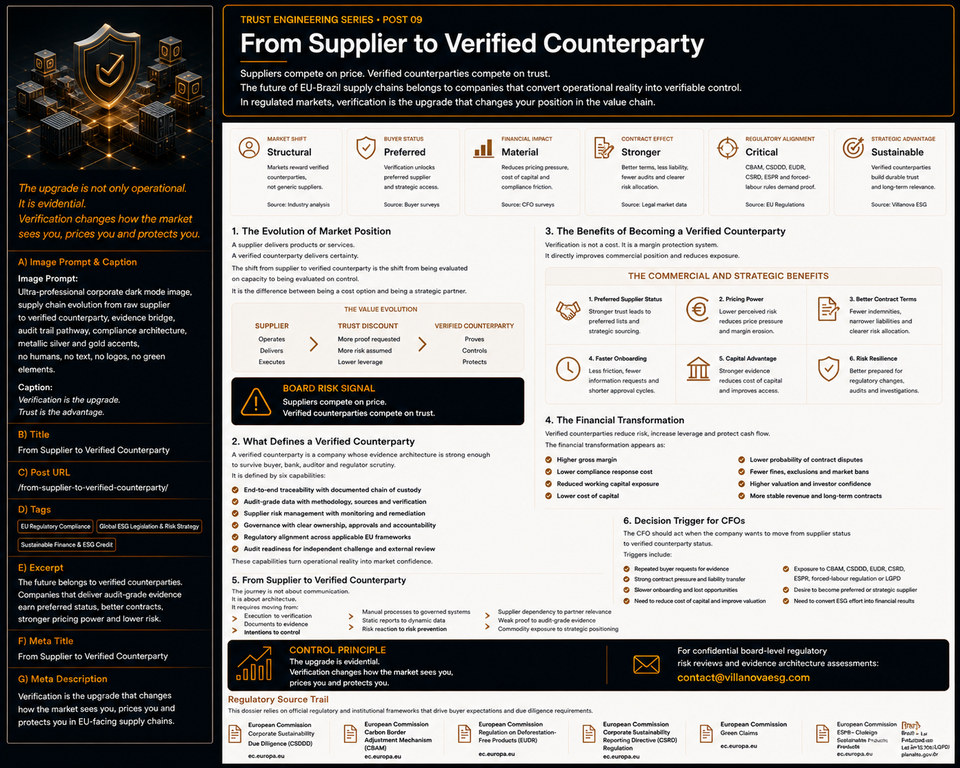
Suppliers compete on price. Verified counterparties compete on trust. The future of EU-Brazil supply chains belongs to companies that convert operational reality into verifiable control.
This dossier is written from the executive perspective of Marcio Villanova, CEO of Ecobraz and Founder of Villanova ESG. In regulated markets, verification is not a compliance accessory. It is the commercial upgrade that changes how the market sees you, prices you and protects you.
Market Shift
Markets reward verified counterparties, not generic suppliers.
Buyer Status
Verification unlocks preferred supplier positioning.
Financial Impact
Lower perceived risk protects margin and reduces friction.
Strategic Advantage
Verified counterparties build durable trust and long-term relevance.
The Evolution of Market Position
A supplier delivers products or services. A verified counterparty delivers certainty.
The shift from supplier to verified counterparty is the shift from being evaluated on capacity to being evaluated on control.
That difference matters. Capacity can be replaced. Control is harder to replicate. Evidence creates preference.
Board Risk Signal
Suppliers compete on price. Verified counterparties compete on trust.
What Defines a Verified Counterparty
A verified counterparty is a company whose evidence architecture is strong enough to survive buyer, bank, auditor and regulator scrutiny.
It is defined by six capabilities:
- end-to-end traceability with documented chain of custody;
- audit-grade data with methodology, sources and verification;
- supplier risk management with monitoring and remediation;
- governance with clear ownership, approvals and accountability;
- regulatory alignment across applicable EU frameworks;
- audit readiness for independent challenge and external review.
These capabilities turn operational reality into market confidence.
Verified Counterparty Formula
Verified Status = Traceability × Evidence Quality × Governance Control × Regulatory Alignment × Audit Readiness
This formula requires internal company data. A real assessment depends on supplier maps, product records, emissions evidence, due-diligence files, contracts, data controls, audit history and buyer-specific requirements.
The Benefits of Becoming a Verified Counterparty
Verification is not a cost. It is a margin-protection system.
It directly improves commercial position and reduces exposure.
Commercial and Strategic Benefits
Preferred Supplier Status
Stronger trust leads to preferred lists, strategic sourcing and more durable buyer relationships.
Pricing Power
Lower perceived risk reduces buyer pressure on price, rebates and margin concessions.
Better Contract Terms
Evidence supports fewer indemnities, narrower liabilities and clearer risk allocation.
Faster Onboarding
Structured evidence reduces information requests, review cycles and approval delays.
Capital Advantage
Stronger evidence improves lender confidence, sustainability-linked finance readiness and governance credibility.
Risk Resilience
Verified counterparties are better prepared for regulatory changes, buyer audits and investigations.
The Financial Transformation
Verified counterparties reduce risk, increase leverage and protect cash flow.
The financial transformation appears as:
- higher gross margin resilience;
- lower compliance response cost;
- reduced working-capital exposure;
- lower cost-of-capital friction;
- lower probability of contract disputes;
- fewer fines, exclusions and market bans;
- higher valuation and investor confidence;
- more stable revenue and long-term contracts.
Control Principle
The upgrade is evidential. Verification changes how the market sees you, prices you and protects you.
From Supplier to Verified Counterparty
The journey is not about communication. It is about architecture.
It requires moving from:
- execution to verification;
- documents to evidence;
- intentions to control;
- manual processes to governed systems;
- static reports to dynamic data;
- risk reaction to risk prevention;
- supplier dependency to partner relevance;
- weak proof to audit-grade evidence;
- commodity exposure to strategic positioning.
Decision Trigger for CFOs
The CFO should act when the company wants to move from supplier status to verified counterparty status.
Triggers include:
- repeated buyer requests for evidence;
- strong contract pressure and liability transfer;
- slower onboarding and lost opportunities;
- need to reduce cost of capital and improve valuation;
- exposure to CBAM, CSDDD, EUDR, CSRD, ESPR, forced-labour regulation or LGPD;
- desire to become preferred or strategic supplier;
- need to convert ESG effort into financial results.
The Villanova ESG Verified Counterparty Framework
Villanova ESG operates at the intersection between European regulatory risk and cash-flow protection for cross-border supply chains.
The role is to move companies from operational competence to verified market credibility.
The framework includes:
- Verified status diagnosis: assess whether the company is seen as a generic supplier or a trusted counterparty.
- Evidence architecture design: structure supplier, product, emissions, due-diligence and governance evidence into a reviewable system.
- Regulatory alignment mapping: connect proof obligations to relevant EU and Brazilian frameworks.
- Buyer-readiness assessment: test whether evidence can support preferred supplier status and strategic account retention.
- Contract-risk review: align warranties, indemnities, audit rights and obligations with actual proof capacity.
- Board dashboard: translate verification maturity into pricing power, contract resilience, revenue protection and capital credibility.
Regulatory Source Trail
This dossier relies on official regulatory and institutional frameworks that drive buyer expectations and due diligence requirements:
- European Commission — Corporate Sustainability Due Diligence
- European Commission — EU Due Diligence Navigator: CSDDD
- European Commission — Implementing the Ecodesign for Sustainable Products Regulation
- European Commission — Carbon Border Adjustment Mechanism
- European Commission — EUDR Information System and Due Diligence Statements
Closing CTA · Become a Verified Counterparty
The next competitive advantage is not being the cheapest supplier. It is being the most verifiable one.
EU-facing companies cannot depend on capacity alone. They need traceability, data integrity, governance, regulatory alignment and audit-grade evidence that convert operational reality into buyer confidence and financial leverage.
Schedule a confidential verified-counterparty readiness review with our advisory team at contact@villanovaesg.com.