
Compliance as P&L Protection
Executive Dossier · Trust Engineering Series
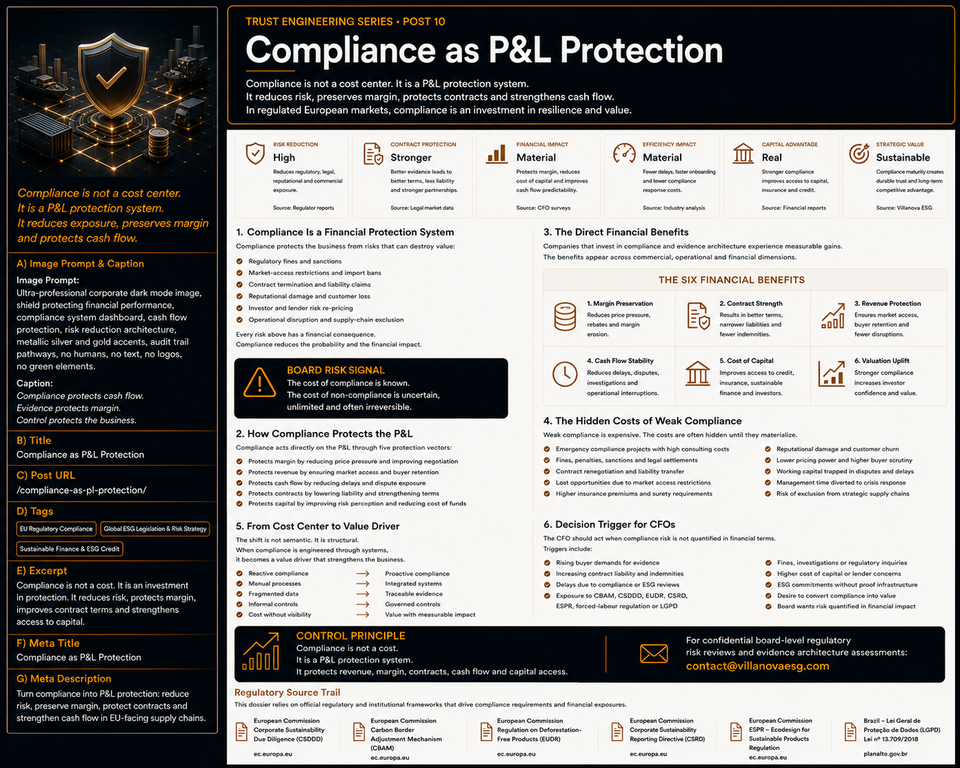
Compliance is not a cost center. It is a P&L protection system. In EU-facing supply chains, regulatory discipline reduces risk, preserves margin, protects contracts and strengthens cash-flow resilience.
This dossier is written from the executive perspective of Marcio Villanova, CEO of Ecobraz and Founder of Villanova ESG. The wrong Board question is whether compliance costs money. The correct question is how much revenue, margin and capital access the company may lose when compliance is weak, fragmented or unverifiable.
Risk Reduction
Compliance reduces regulatory, legal, reputational and commercial exposure.
Contract Protection
Better evidence supports stronger terms and lower liability transfer.
Financial Impact
Audit-grade controls protect margin, revenue timing and cash flow.
Capital Advantage
Stronger compliance improves credit, insurance and investor conversations.
Compliance Is a Financial Protection System
Compliance protects the business from risks that can destroy value.
Those risks include regulatory fines, sanctions, import restrictions, contract termination, buyer exclusion, lender repricing, reputational damage, operational disruption and supplier-chain failure.
Every one of these risks has a financial consequence. Compliance reduces the probability and severity of that consequence.
Board Risk Signal
The cost of compliance is known. The cost of non-compliance is uncertain, unlimited and often irreversible.
How Compliance Protects the P&L
Compliance acts directly on the P&L through five protection vectors.
- Margin protection: reduces buyer uncertainty, price pressure and emergency remediation cost.
- Revenue protection: preserves market access, buyer onboarding and contract continuity.
- Cash-flow protection: reduces delays, disputes, customs friction and investigation-related disruption.
- Contract protection: lowers liability transfer, warranty exposure and indemnity pressure.
- Capital protection: improves risk perception with banks, investors, insurers and strategic partners.
Compliance becomes financially relevant when it converts risk avoidance into measurable business resilience.
P&L Protection Formula
Protected P&L = Revenue at Risk × Compliance Control Strength × Evidence Quality × Buyer Confidence × Regulatory Resilience
This formula requires internal company data. A real assessment depends on revenue by market, product exposure, buyer concentration, contract terms, supplier maturity, compliance controls, evidence gaps and applicable EU frameworks.
The Direct Financial Benefits
Companies that invest in compliance and evidence architecture experience measurable gains across commercial, operational and financial dimensions.
Six Financial Benefits
Margin Preservation
Reduces buyer risk discounts, rebate pressure, emergency remediation and margin erosion.
Contract Strength
Supports better terms, narrower liabilities, fewer indemnities and clearer risk allocation.
Revenue Protection
Protects market access, buyer retention, preferred supplier status and continuity of sales.
Cash-Flow Stability
Reduces delays, disputes, investigations, customs interruptions and working-capital stress.
Cost of Capital
Improves access to credit, insurance, sustainability-linked finance discussions and investor confidence.
Valuation Uplift
Stronger governance and risk controls improve enterprise confidence and long-term value defensibility.
The Hidden Costs of Weak Compliance
Weak compliance is expensive. The cost is often hidden until the risk materializes.
Typical costs include:
- emergency consulting projects with high urgency premiums;
- fines, penalties, sanctions and legal settlements;
- contract renegotiation and liability transfer;
- lost opportunities due to market-access restrictions;
- higher insurance premiums and surety requirements;
- reputational damage and customer churn;
- lower pricing power under buyer scrutiny;
- working capital trapped in disputes and delays;
- management time diverted to crisis response;
- risk of exclusion from strategic supply chains.
Control Principle
Compliance is not a cost. It is a P&L protection system. It protects revenue, margin, contracts, cash flow and capital access.
From Cost Center to Value Driver
The shift is not semantic. It is structural.
When compliance is engineered through systems, it becomes a value driver that strengthens the business.
The transition requires moving from:
- reactive compliance to proactive compliance;
- manual processes to integrated systems;
- fragmented data to traceable evidence;
- informal controls to governed controls;
- cost without visibility to value with measurable impact;
- crisis response to risk prevention;
- buyer friction to buyer confidence;
- unsupported claims to audit-grade proof.
Decision Trigger for CFOs
The CFO should act when compliance risk is not quantified in financial terms.
A P&L protection review becomes urgent when:
- buyers are increasing demands for evidence;
- contracts contain rising liability, warranty or indemnity pressure;
- sales cycles are delayed by compliance or ESG reviews;
- the company is exposed to CBAM, CSDDD, EUDR, CSRD, ESPR, forced-labour regulation or LGPD;
- fines, investigations or regulatory inquiries are possible but not financially modelled;
- cost of capital is affected by governance or evidence weakness;
- ESG commitments exist without financial-risk infrastructure;
- the Board wants regulatory risk quantified in P&L terms.
The Villanova ESG P&L Protection Framework
Villanova ESG operates at the intersection between European regulatory risk and cash-flow protection for cross-border supply chains.
The role is not to position compliance as a moral expense. The role is to quantify and reduce financial exposure.
The framework includes:
- Revenue-at-risk mapping: identify which markets, buyers, contracts and product lines are exposed to regulatory pressure.
- Compliance-control assessment: evaluate the maturity of systems, evidence, supplier controls and governance architecture.
- P&L sensitivity modelling: connect regulatory exposure to margin, cash flow, working capital, cost of capital and buyer retention.
- Contract-risk review: quantify liability transfer, warranty exposure, indemnities, audit rights and termination triggers.
- Evidence architecture: structure proof so buyers, banks, auditors and regulators can test it efficiently.
- Board dashboard: translate compliance risk into financial exposure, decision priorities and capital-allocation logic.
Regulatory Source Trail
This dossier relies on official regulatory and institutional frameworks that drive compliance requirements and financial exposure:
- European Commission — Corporate Sustainability Due Diligence
- European Commission — Carbon Border Adjustment Mechanism
- European Commission — CBAM Entered into Force on 1 January 2026
- European Commission — Simplification Review of the EU Deforestation Regulation
- Directive (EU) 2026/470 — Amendments to CSRD and CSDDD Reporting Requirements
Closing CTA · Protect the P&L Before Risk Hits Cash Flow
The strongest compliance systems do not only prevent sanctions. They protect financial performance.
EU-facing companies cannot treat compliance as a disconnected legal function. Regulatory exposure affects contracts, pricing power, working capital, market access and cost of capital. The CFO must see it as P&L protection.
Schedule a confidential P&L protection and regulatory evidence review with our advisory team at contact@villanovaesg.com.