
European Buyers Do Not Buy Intentions
Executive Dossier · Trust Engineering Series
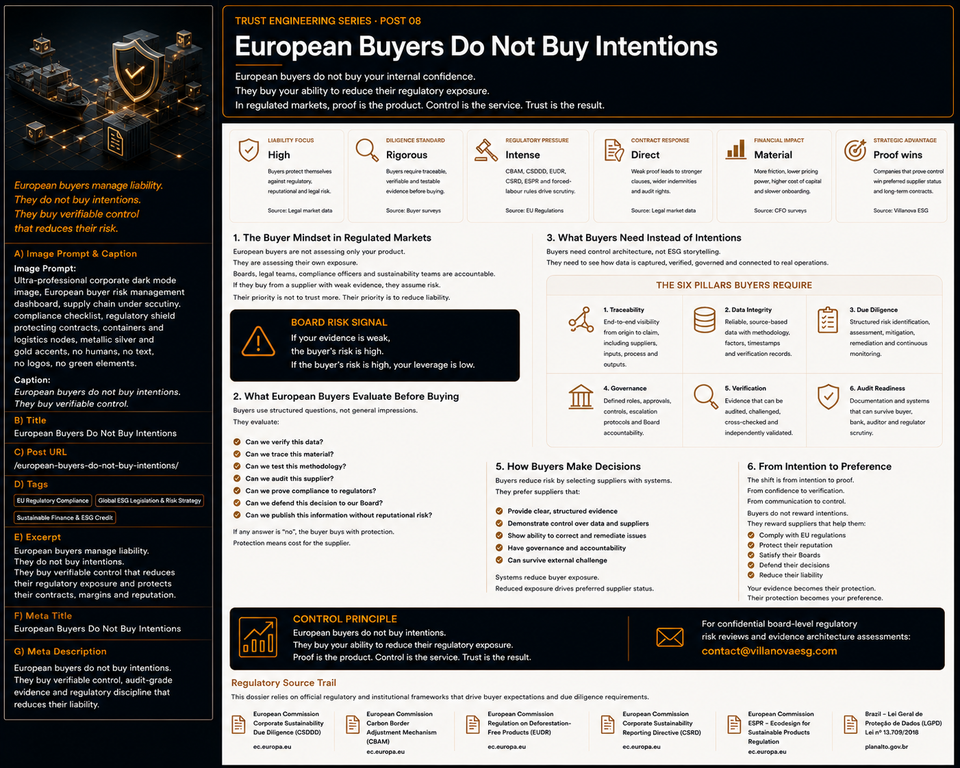
European buyers do not buy intentions. They buy the supplier’s ability to reduce their regulatory exposure, defend their contracts and protect their own Board from uncontrolled supply-chain risk.
This dossier is written from the executive perspective of Marcio Villanova, CEO of Ecobraz and Founder of Villanova ESG. In regulated European markets, the supplier’s confidence is irrelevant unless it becomes verifiable control. Proof is the product. Control is the service. Trust is the result.
Liability Focus
Buyers protect themselves against regulatory, reputational and legal risk.
Diligence Standard
Buyers require traceable, verifiable and testable evidence before buying.
Contract Response
Weak proof leads to stronger clauses, wider indemnities and audit rights.
Strategic Advantage
Companies that prove control win preferred supplier status.
The Buyer Mindset in Regulated Markets
European buyers are not assessing only your product. They are assessing their own exposure.
Boards, legal teams, compliance officers, procurement leaders and sustainability teams are accountable for what enters their supply chain. When a supplier introduces uncertainty, that uncertainty becomes the buyer’s risk.
If they buy from a supplier with weak evidence, they assume risk. Their priority is not to trust more. Their priority is to reduce liability.
Board Risk Signal
If your evidence is weak, the buyer’s risk is high. If the buyer’s risk is high, your leverage is low.
What European Buyers Evaluate Before Buying
Buyers use structured questions, not general impressions. They evaluate whether the supplier can reduce risk before the contract is signed.
They ask:
- Can we verify this data?
- Can we trace this material?
- Can we test this methodology?
- Can we audit this supplier?
- Can we prove compliance to regulators?
- Can we defend this decision to our Board?
- Can we publish this information without reputational risk?
If any answer is uncertain, the buyer buys protection. Protection means cost for the supplier.
Buyer Confidence Formula
Buyer Confidence = Evidence Quality × Traceability × Verification × Governance Control × Liability Reduction
This formula requires internal company data. A real assessment depends on product records, supplier evidence, emissions methodology, due-diligence files, chain-of-custody documents, legal exposure and buyer-specific risk tolerance.
What Buyers Need Instead of Intentions
Buyers need control architecture, not ESG storytelling.
They need to see how data is captured, verified, governed and connected to real operations.
Six Pillars Buyers Require
Traceability
End-to-end visibility from origin to claim, including suppliers, inputs, process and outputs.
Data Integrity
Reliable, source-based data with methodology, factors, timestamps and verification records.
Due Diligence
Structured risk identification, assessment, mitigation, remediation and continuous monitoring.
Governance
Defined roles, approvals, controls, escalation protocols and Board accountability.
Verification
Evidence that can be audited, challenged, cross-checked and independently validated.
Audit Readiness
Documentation and systems that can survive buyer, bank, auditor and regulator scrutiny.
How Buyers Make Decisions
Buyers reduce risk by selecting suppliers with systems.
They prefer suppliers that:
- provide clear, structured evidence;
- demonstrate control over data and suppliers;
- show ability to correct and remediate issues;
- have governance and accountability;
- can survive external challenge.
Systems reduce buyer exposure. Reduced exposure drives preferred supplier status.
From Intention to Preference
The shift is from intention to proof.
From confidence to verification. From communication to control. From supplier promise to buyer protection.
Buyers do not reward intentions. They reward suppliers that help them:
- comply with EU regulations;
- protect their reputation;
- satisfy their Boards;
- defend their decisions;
- reduce their liability.
Your evidence becomes their protection. Their protection becomes your preference.
Control Principle
European buyers do not buy intentions. They buy your ability to reduce their regulatory exposure.
Decision Trigger for CFOs
The CFO should act when buyer confidence depends on claims that cannot be converted into defensible evidence.
A buyer-confidence review becomes urgent when:
- European buyers request repeated documentation before approval;
- contracts are delayed because evidence is unclear or fragmented;
- commercial teams cannot explain what buyers actually need to approve the supplier;
- supplier data, emissions data or due-diligence records are not audit-ready;
- buyer objections are treated as bureaucracy instead of liability management;
- management wants to convert compliance evidence into preferred supplier positioning.
The Villanova ESG Buyer-Confidence Framework
Villanova ESG operates at the intersection between European regulatory risk and cash-flow protection for cross-border supply chains.
The role is not to help suppliers describe their intentions better. The role is to help them reduce the buyer’s exposure with evidence.
The framework includes:
- Buyer-liability diagnosis: identify which risks the European buyer is trying to avoid.
- Evidence expectation mapping: translate buyer requests into documentation, traceability and verification requirements.
- Supplier control architecture: structure supplier, product, emissions and due-diligence evidence into reviewable systems.
- Contract-risk alignment: connect warranties, audit rights, indemnities and data obligations to proof capacity.
- Preferred supplier readiness: prepare the company to demonstrate risk reduction before negotiation pressure begins.
- Board dashboard: translate buyer concerns into margin exposure, onboarding risk, contract pressure and market-access probability.
Regulatory Source Trail
This dossier relies on official regulatory and institutional frameworks that drive buyer expectations and due diligence requirements:
- European Commission — Carbon Border Adjustment Mechanism
- European Commission — EUDR Information System and Due Diligence Statements
- European Commission — Green Claims
- European Commission — Corporate Sustainability Due Diligence
- European Commission — Implementing the Ecodesign for Sustainable Products Regulation
Closing CTA · Convert Evidence into Buyer Preference
European buyers reward suppliers that reduce liability before the contract is signed.
EU-facing companies cannot depend on intentions, internal confidence or unsupported claims. They need traceability, data integrity, due diligence, governance and audit-ready evidence that makes the buyer’s decision defensible.
Schedule a confidential buyer-confidence and evidence architecture review with our advisory team at contact@villanovaesg.com.