
EU Textile Regulation: Product-Data Proof as Market-Access Risk
Executive Dossier · EU Textile Regulation
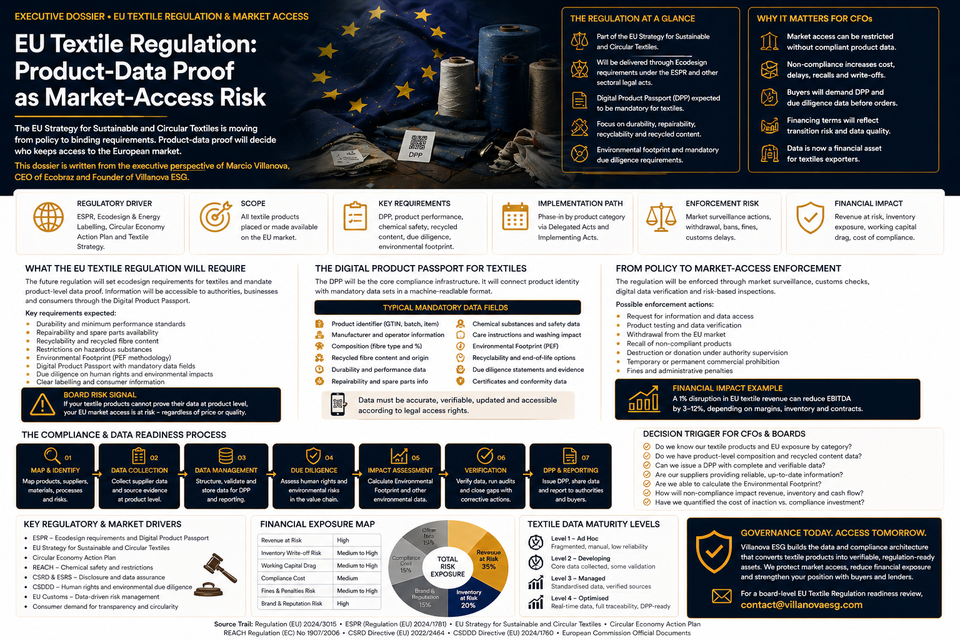
EU textile compliance is shifting from marketing language to product-data proof. Durability, repairability, recyclability, unsold stock, waste responsibility and digital traceability are becoming market-access variables.
This dossier is written from the executive perspective of Marcio Villanova, CEO of Ecobraz and Founder of Villanova ESG. The analysis treats EU textile regulation as a cash-flow, inventory and buyer-retention issue. The board question is direct: can the company prove product composition, lifecycle performance, waste exposure and traceability before European buyers, customs authorities and market surveillance bodies convert missing data into commercial friction?
Regulatory Stack
ESPR · WFD · Textile Strategy · DPP
Priority Product
Textiles, focused on apparel
Large Company Ban
Unsold apparel destruction · 19 July 2026
Financial Exposure
Inventory, EPR fees, buyer friction, customs delay
There Is No Single “EU Textile Regulation”
The phrase “EU Textile Regulation” is useful commercially, but legally incomplete. The regulatory risk comes from a stack of instruments: the EU Strategy for Sustainable and Circular Textiles, the Ecodesign for Sustainable Products Regulation, the Digital Product Passport architecture, the targeted revision of the Waste Framework Directive, waste-shipment controls, greenwashing rules and textile labelling reforms.
This matters for CFOs because each instrument creates a different financial exposure. Some affect product design. Some affect product data. Some affect unsold stock. Some affect end-of-life cost. Some affect buyer evidence requests. Treating them as one generic sustainability requirement creates budget leakage and weak control.
The correct operating model is not one textile compliance document. It is a product-data and cost-exposure architecture.
Board Risk Signal
If textile compliance is managed as marketing, the company will discover the real cost at product-data verification, buyer onboarding, EPR registration, inventory handling or border review.
The board should demand product-level evidence. Broad commitments will not defend a shipment, a label, a return flow or an EPR fee calculation.
The EU Textile Strategy Sets the Commercial Direction
The EU Strategy for Sustainable and Circular Textiles sets the direction: textiles on the EU market are expected to become more durable, repairable, recyclable and traceable, with stronger rules around product information, green claims, producer responsibility, waste exports and circular business models.
The strategy is not only policy language. It has already moved into implementation through the ESPR, the revised Waste Framework Directive and specific measures on unsold apparel, clothing accessories and footwear.
01 · Product Design
Durability, repairability, recyclability and hazardous-substance controls become measurable product attributes.
02 · Product Data
Digital Product Passport requirements will push product composition, lifecycle and traceability evidence into structured formats.
03 · End-of-Life Cost
EPR rules shift collection, sorting, re-use, recycling and disposal costs toward producers placing products on the market.
The financial issue is convergence. The same product must satisfy design, data, waste and buyer expectations simultaneously.
Textiles Are a Priority Under the ESPR Working Plan
The 2025–2030 ESPR Working Plan identifies textiles, with a focus on apparel, as one of the priority products for which the Commission will consider setting ecodesign requirements over the next five years.
This is a strategic early-warning signal. Product families in scope should be mapped now, before delegated acts define the exact technical requirements. Waiting for final sectoral details creates a predictable cost problem: emergency data collection, supplier rework, buyer delays and remediation under deadline pressure.
Textile Product-Data Exposure Map
Composition
Fibre mix, recycled content, chemical substances, trims, dyes, finishes and material origin evidence.
Lifecycle
Durability, repairability, recyclability, spare parts logic, reuse potential and end-of-life treatment pathways.
Traceability
Supplier identity, production site, material flow, chain-of-custody and data ownership across tiers.
The CFO should rank textile product lines by EU revenue, buyer concentration, data maturity, inventory exposure and supplier complexity.
The Ban on Destroying Unsold Apparel Creates Inventory Risk
Under the ESPR, the Commission adopted measures to prevent the destruction of unsold apparel, clothing accessories and footwear. The ban applies to large companies from 19 July 2026. Medium-sized companies are expected to follow in 2030. Large companies already face disclosure obligations for discarded unsold consumer products, with a standardised format for disclosure applying from February 2027.
This transforms unsold textile inventory into a governance and working-capital issue. Companies must know what they hold, why it is unsold, whether destruction is prohibited, whether a derogation applies, and what alternative routes exist.
Unsold Textile Inventory Formula Stack
Unsold Inventory Exposure = Unsold Apparel Stock Value × Probability of Restricted Disposal × Holding Period / Commercial Cycle
Working-Capital Drag = Blocked Inventory Value × Additional Holding Days × Cost of Capital / 365
Disclosure Failure Risk = Required Discarded Product Data − Verified Inventory Disposal Records
Alternative Route Cost = Sorting + Resale + Repair + Donation + Remanufacturing + Logistics + Compliance Documentation
The exact values require internal company data. A responsible model needs SKU-level inventory, unsold stock age, destination market, disposal history, resale capacity, repair or donation channels, logistics cost, working-capital cost and documentation maturity.
Textile EPR Converts End-of-Life Into Producer Cost
The revised Waste Framework Directive introduces common rules for Extended Producer Responsibility for textiles and footwear. Member States must establish EPR schemes under which producers pay fees for each product placed on the market. Those fees finance collection schemes and the management of collected textiles, including re-use, preparing for re-use, recycling and disposal.
Fees will be adjusted based on sustainability criteria, including durability and recyclability. This eco-modulation logic creates a direct bridge between product design and cost exposure.
CFO Decision Rule
Do not treat textile EPR as a waste fee. Treat it as a product-design cost signal that will penalize poor durability, weak recyclability and incomplete product data.
The board should require finance, design, procurement and logistics teams to model EPR exposure by product family before fees become budget surprises.
The Digital Product Passport Will Become the Evidence Layer
The Digital Product Passport is one of the central tools in the EU textile strategy. For textile exporters and brands, it will push product information into a structured, digital, accessible and potentially machine-readable format.
Exact DPP fields will depend on product-specific rules. But the direction is already clear: product identity, composition, material characteristics, circularity attributes, environmental information, compliance data and access rights will become operational requirements.
Product Identity
Identifiers, SKU logic, batch data, model data, product category and market placement information.
Material Evidence
Fibre composition, recycled content, chemical compliance, supplier source evidence and quality records.
Circularity Evidence
Durability, repairability, recyclability, end-of-life guidance, spare parts or repair pathways where applicable.
The company that controls textile product data controls clearance speed, buyer confidence and future EPR cost negotiation.
Green Claims and Textile Labels Will Require Evidence
Textiles are exposed to greenwashing risk because product claims often use broad language: recycled, circular, sustainable, responsible, low-impact or eco-designed. EU consumer protection and green-claims rules are moving toward evidence-based communication.
Claims must be connected to product facts. If the company cannot prove composition, recycled content, durability, repairability, environmental footprint or end-of-life pathway, the claim becomes a legal and commercial liability.
Textile Claim Defense Map
Composition Claims
Fibre content, recycled content and material-origin claims must be supported by source evidence.
Performance Claims
Durability, repairability and recyclability claims require testable product data and clear conditions of use.
Circularity Claims
Reuse, repair, remanufacturing and recycling statements must align with actual operational pathways.
The safest textile claim is the one backed by product-level evidence before publication, sale or buyer negotiation.
Financial Exposure Model
A CFO-grade textile compliance model must translate product-data gaps into measurable financial exposure. The issue is not only legal compliance. It is revenue continuity, inventory efficiency, buyer retention and working-capital control.
Textile Compliance Financial Formula Stack
Product-Data Gap Cost = Required Textile Evidence Fields − Verified Data Available Before Buyer or Regulatory Deadline
EPR Cost Exposure = Units Placed on Market × EPR Fee Rate × Eco-Modulation Factor
Buyer Suspension Exposure = EU Textile Revenue × Probability of Evidence Failure × Suspension Period / Contract Period
Inventory Risk = Unsold Stock Value + Return Flow Exposure + Restricted Disposal Cost + Alternative Route Cost
The exact values require internal company data. A responsible model needs EU revenue by product family, units placed on market, EPR fee assumptions, inventory age, return rates, buyer deadlines, SKU-level composition data, supplier evidence maturity and cost of capital.
Contract Controls Must Follow the Data
European buyers will push textile evidence obligations upstream. Exporters should not accept product-data obligations without supplier rights to collect, verify, update and disclose the required data.
Supplier and buyer contracts should define:
- fibre composition evidence and acceptable testing methods;
- recycled content documentation and chain-of-custody records;
- chemical compliance and restricted substance evidence;
- durability, repairability and recyclability data obligations;
- product-data update frequency and version control;
- responsibility for DPP-related data fields;
- rights to disclose product data to buyers, authorities and platforms;
- cost allocation for EPR, eco-modulated fees and data verification;
- liability for false, incomplete or late product information;
- remediation pathways for non-compliant product batches.
Contract silence creates financial leakage. The buyer-facing obligation must be mirrored by upstream enforceable rights.
Textile Regulation and Sustainability-Linked Finance
Textile data can support financing when it proves product-level risk control. Lenders and investors do not finance sustainability narratives. They finance evidence that reduces market-access, inventory, regulatory and reputational risk.
Relevant finance-grade indicators may include:
- percentage of EU textile revenue covered by verified product data;
- percentage of SKUs with complete composition evidence;
- share of product lines with validated recycled content records;
- share of suppliers under product-data and verification clauses;
- reduction in unsold stock destruction exposure;
- percentage of textile products ready for DPP data fields;
- reduction in buyer evidence delays and product-data rework;
- share of products designed for durability, repairability or recyclability according to documented criteria.
The capital argument is clear. Product-data maturity reduces uncertainty. Reduced uncertainty improves lender confidence.
Textile Finance Readiness Map
Revenue Protection
Map EU revenue linked to product families exposed to ESPR, DPP, EPR and unsold-stock restrictions.
Data Integrity
Convert composition, supplier, lifecycle and end-of-life data into verifiable, lender-readable evidence.
Capital Access
Use textile compliance maturity to support Sustainability-Linked Loan KPIs and buyer-backed financing confidence.
Exporter Scenario Planning
EU textile exposure should be modelled through product, buyer and inventory scenarios. A generic sustainability roadmap will not protect cash flow.
Textile Risk Scenarios
Base Case
Product families are mapped, supplier data is verified and buyer evidence packs are ready before delegated requirements crystallise.
Stress Case
A major EU buyer requests DPP-ready composition, durability and recycled-content evidence across a high-revenue apparel line.
Severe Case
The company cannot evidence product claims or disposal alternatives, triggering buyer suspension, inventory drag and regulatory review.
The scenario output should include revenue at risk, inventory exposure, EPR fee sensitivity, buyer delay, product-data remediation cost and working-capital drag.
The Villanova ESG Control Architecture
Villanova ESG operates exclusively at the intersection between European regulatory risk and cash-flow protection for cross-border supply chains. For textiles, the objective is not to create a sustainability label. The objective is to build a product-data control system that protects EU market access, inventory value, buyer confidence and financing credibility.
01 · Product Exposure Map
Map textile products by EU revenue, SKU, buyer, market channel, material composition, supplier and inventory exposure.
02 · Textile Data File
Structure composition, recycled content, chemical compliance, durability, repairability, recyclability and end-of-life evidence.
03 · Supplier Evidence Layer
Collect source documentation from fibre, fabric, dyeing, finishing, manufacturing, logistics and waste partners.
04 · Contract Shield
Align buyer evidence demands with upstream supplier data rights, verification clauses, EPR cost allocation and remediation triggers.
05 · CFO Risk Model
Quantify EPR exposure, inventory risk, buyer suspension, product-data gap cost and working-capital drag.
06 · Finance Readiness
Convert textile compliance maturity into lender-ready indicators for Sustainability-Linked Loan and buyer-backed financing discussions.
Decision Trigger for CFOs
The CFO should escalate EU textile regulation exposure when any of the following signals appear:
- the company exports apparel, footwear, accessories or textile products into the EU;
- composition, recycled content or chemical compliance data is fragmented across suppliers and spreadsheets;
- EU buyers request DPP-ready data faster than internal teams can validate it;
- product claims use sustainability language without SKU-level evidence;
- unsold stock, returns and disposal routes are not tracked with finance-grade records;
- EPR fees are not modelled by product category, market and eco-modulation sensitivity;
- supplier contracts do not require product-data rights, updates, verification and disclosure permissions;
- inventory teams cannot identify alternatives to destruction, including resale, repair, donation or remanufacturing;
- lenders ask for product traceability, circularity, emissions or supply-chain evidence;
- management cannot quantify buyer suspension, working-capital drag or product-data remediation cost.
These are not product-management issues. They are market-access, inventory and cash-flow risk indicators.
Regulatory Source Trail
This dossier relies on official EU legal and implementation references verified for textiles strategy, ESPR priority products, Digital Product Passport direction, unsold textile destruction rules and textile EPR:
- European Commission — EU Strategy for Sustainable and Circular Textiles
- European Commission Green Forum — ESPR and Energy Labelling Working Plan 2025–2030
- European Commission — New EU Rules to Stop Destruction of Unsold Clothes and Shoes
- European Commission — Revised Waste Framework Directive Enters into Force
- EUR-Lex — Regulation (EU) 2024/1781, Ecodesign for Sustainable Products Regulation
- EUR-Lex — EU Strategy for Sustainable and Circular Textiles
Closing CTA · Textile Product-Data Defense
If textile product data is not controlled before the buyer asks, the company will finance the evidence gap through delays, discounts, inventory drag and compliance rework.
Villanova ESG structures the product-data architecture required to protect EU textile market access, reduce EPR exposure, defend buyer relationships and convert compliance maturity into finance-grade evidence.
For a confidential EU textile regulation and product-data readiness review, contact contact@villanovaesg.com.