
EU Forced-Labour Regulation: Import Restrictions and Due-Diligence Obligations
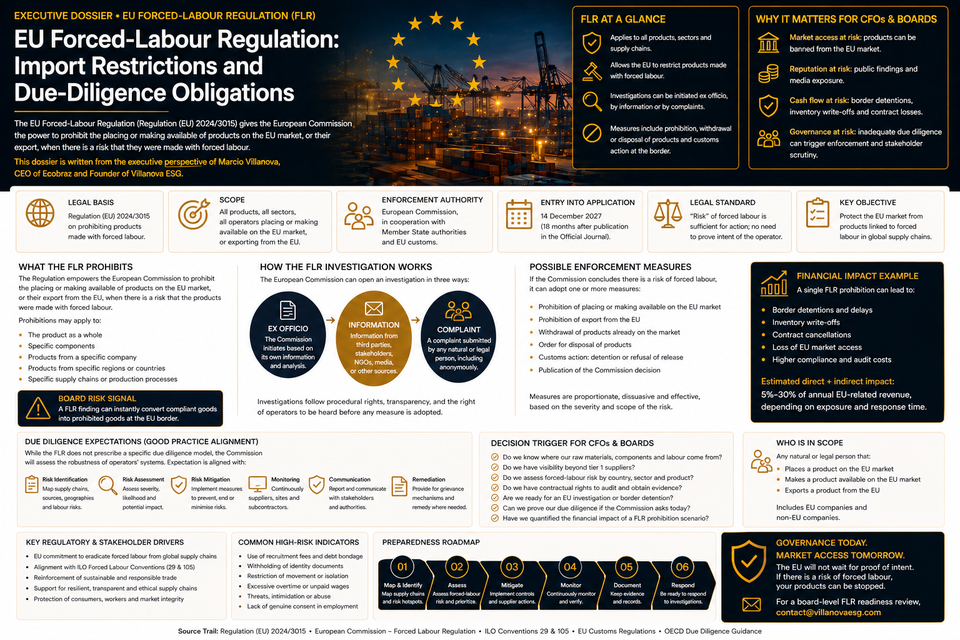
Executive Dossier · EU Forced-Labour Regulation
The EU Forced-Labour Regulation turns labour-risk evidence into a market-access control. Products linked to forced labour can be prohibited from being placed on the EU market, withdrawn, disposed of or blocked at the border.
This dossier is written from the executive perspective of Marcio Villanova, CEO of Ecobraz and Founder of Villanova ESG. The analysis treats forced-labour exposure as a cash-flow, customs and contract-continuity issue. The board question is direct: can the company prove where labour risk sits in the value chain before an investigation, buyer demand or customs action freezes revenue?
Legal Basis
Regulation (EU) 2024/3015
Application Date
14 December 2027
Scope
All products · all sectors · all operators
Financial Exposure
Border action, withdrawal, disposal, lost revenue
The EU Forced-Labour Regulation Is a Market-Access Ban
The EU Forced-Labour Regulation prohibits economic operators from placing or making available on the EU market, or exporting from the EU market, products made with forced labour. The regulation is broad by design. It applies to all products, all sectors and all operators, whether the product is manufactured inside or outside the European Union.
The application date is 14 December 2027. That date should not be treated as distant. Forced-labour evidence requires supplier mapping, risk screening, contractual control, worker-level indicators, remediation records and product linkage. Those systems cannot be created after a buyer request or customs hold.
The regulation does not operate as a generic corporate reporting duty. It operates as a product restriction mechanism. If a product is found to be linked to forced labour, the commercial result can be direct: prohibition, withdrawal from the market, disposal or border friction.
Board Risk Signal
A product can be commercially compliant on price, quality and delivery, and still become unsellable in Europe if labour-risk evidence fails.
The CFO should treat forced-labour exposure as inventory and revenue risk. The issue is not public relations. The issue is whether the product can legally move, be sold and be paid for.
The Scope Is Product-Based, Not Company-Size Based
The Forced-Labour Regulation does not rely on a narrow company-size threshold as the main gateway. The decisive point is the product and whether there is a risk that it was made with forced labour.
This is a different risk architecture from many corporate due diligence laws. A company outside CSDDD scope can still face forced-labour restrictions if its product, component, raw material, supplier or production process is linked to forced labour risk.
01 · Product Link
The investigation and restriction logic connects to products, product groups, components, operators, regions or supply-chain segments.
02 · Operator Exposure
Any operator placing, making available or exporting products can face consequences if products are linked to forced labour.
03 · Supplier Reality
The relevant risk may sit below Tier 1, inside labour brokers, subcontractors, raw material extraction, factories, farms or logistics providers.
The board should not ask only whether the company is directly regulated. It should ask whether any product sold into or from Europe contains a labour-risk failure that can stop revenue.
The Global Risk Baseline Is Material
The International Labour Organization reports 27.6 million people in forced labour, with a large share occurring in the private economy. Global estimates from ILO, Walk Free and IOM indicate 49.6 million people in modern slavery in 2021, including 27.6 million in forced labour and 22 million in forced marriage.
These figures matter because EU enforcement will not operate in a vacuum. Authorities, buyers, civil society organisations, media, trade unions and workers can all influence the risk signal that triggers deeper scrutiny.
Forced-Labour Risk Indicators
Recruitment Abuse
Recruitment fees, debt bondage, document retention, coercive transport or dependency on labour intermediaries.
Workplace Control
Restriction of movement, threats, intimidation, unpaid wages, excessive overtime or isolation from remedy channels.
Supply-Chain Concealment
Unauthorised subcontracting, hidden workshops, undocumented labour or missing worker grievance evidence.
The CFO should require risk indicators to be tied to specific suppliers, products, geographies and revenue streams. Generic human rights policy language does not protect inventory.
How Investigations Can Become Cash-Flow Events
The regulation allows competent authorities and the European Commission to investigate suspected forced-labour products. Investigations can be informed by risk-based data, submissions, complaints, publicly available information, civil society reports and other sources.
Once a product is under scrutiny, the financial exposure expands beyond legal review. The company may face buyer suspension, shipment delays, evidence collection costs, product segregation, inventory write-downs, contract penalties and reputation-linked revenue loss.
Forced-Labour Financial Exposure Formula Stack
Revenue at Risk = EU Product Revenue × Probability of Restriction × Restriction Period / Contract Period
Inventory Exposure = Affected Stock Value × Probability of Withdrawal, Disposal or Market Diversion
Working-Capital Drag = Blocked Invoice Value × Evidence Delay Days × Cost of Capital / 365
Contract Loss Exposure = Buyer Revenue × Probability of Suspension or Termination × Remaining Contract Term
The exact values must be calculated with internal company data. A responsible model requires EU revenue by product, supplier mapping, affected inventory value, buyer concentration, contract terms, average evidence delay, remediation cost, logistics status and cost of capital.
The Due-Diligence Obligation Is Practical, Even When Not Formally Framed as a Reporting Regime
The Forced-Labour Regulation is not identical to CSDDD. It does not create a general corporate sustainability report. It creates a product prohibition and enforcement system. However, due diligence becomes commercially necessary because companies must be able to prove that forced-labour risk is identified, assessed, mitigated and remediated.
A weak due-diligence system leaves the company unable to answer authority, buyer or customs questions within commercial timeframes.
Forced-Labour Evidence File
Product Linkage
Connect finished products to components, suppliers, subcontractors, raw materials and production sites.
Labour Risk Evidence
Document recruitment, wages, working hours, contracts, worker voice, grievance channels and labour broker controls.
Remediation Record
Maintain evidence of corrective action, repayment, disengagement logic, monitoring and worker-centered remedy where needed.
The company must be able to show not only that a policy exists, but that it works at supplier and product level.
Border Risk Requires Product-Level Traceability
Forced-labour restrictions become most damaging when the company cannot isolate affected products. If traceability is weak, one supplier allegation can contaminate broader product lines, shipments or customer relationships.
The control objective is narrow: link labour-risk evidence to the product at risk. The more precise the traceability, the more precise the defense.
CFO Decision Rule
Do not treat forced-labour due diligence as a supplier questionnaire. Treat it as product-level evidence for market access and customs defense.
Without product-level traceability, the company may over-withdraw compliant stock, under-detect contaminated shipments or fail to satisfy buyer evidence deadlines.
Contract Controls Must Move Upstream
European buyers will push forced-labour obligations upstream through contracts. Exporters should not accept buyer-facing duties unless supplier contracts provide enforceable rights to collect labour evidence, audit high-risk sites, access subcontractor information and require remediation.
Supplier contracts should address:
- prohibition of forced labour and indicators linked to ILO standards;
- disclosure of subcontractors, labour brokers and recruitment channels;
- worker documentation, wage and working-hour evidence where legally appropriate;
- audit rights for high-risk suppliers and production sites;
- notification obligations for labour-risk incidents;
- corrective action and remediation requirements;
- rights to suspend orders or disengage where risk cannot be mitigated;
- indemnity or cost allocation for false, late or incomplete evidence;
- data protection and confidentiality rules for worker-related information;
- buyer evidence deadlines aligned with EU market-access risk.
The exporter should not carry European market-access risk without upstream legal control over the labour-risk file.
Forced-Labour Exposure and Sustainability-Linked Finance
Forced-labour risk can affect financing when it threatens revenue continuity, buyer relationships, inventory value and governance quality. Banks and investors increasingly examine whether supply-chain controls are credible, not whether the company has a generic human rights statement.
A finance-grade forced-labour control system can support Sustainability-Linked Loan discussions where indicators are measurable and material:
- percentage of high-risk suppliers mapped beyond Tier 1;
- share of high-risk product lines covered by labour-risk evidence;
- percentage of suppliers screened for recruitment fees and labour broker risk;
- corrective action closure rate for labour-risk findings;
- worker grievance access coverage in high-risk facilities;
- reduction in unresolved forced-labour risk indicators over time;
- share of EU revenue protected by product-level labour-risk traceability.
The financing value is not created by a social claim. It is created by measurable control over a market-access risk.
Forced-Labour Finance Readiness Map
Revenue Protection
Quantify EU revenue tied to high-risk products, suppliers, components and geographies.
Evidence Quality
Replace self-declarations with labour-risk documentation, audits, worker voice and remediation records.
Credit Signal
Show lenders that product-restriction risk is measured, monitored and contractually controlled.
Exporter Scenario Planning
Forced-labour risk should be modelled through product and supplier scenarios. A generic country-risk map is insufficient because enforcement may connect to a specific product, component, supplier, operator, region or production process.
Forced-Labour Risk Scenarios
Base Case
High-risk suppliers are mapped, evidence is available and buyer requests can be answered before shipment disruption.
Stress Case
A labour-risk allegation targets a component supplier and the company must isolate affected product lines under deadline pressure.
Severe Case
A product cannot be defended, triggering EU restriction, buyer suspension, inventory write-down and contract loss.
The scenario output should include EU revenue at risk, affected inventory value, remediation cost, supplier replacement cost, buyer suspension exposure, working-capital drag and contract penalties.
The Villanova ESG Control Architecture
Villanova ESG operates exclusively at the intersection between European regulatory risk and cash-flow protection for cross-border supply chains. For the EU Forced-Labour Regulation, the objective is not to write a human rights policy. The objective is to build a product-level evidence architecture that protects EU market access, buyer confidence, financing credibility and cash-flow continuity.
01 · Product-Risk Map
Map products, components, raw materials, suppliers, labour brokers, geographies, buyer exposure and EU revenue.
02 · Labour-Risk Evidence File
Collect source evidence on recruitment, wages, working time, document retention, worker voice and grievance access.
03 · Supplier Verification
Validate high-risk suppliers through audits, document review, worker engagement, corrective action and escalation controls.
04 · Contract Shield
Align buyer obligations with upstream rights to evidence, audit access, remediation, suspension, indemnity and supplier replacement.
05 · CFO Risk Model
Quantify revenue at risk, inventory exposure, buyer suspension, working-capital drag, remediation cost and contract loss.
06 · Response Protocol
Prepare evidence packs, escalation workflows, authority response files, buyer communication and remediation documentation.
Decision Trigger for CFOs
The CFO should escalate EU Forced-Labour Regulation exposure when any of the following signals appear:
- the company sells or exports products into the EU with suppliers in high-risk labour environments;
- critical products cannot be linked to component-level or raw-material-level labour evidence;
- supplier due diligence relies on generic codes of conduct or self-declarations;
- labour brokers, subcontractors or temporary labour providers are not mapped;
- contracts do not give the company audit rights, evidence rights or remediation rights upstream;
- buyers ask for forced-labour evidence faster than internal teams can produce it;
- the company cannot isolate affected inventory if one supplier is challenged;
- worker grievance channels are undocumented or inaccessible in high-risk facilities;
- management cannot quantify the revenue impact of product withdrawal, disposal or border delay;
- banks or insurers request human rights due diligence evidence for supply-chain risk review.
These are not social compliance issues. They are EU market-access, working-capital and revenue-continuity indicators.
Regulatory Source Trail
This dossier relies on official EU legal and institutional materials and international labour references verified for the Forced-Labour Regulation, product prohibition scope, application date and global forced-labour context:
- European Commission — Forced Labour Regulation
- EUR-Lex — Regulation (EU) 2024/3015
- International Labour Organization — Forced Labour, Modern Slavery and Trafficking in Persons
- ILO — Global Estimates of Modern Slavery: Forced Labour and Forced Marriage
- Walk Free — Global Estimates of Modern Slavery 2022
- IOM — Global Estimates of Modern Slavery
Closing CTA · Forced-Labour Market Access Defense
If forced-labour evidence is not product-linked before scrutiny begins, the company may discover the risk only when revenue is already blocked.
Villanova ESG structures the product-level due diligence architecture required to protect EU market access, reduce border friction, defend buyer relationships and convert labour-risk controls into finance-grade evidence.
For a confidential EU Forced-Labour Regulation exposure review, contact contact@villanovaesg.com.