
Digital Product Passport: Transforming Primary Data Into Customs Clearance
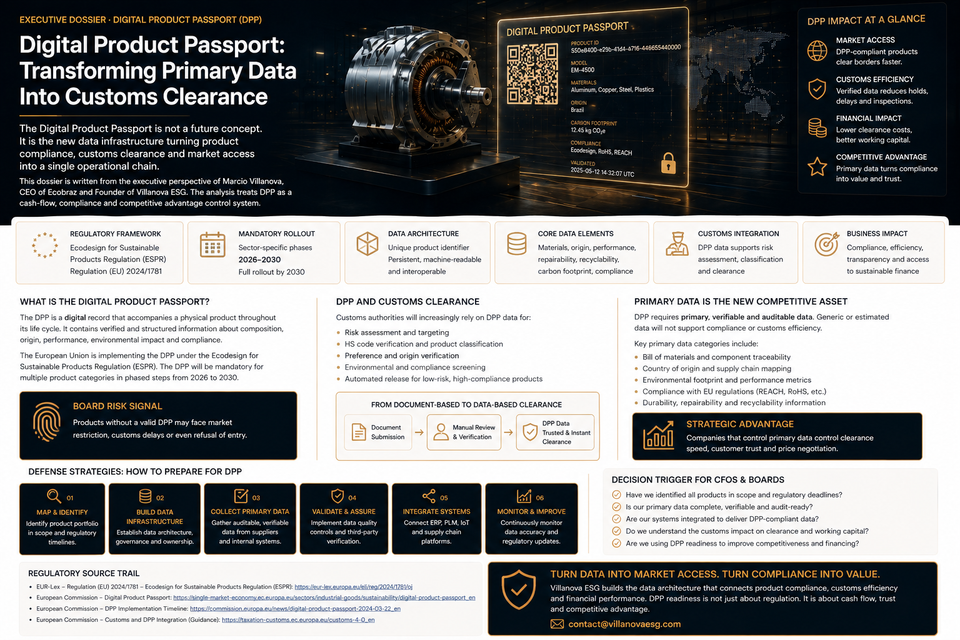
Executive Dossier · Digital Product Passport
The Digital Product Passport is not a sustainability label. It is the EU’s emerging product-data infrastructure for market access, customs verification, traceability and compliance evidence.
This dossier is written from the executive perspective of Marcio Villanova, CEO of Ecobraz and Founder of Villanova ESG. The analysis treats Digital Product Passport readiness as a cash-flow and customs-clearance control issue. The board question is direct: can the company convert fragmented product, supplier and compliance data into a machine-readable evidence layer before European buyers, customs authorities and market surveillance bodies demand it?
Regulatory Framework
ESPR · Regulation (EU) 2024/1781
Working Plan
2025–2030 priority products
Data Standard
Structured, searchable, machine-readable
Financial Exposure
Customs delay, buyer suspension, data rework
The Digital Product Passport Is a Market-Access Infrastructure
The Digital Product Passport is a structured digital record that accompanies a physical product through its life cycle. Under the EU’s sustainable product framework, it is designed to make product information accessible to different actors across the value chain, including businesses, consumers, market surveillance authorities and customs authorities.
The commercial consequence is direct. Product data will no longer sit only inside internal spreadsheets, supplier emails, technical folders or certification PDFs. It will need to be connected to product identifiers, data carriers, registries, access rights and regulatory use cases.
For exporters, the DPP is not only an EU digitalisation project. It is a future clearance, buyer-confidence and evidence-readiness mechanism.
Board Risk Signal
Products without a defensible data architecture may face slower clearance, higher inspection risk, buyer friction and weaker financing credibility.
The CFO should not treat the DPP as an IT project. It is an operating model for proving product compliance at commercial speed.
The Legal Status Must Be Kept Precise
The ESPR creates the horizontal framework for ecodesign requirements and the Digital Product Passport. The DPP will become mandatory through product-specific delegated acts and sectoral legal instruments, not through one universal immediate deadline for every product.
This distinction matters. A company should not claim that every product already needs a DPP today. That would be legally imprecise. The correct position is that the EU framework is adopted, priority products have been identified in the 2025–2030 working plan, and sector-specific implementation will determine when each product category must comply.
01 · Framework Law
The ESPR establishes the legal architecture for future ecodesign and DPP requirements.
02 · Product-Specific Rules
Mandatory DPP obligations depend on delegated acts or sector-specific legislation for the relevant product category.
03 · Exporter Control
Build primary data now, but label legal deadlines by product category to avoid overclaiming or misallocation of budget.
Legal precision protects credibility. It also prevents the company from funding generic systems that cannot produce the exact product evidence required by future delegated acts.
The 2025–2030 Working Plan Defines the First Strategic Exposure Zone
The first ESPR Working Plan for 2025–2030 identifies priority products for which the Commission will consider ecodesign and energy labelling requirements over the next five years. The priority list includes steel and aluminium, textiles with focus on apparel, furniture, tyres, mattresses and energy-related products.
For cross-border exporters, this priority list is a financial early-warning system. It shows where data architecture should be built first.
DPP Priority Exposure Map
Industrial Materials
Steel and aluminium require early data control because material origin, composition and performance can affect buyer and customs review.
Consumer Products
Textiles, furniture, tyres and mattresses require product-level evidence across composition, durability, repairability and end-of-life logic.
Energy-Related Products
Energy performance and technical documentation must be connected to product identifiers and market surveillance needs.
The CFO should prioritise product families by EU revenue, buyer concentration, customs exposure and internal data maturity.
Customs Clearance Is the Strategic Use Case
The DPP is often discussed as a transparency tool. That is incomplete. Its stronger financial relevance is customs and market surveillance.
EU legislative materials show the direction clearly: DPP data and related registries are intended to support customs authorities in risk management, targeted border controls and automatic verification. In the emerging model, the product identifier, operator identifier, registration identifier and commodity code become part of the clearance architecture.
Customs Data Logic
DPP Clearance Readiness = Product Identifier + Operator Identifier + Registration Identifier + Commodity Code + Required Compliance Data
Border Friction Risk = Probability of Data Mismatch × Affected Shipment Value × Delay Days × Cost of Capital / 365
Customs Evidence Gap = Required DPP Fields − Verified Product Data Available at Shipment Date
Buyer Suspension Exposure = EU Customer Revenue × Probability of Product Evidence Failure × Suspension Period / Contract Period
The exact values must be calculated with internal company data. A responsible model requires product portfolio, CN or commodity codes, EU shipment value, buyer deadlines, product family exposure, data-field maturity, supplier coverage and cost of capital.
Primary Data Becomes a Competitive Asset
DPP compliance depends on primary data. Generic claims, supplier declarations without verification and fragmented certification files will not be enough for a digital product evidence system.
Companies must control product-level information that can be structured, updated, authenticated and accessed according to legal access rights.
Product Identity
Unique product identifiers, product model logic, data carriers and registry references.
Technical Composition
Materials, components, substances of concern, origin, supplier evidence and technical specifications.
Lifecycle Performance
Durability, repairability, reusability, recyclability, environmental footprint and end-of-life information where required.
The exporter that controls the evidence file controls speed. The exporter that waits for buyer templates will finance rework, delays and margin pressure.
The Data Architecture Must Be Built Before the Delegated Act Arrives
Waiting for every product-specific detail before preparing is a weak board position. The technical elements that make a DPP operational are already visible: identifiers, machine-readable data, data carriers, access rights, interoperability, registry linkage and evidence accuracy.
The company should build the backbone now and adapt the fields when product-specific rules are finalised.
DPP Data Backbone
Data Governance
Define who owns, validates, updates and approves each product data field.
System Integration
Connect ERP, PLM, supplier data, quality files, compliance records and logistics systems.
Verification Layer
Create controls for data accuracy, source evidence, version history, audit trail and exception management.
Data architecture is cheaper before emergency buyer requests. After a shipment is at risk, the company pays for speed, rework and commercial concessions.
DPP and the Customs Single Window Logic
The emerging EU architecture connects product data to customs processes. Legislative references show that customs authorities should be able to retrieve and use DPP data and registry information for risk management, customs controls and release-for-free-circulation procedures.
This means DPP readiness should be linked to the company’s customs and trade compliance function, not only sustainability or product design.
Control Principle
The DPP evidence file should be built for customs, market surveillance, buyers and lenders at the same time. Separate files create delay and contradiction.
For CFOs, the relevant exposure is operational: delayed release, blocked inventory, customer penalties, reclassification disputes, duplicated document handling and higher working-capital absorption.
The Contract Risk Is Underestimated
European buyers will likely transfer DPP-related obligations upstream. Exporters and suppliers should expect requests for product composition, origin evidence, materials data, repairability information, recyclability data and technical compliance records.
Supplier and buyer contracts should define:
- which products are expected to require DPP evidence;
- which data fields must be supplied by each party;
- who owns data accuracy risk;
- who pays for third-party verification or testing;
- how often product data must be updated;
- which data can be shared publicly, commercially or with authorities;
- what happens if a supplier cannot support required fields;
- how delays affect delivery obligations and penalties;
- how confidential information is protected while satisfying legal access rights.
CFO Decision Rule
Do not accept DPP evidence obligations from European buyers unless upstream supplier contracts give the company enforceable rights to collect, verify, update and disclose the required data.
The company should not carry buyer-facing DPP liability without upstream control over the data source.
DPP Readiness and Sustainability-Linked Finance
DPP readiness can support financing when it turns supply-chain transparency into measurable control. Banks and trade finance providers do not need another ESG narrative. They need evidence that market-access risk, product compliance risk and traceability risk are controlled.
A finance-grade DPP architecture can support Sustainability-Linked Loan discussions through measurable indicators:
- percentage of EU revenue covered by structured product evidence;
- share of priority products mapped against ESPR exposure;
- supplier data coverage rate for required product fields;
- customs-delay reduction after data standardisation;
- percentage of product records with verified source evidence;
- reduction in manual compliance rework per shipment;
- number of high-risk product data gaps closed before buyer deadlines.
The financing argument is not that the company is “more sustainable.” The argument is that the company has converted regulatory uncertainty into measurable operational control.
DPP Finance Readiness Map
Market-Access Control
Evidence that priority products can satisfy EU product-data expectations.
Working-Capital Control
Reduced probability of customs delays, document rework and blocked shipment value.
Credit Evidence
Traceability data that supports lender diligence and Sustainability-Linked Loan performance indicators.
Exporter Scenario Planning
DPP exposure should be modelled by product family, buyer market and data maturity. A general technology roadmap is not enough. The CFO needs a scenario view of where cash-flow disruption can occur.
DPP Risk Scenarios
Base Case
Priority products are mapped, data owners are assigned and buyer evidence packs are produced before contract deadlines.
Stress Case
European buyer requests DPP-ready fields that are scattered across suppliers, ERP, technical teams and certification files.
Severe Case
A product cannot support required identifiers, composition data or compliance evidence, triggering shipment delay or customer suspension.
The scenario output should include affected EU revenue, data remediation cost, shipment delay exposure, supplier rework, buyer penalty risk and working-capital drag.
The Villanova ESG Control Architecture
Villanova ESG operates exclusively at the intersection between European regulatory risk and cash-flow protection for cross-border supply chains. For Digital Product Passport readiness, the objective is not to buy software first. The objective is to build a defensible evidence architecture that connects product compliance, customs efficiency, buyer confidence and financing value.
01 · Product Exposure Map
Map products, EU revenue, buyer concentration, priority product groups, commodity codes and likely DPP exposure.
02 · Data Field Inventory
Identify available and missing data across composition, origin, performance, lifecycle, repairability and compliance evidence.
03 · Supplier Evidence File
Collect auditable supplier data with source documents, version control, validation logic and escalation triggers.
04 · Customs Data Layer
Connect product identifiers, commodity codes, registry logic and shipment documentation for border-risk reduction.
05 · CFO Risk Model
Quantify data gap cost, shipment-delay exposure, buyer suspension risk, evidence rework and working-capital drag.
06 · SLL Readiness
Convert product-data control into finance-grade indicators for lenders, buyers and Sustainability-Linked Loan negotiations.
Decision Trigger for CFOs
The CFO should escalate Digital Product Passport exposure when any of the following signals appear:
- the company exports steel, aluminium, textiles, furniture, tyres, mattresses or energy-related products into the EU;
- product data is fragmented across ERP, PLM, spreadsheets, supplier emails and certification PDFs;
- supplier contracts do not require structured product data, update rights and verification evidence;
- customs classification is disconnected from product compliance evidence;
- European buyers request lifecycle, composition, repairability or recyclability information faster than internal teams can validate it;
- the company cannot identify which data fields are public, restricted, authority-only or commercially sensitive;
- product identifiers and data carriers have not been mapped;
- the company cannot quantify customs delay exposure or data remediation cost;
- banks or trade finance providers request traceability or product compliance evidence;
- management assumes DPP readiness is a software purchase rather than a legal, operational and financial control system.
These are not technology gaps. They are market-access, customs and cash-flow risk indicators.
Regulatory Source Trail
This dossier relies on official EU legal and implementation references verified for the ESPR, Digital Product Passport development, product-priority planning, customs use cases and technical data architecture:
- European Commission Green Forum — Implementing the Ecodesign for Sustainable Products Regulation
- European Commission Green Forum — 2025–2030 Working Plan
- EUR-Lex — Regulation (EU) 2024/1781
- European Commission — Digital Product Passport Impact Assessment Surveys
- Council of the EU — DPP, Registry and Customs Control References
- European Commission — Construction Products Working Plan and DPP References
Closing CTA · Digital Product Passport Defense
If your product data cannot travel with the product, market access will depend on manual rescue work.
Villanova ESG structures the data architecture required to connect product compliance, customs clearance, buyer confidence, supply-chain traceability and finance-grade evidence for boards, lenders and authorities.
For a board-level Digital Product Passport readiness review, contact contact@villanovaesg.com.