
CSDDD Civil Liability: From 5% Turnover Exposure to the New 3% Sanctions Cap
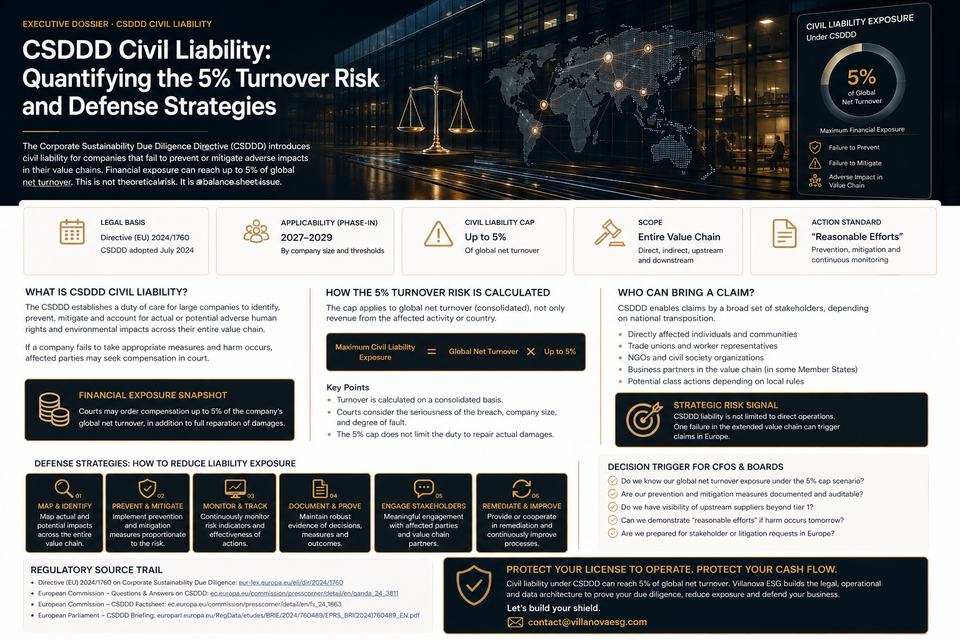
Executive Dossier · CSDDD Civil Liability
The CSDDD risk equation has changed. The original 5% turnover exposure has been replaced by a revised sanctions cap of up to 3% of net worldwide turnover, while civil liability moves back into national legal regimes.
This dossier is written from the executive perspective of Marcio Villanova, CEO of Ecobraz and Founder of Villanova ESG. The analysis treats CSDDD liability as a cash-flow, litigation and governance control issue. The board question is direct: can the company prove that its due diligence system is proportionate, risk-based, documented and defensible before a regulator, buyer, lender or claimant tests the file?
Legal Basis
Directive (EU) 2024/1760
Revised Scope
5,000+ employees · €1.5bn+ turnover
Application Date
26 July 2029
Sanctions Cap
Up to 3% of net worldwide turnover
The 5% Risk Is No Longer the Current Sanctions Benchmark
The original CSDDD framework created a high-impact risk narrative around penalties of up to 5% of worldwide turnover. That figure was central to early board discussions because it translated due diligence failure into a direct P&L exposure.
The current legislative position has changed. Under the revised Omnibus agreement approved by the European Parliament and signed off by the Council, the due diligence scope is narrowed and the maximum sanctions cap is set at up to 3% of the company’s net worldwide turnover.
This correction matters. A board memo using the old 5% benchmark without qualification risks overstating the current sanctions cap. A board memo ignoring the 3% cap risks underpricing the remaining exposure. The correct position is technical: the sanctions cap is lower, but the liability architecture remains financially material.
Board Risk Signal
The reduction from 5% to 3% does not eliminate CSDDD risk. It changes the risk model from maximum shock narrative to evidence-based defense architecture.
The CFO should not treat the Omnibus revision as a free pass. It reduces the population of companies directly in scope and lowers the sanctions ceiling. It does not remove buyer pressure, lender scrutiny, contractual pass-through, national litigation exposure or supply-chain evidence demands.
The New Scope Is Narrower but More Concentrated
The revised CSDDD scope targets very large corporations. EU companies with more than 5,000 employees and more than €1.5 billion in net turnover are the central population. Non-EU companies are also covered where they meet the relevant EU turnover threshold.
This means fewer companies are directly regulated. It also means the companies that remain in scope are systemically important buyers, multinational groups and high-leverage counterparties. Their compliance obligations will still move pressure down the value chain.
01 · Direct Scope
Very large EU companies above the employee and turnover thresholds must operate due diligence controls.
02 · Non-EU Exposure
Non-EU companies can fall in scope when EU turnover exceeds the revised threshold.
03 · Supplier Impact
Out-of-scope suppliers can still face evidence requests from in-scope buyers protecting their own compliance position.
The board should distinguish between legal scope and commercial exposure. A supplier may be outside the directive’s direct scope and still lose revenue if it cannot support the buyer’s due diligence file.
Civil Liability Has Shifted to National Legal Risk
The current Omnibus position removes the EU-harmonised civil liability conditions and defers to national civil liability regimes. That is not the same as removing litigation risk. It changes where the risk is tested.
For CFOs and general counsel, this creates a more fragmented litigation map. The question is no longer only whether the company meets one EU-level civil liability test. The question becomes how national courts, national transposition choices, claimant strategy and evidentiary records interact.
Civil Liability Risk Map
EU-Harmonised Test
Removed under the current Omnibus compromise position.
National Liability
Claims remain dependent on national law, evidence rules and local transposition.
Board Control
The defense file must prove risk-based identification, mitigation, monitoring and decision discipline.
Legal fragmentation increases the value of documentation. If liability is tested nationally, the company needs a record that can survive multiple legal interpretations.
The Financial Formula Has Changed
A CFO-grade CSDDD model cannot rely on a single penalty headline. The model must separate administrative sanctions, civil litigation, contractual exposure, buyer suspension and working-capital drag.
CSDDD Financial Exposure Formula Stack
Maximum Administrative Sanctions Exposure = Net Worldwide Turnover × Up to 3%
National Litigation Exposure = Claimed Damages × Probability of Liability × Jurisdictional Enforcement Factor
Buyer Suspension Exposure = At-Risk Customer Revenue × Suspension Period / Contract Period
Working-Capital Drag = Delayed Invoice Value × Evidence Delay Days × Cost of Capital / 365
The exact values must be calculated with internal company data. A responsible model requires global net turnover, EU revenue exposure, buyer concentration, supplier risk segmentation, contract terms, adverse-impact history, litigation jurisdictions and cost of capital.
Why Out-of-Scope Suppliers Still Face Commercial Pressure
The revised CSDDD protects smaller companies from unnecessary information requests, especially where information can be obtained by other means. That matters. It reduces indiscriminate supplier questionnaires and weak blanket data demands.
But it does not eliminate targeted buyer pressure. In-scope companies still need evidence where risks are likely and severe. If a supplier sits in a high-risk geography, high-risk sector, high-risk commodity chain or high-risk labour context, the buyer may still need specific information to defend its own due diligence position.
Risk-Based Requests
Evidence requests become more targeted around likely and severe adverse impacts.
Commercial Gatekeeping
EU buyers may convert due diligence weakness into supplier ranking, contract conditions or suspension decisions.
Finance Impact
Banks and trade finance providers can treat weak due diligence evidence as counterparty or supply-chain risk.
Direct legal scope is narrower. Commercial exposure remains broader.
The Action Standard: Reasonable, Risk-Based and Documented
The revised CSDDD moves companies toward a more risk-based due diligence structure. The control file must show that the company used available information to identify where adverse impacts are most likely and most severe, then focused deeper assessment where the risk profile justifies it.
For boards, the technical weakness is usually not the absence of policy. It is the absence of evidence that the policy changed operational decisions.
Due Diligence Defense File
Scoping Exercise
Identify where adverse impacts are most likely and most severe across operations and chain of activities.
Prioritisation Logic
Document why certain risks, suppliers, regions or business partners were escalated first.
Corrective Evidence
Show prevention, mitigation, monitoring, remediation and governance decisions in auditable form.
The legal question is not whether the company promised due diligence. The legal question is whether the company can prove a disciplined risk process when the file is challenged.
Contract Risk Moves Faster Than Regulation
Many exporters and suppliers will feel CSDDD pressure through contracts before they ever receive a formal regulatory notice. Large European buyers will protect themselves through supplier codes, audit clauses, termination rights, data obligations and adverse-impact escalation procedures.
Supplier contracts should be reviewed for:
- human rights and environmental due diligence clauses;
- audit rights across Tier 1 and higher-risk deeper-tier suppliers;
- documentation obligations and evidence deadlines;
- corrective action plan requirements;
- termination and suspension triggers;
- indemnities linked to false, late or incomplete information;
- obligations to notify adverse impacts;
- alignment with buyer reporting and lender due diligence requirements.
CFO Decision Rule
Do not accept broad CSDDD pass-through obligations from buyers unless upstream supplier contracts give the company enforceable rights to obtain evidence, correct failures and allocate risk.
The exporter should not carry downstream liability without upstream control over the facts.
Litigation Risk Is an Evidence Problem
Once civil liability is left to national regimes, evidentiary quality becomes the core defense asset. A weak file gives claimants and commercial counterparties room to argue that the company failed to identify, prevent, mitigate or monitor adverse impacts.
The strongest defense file is not a sustainability report. It is a traceable chain of decisions.
- Which risks were identified?
- Which suppliers were prioritised?
- Which information sources were used?
- Which mitigation actions were taken?
- Which corrective action plans were required?
- Which suppliers failed to cooperate?
- Which escalation decisions were taken by management?
- Which trade-offs were approved by the board?
Without this record, the company may have compliance activity but no legal defense architecture.
CSDDD and Sustainability-Linked Finance
CSDDD readiness can support financing when it creates measurable, verified and auditable risk indicators. Lenders need to understand whether the borrower can maintain market access, preserve buyer relationships and reduce adverse-impact exposure across critical supply chains.
A credible Sustainability-Linked Loan structure can use due diligence indicators only when they are technically robust. Generic ESG claims do not reduce credit risk.
CSDDD Finance Readiness Map
Supplier Risk Coverage
Percentage of high-risk suppliers covered by verified due diligence evidence.
Corrective Action Closure
Rate of high-priority corrective actions closed within board-approved deadlines.
Revenue Protection
Share of EU customer revenue supported by defensible supply-chain evidence.
The opportunity is capital discipline. If due diligence reduces buyer disruption, litigation probability and supplier opacity, it can become a financing argument.
The Villanova ESG Control Architecture
Villanova ESG operates exclusively at the intersection between European regulatory risk and cash-flow protection for cross-border supply chains. For CSDDD, the objective is not to produce another policy. The objective is to build a legal and financial defense system that boards, buyers, lenders and regulators can test.
01 · Scope Exposure Map
Map EU and non-EU exposure by corporate group, turnover, buyer relationships, supplier geography and value-chain risk.
02 · Adverse Impact Register
Classify actual and potential human rights and environmental impacts by severity, likelihood and business relevance.
03 · Supplier Evidence File
Build auditable evidence across high-risk suppliers, corrective actions, monitoring results and escalation decisions.
04 · Contract Shield
Align buyer obligations with upstream audit rights, evidence deadlines, corrective action rights and risk allocation.
05 · CFO Risk Model
Quantify sanctions exposure, national litigation risk, buyer suspension, contract loss and working-capital drag.
06 · Board Dashboard
Translate due diligence into market access, litigation defense, customer retention, lender confidence and cash-flow continuity.
Decision Trigger for CFOs
The CFO should escalate CSDDD exposure when any of the following signals appear:
- the company sells to large EU buyers that are likely to fall within the revised CSDDD scope;
- supplier due diligence is limited to generic questionnaires without risk-based verification;
- contracts transfer due diligence obligations without upstream evidence rights;
- high-risk suppliers are not classified by severity, likelihood and revenue relevance;
- corrective action plans are not tracked with deadlines, owners and evidence of closure;
- the company cannot quantify buyer suspension exposure or working-capital drag from evidence delays;
- lenders request human rights or environmental due diligence evidence for credit review;
- board minutes do not show escalation of material adverse-impact risks;
- management cannot explain how the company would defend its due diligence process in a national court or supervisory review.
These are not documentation gaps. They are litigation, revenue and capital-cost indicators.
Regulatory Source Trail
This dossier relies on official EU legal materials and current legislative references verified for the CSDDD, the Omnibus revision, scope thresholds, application date, sanctions cap and civil liability position:
- European Commission — Corporate Sustainability Due Diligence
- Council of the EU — Simplification of Sustainability Reporting and Due Diligence Requirements
- European Parliament — Simplified Sustainability Reporting and Due Diligence Rules
- Council of the EU — Provisional Agreement on Sustainability Simplification
- Council of the EU — Final Compromise Text, ST 16159/1/25 REV 1
- EUR-Lex — Directive (EU) 2024/1760
Closing CTA · CSDDD Liability Defense
If your due diligence file cannot prove risk-based decisions, the sanctions cap is only one part of the exposure.
Villanova ESG structures the regulatory shield required to protect European market access, reduce litigation exposure, defend buyer relationships and convert due diligence performance into finance-grade evidence for boards, lenders and authorities.
For a board-level CSDDD exposure review, contact contact@villanovaesg.com.