
CBAM 2026–2034: The Financial Impact on Your Supply Chain and the Cost of Inaction
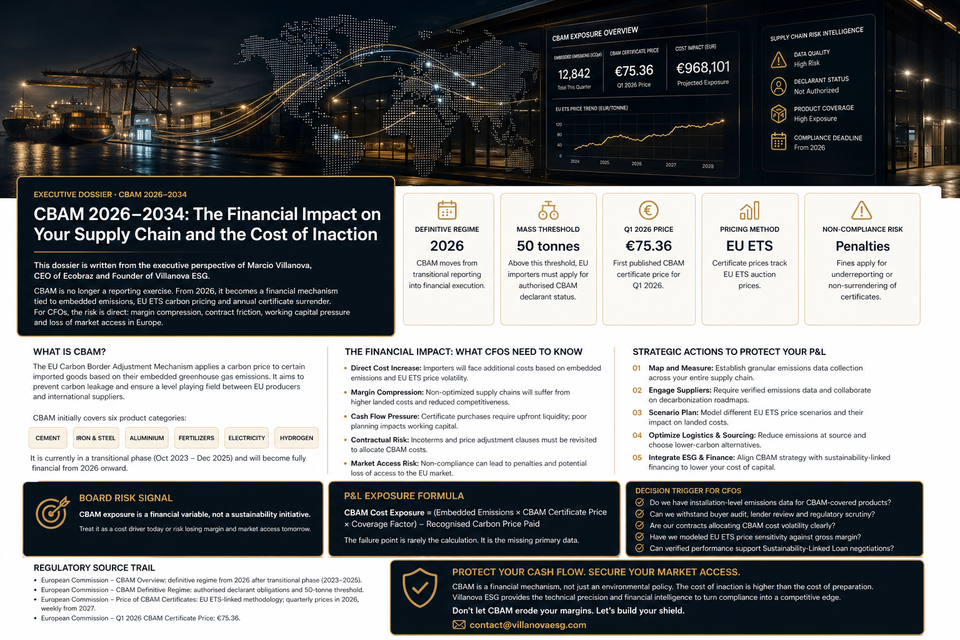
Executive Dossier · CBAM 2026–2034
CBAM is no longer a reporting exercise. From 2026, carbon intensity becomes a financial variable inside landed cost, supplier negotiation, working capital and European market access.
This dossier is written from the executive perspective of Marcio Villanova, CEO of Ecobraz and Founder of Villanova ESG. The analysis treats CBAM as a cash-flow protection issue. The board question is direct: can the company prove embedded-emissions exposure before the European buyer converts uncertainty into price pressure, contractual liability or supplier replacement?
Definitive Regime
1 January 2026
Mass Threshold
50 tonnes of CBAM goods
Q1 2026 Price
€75.36
Financial Exposure
Margin compression, contract friction, buyer substitution
CBAM Has Entered the Financial Phase
The Carbon Border Adjustment Mechanism is the European Union’s carbon-cost control for selected imported goods. Its purpose is to apply a carbon price to emissions embedded in carbon-intensive goods entering the EU and to reduce carbon leakage between EU producers and non-EU suppliers.
The transitional period from 2023 to 2025 was primarily a reporting phase. The definitive regime began in 2026. That changes the financial profile for exporters, manufacturers and European buyers.
EU importers and indirect customs representatives importing more than the single mass-based threshold of 50 tonnes of CBAM goods must apply for authorised CBAM declarant status. They must declare embedded emissions and surrender the corresponding number of certificates. Exporters outside the EU may not be the formal declarant, but they control the operational data that determines the buyer’s exposure.
Board Risk Signal
If the exporter cannot prove embedded emissions at product and installation level, the European buyer will price the uncertainty into procurement.
The financial issue is not whether CBAM applies to the exporter directly. The issue is whether the exporter can protect its commercial position when the European buyer must quantify and fund carbon exposure.
The Current CBAM Scope
The current CBAM sector scope covers six categories: cement, aluminium, fertilisers, iron and steel, hydrogen and electricity. The analysis must start with customs classification. A product is not “CBAM exposed” because it has a high carbon footprint. It is exposed when the relevant CN code falls within the covered scope.
01 · Industrial Inputs
Cement, iron and steel, aluminium and fertilisers are core risk areas for exporters and industrial buyers.
02 · Energy-Linked Goods
Hydrogen and electricity create exposure where energy origin, production method and emissions intensity affect the compliance file.
03 · Exporter Control
The exporter must map CN codes, production installations, emissions factors, precursor data and buyer evidence requirements.
For CFOs, the practical conclusion is simple. CBAM exposure begins with product classification. It becomes financial exposure when emissions data, carbon price and contractual cost allocation meet inside the buyer’s landed-cost model.
The Price Signal Is Now Visible
The European Commission published the first CBAM certificate price for Q1 2026: €75.36. The methodology links CBAM certificate prices to EU ETS auction prices. In 2026, the Commission calculates and publishes four quarterly prices. From 2027 onward, the price is calculated and published weekly.
This matters because CBAM is not a fixed tariff. It is a carbon-price exposure. The cost can move with EU ETS price dynamics, shipment volume, embedded emissions, available carbon-price deductions and the gradual interaction with EU ETS free allocation.
CBAM Price Architecture
2026 Pricing
Quarterly CBAM certificate prices are calculated from EU ETS auction data.
2027 Onward
Certificate prices move to weekly publication, increasing exposure to carbon-price volatility.
Exporter Risk
Weak emissions evidence increases buyer uncertainty and can trigger conservative pricing assumptions.
For a CFO, €75.36 is not just a regulatory number. It is the first benchmark for budget exposure, supplier ranking, margin sensitivity and commercial negotiation.
The P&L Mechanism: How CBAM Compresses Margin
CBAM can affect margin before any public enforcement event occurs. The buyer does not need to wait for a fine to adjust procurement behavior. If the data file is weak, the buyer can reduce price, demand indemnities, delay approval or replace the supplier.
The most relevant exposure channels are:
- carbon-cost pass-through into landed cost;
- price discounts demanded by EU importers to absorb uncertainty;
- contract clauses shifting CBAM cost volatility to the exporter;
- working-capital pressure from certificate planning and buyer payment delays;
- supplier replacement where competitors provide stronger emissions evidence;
- lender scrutiny where transition risk affects credit analysis.
CBAM P&L Exposure Formula Stack
CBAM Cost Exposure = Embedded Emissions × CBAM Certificate Price × Applicable Coverage Factor − Recognised Carbon Price Paid
Margin Compression = CBAM Cost Exposure + Buyer Risk Discount + Contractual Indemnity Reserve
Working-Capital Drag = Delayed Invoice Value × Evidence Delay Days × Cost of Capital / 365
Revenue at Risk = EU Customer Revenue × Probability of Supplier Suspension × Suspension Period / Contract Period
The exact values must be calculated with internal company data. A responsible model requires product CN codes, annual EU shipment volume, installation-level emissions, precursor exposure, declared carbon price paid in the country of production, buyer contract terms, invoice cycle and cost of capital.
Primary Data Is Now a Commercial Asset
The strongest commercial defense is not a sustainability claim. It is auditable operational data.
European buyers need evidence that can support CBAM declarations. That evidence must be linked to the correct product, installation, production route, reporting period and applicable methodology. Generic averages weaken the exporter’s negotiating position.
Installation Data
Facility-level production data supports more defensible embedded-emissions calculations.
Product Traceability
CN code mapping connects regulatory scope to commercial shipments and buyer obligations.
Finance-Grade Evidence
Verified performance can support buyer confidence, credit review and Sustainability-Linked Loan structuring.
The exporter that controls emissions evidence controls negotiation leverage. The exporter that waits for the buyer’s request negotiates from a defensive position.
The Contract Risk Is Underestimated
CBAM will increasingly appear in supply contracts. The critical issue is not only who files the declaration. The issue is who carries the economic risk when data are late, incomplete, unverifiable or commercially unfavorable.
Supplier and buyer contracts should define:
- which products and CN codes are within CBAM scope;
- which party provides installation-level emissions data;
- which methodology is accepted by the EU buyer;
- how carbon-price paid in the country of production is documented;
- who absorbs certificate-price volatility;
- which audit rights apply to facilities and upstream data sources;
- what happens if data are missing or rejected;
- whether CBAM costs can trigger price adjustment or termination.
CFO Decision Rule
Do not sign CBAM cost-allocation clauses before modeling embedded-emissions exposure, EU ETS price sensitivity and buyer data requirements.
Contract silence is not neutral. If the contract does not allocate CBAM risk, the margin may absorb it by default through renegotiation pressure.
CBAM and Sustainability-Linked Finance
CBAM readiness can support financing when it produces measurable, verified and lender-readable indicators. Banks do not finance narratives. They finance controlled risk.
A CBAM evidence architecture can support Sustainability-Linked Loan preparation when it translates operational performance into finance-grade metrics:
- emissions intensity by product line;
- verified reduction pathways by facility;
- supplier data coverage rate;
- CBAM exposure reduction over time;
- share of EU revenue supported by verified emissions data;
- contractual pass-through and risk-allocation controls;
- audit-ready documentation for creditor review.
The opportunity is not “green positioning.” The opportunity is cost of capital. A company that can quantify regulatory exposure and show verified risk reduction has stronger material for credit negotiation.
CBAM Finance Readiness Map
Risk Quantification
Translate carbon-price exposure into margin, working-capital and revenue-at-risk scenarios.
Data Verification
Convert operational emissions data into audit-ready documentation for buyers and lenders.
Credit Leverage
Use controlled CBAM exposure as evidence for Sustainability-Linked Loan negotiations.
Exporter Scenario Planning
CBAM exposure should be modeled through scenarios. A single static estimate is not enough because the cost variable depends on emissions intensity, EU ETS-linked certificate prices, buyer terms, carbon price recognition and shipment mix.
CBAM Risk Scenarios
Base Case
Verified emissions data support buyer declarations and reduce conservative carbon-cost assumptions.
Stress Case
Buyer requires data before contract renewal and applies a margin discount for incomplete evidence.
Severe Case
Supplier cannot substantiate embedded emissions, forcing buyer suspension, contract renegotiation or source substitution.
The scenario output should include gross margin impact, working-capital drag, buyer delay, evidence remediation cost, contract exposure and credit implications.
The Villanova ESG Control Architecture
Villanova ESG operates exclusively at the intersection between European regulatory risk and cash-flow protection for cross-border supply chains. For CBAM, the objective is not to create another ESG report. The objective is to build a financial control system that protects EU revenue, commercial leverage and capital access.
01 · Product Scope Map
Map products, CN codes, shipment volumes, buyer destinations and CBAM-covered categories.
02 · Embedded-Emissions File
Structure installation-level emissions data, production routes, precursor exposure and calculation evidence.
03 · Buyer Evidence Pack
Prepare documentation that supports EU buyer declarations, contract review and audit requests.
04 · Contract Shield
Define data obligations, audit rights, carbon-cost allocation, price-adjustment triggers and indemnity logic.
05 · CFO Risk Model
Quantify CBAM cost exposure, margin compression, working-capital drag and revenue at risk.
06 · SLL Readiness
Convert verified emissions performance into finance-grade evidence for creditors and Sustainability-Linked Loans.
Decision Trigger for CFOs
The CFO should escalate CBAM exposure when any of the following signals appear:
- the company exports cement, aluminium, fertilisers, iron and steel, hydrogen or electricity-linked products into the EU;
- CN code mapping has not been completed at product level;
- installation-level embedded-emissions data are incomplete or not auditable;
- buyer contracts do not define CBAM cost allocation;
- commercial teams are negotiating EU contracts without carbon-price sensitivity analysis;
- the company cannot evidence carbon price paid in the country of production;
- buyers are requesting emissions data faster than internal teams can validate it;
- EU revenue depends on suppliers that cannot support precursor or production-route evidence;
- banks or trade finance providers are asking for transition-risk data;
- management cannot quantify margin impact under different EU ETS price scenarios.
These are not reporting issues. They are cash-flow, procurement and credit-risk indicators.
Regulatory Source Trail
This dossier relies on official European Union materials verified for the CBAM definitive regime, certificate pricing methodology, sector scope and current implementation position:
- European Commission — Carbon Border Adjustment Mechanism
- European Commission — Price of CBAM Certificates
- European Commission — First CBAM Certificate Price Available
- European Commission — CBAM Sectors
- EUR-Lex — Consolidated Regulation (EU) 2023/956
Closing CTA · CBAM Financial Defense
If your CBAM exposure is not quantified before the buyer renegotiates, carbon cost becomes a margin shock.
Villanova ESG structures the regulatory shield required to protect EU market access, preserve cash flow and convert embedded-emissions control into finance-grade evidence for boards, buyers, lenders and authorities.
For a board-level CBAM exposure review, contact contact@villanovaesg.com.