
Board Liability and Supply Chain Evidence: Why Directors Need Regulatory Defensibility
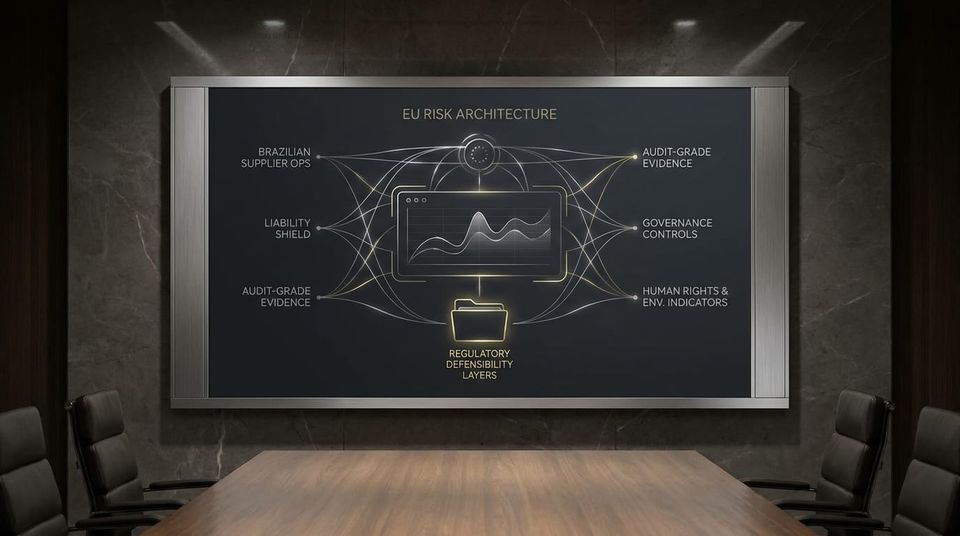
Villanova ESG | Executive Regulatory Dossier
Board Liability and Supply Chain Evidence: Why Directors Need Regulatory Defensibility
Supply-chain regulation changes the role of the board. Directors are no longer judged only by financial supervision, internal controls and strategic oversight. In European-facing value chains, boards increasingly need to understand whether supply-chain risk has been identified, escalated, documented and made defensible.
Risk Vector
Oversight Evidence
Boards need evidence that material supply-chain risks were identified, reviewed, escalated and monitored through governance channels.
Financial Exposure
Director-Level Scrutiny
Evidence gaps can affect audit committee review, investor confidence, lender questions, customer trust and litigation-readiness.
Board Relevance
Regulatory Defensibility
The board-level question is not whether risks existed. It is whether governance can prove that risks were handled with discipline.
The Strategic Change
European sustainability due diligence changes how directors should look at supply chains. The supply chain is no longer only a procurement structure. It is a risk perimeter. Environmental, human-rights, traceability, emissions, waste and supplier-control failures can become governance issues when they affect reporting, contracts, financing, market access or regulatory exposure.
This does not mean that every director is automatically personally liable for every supplier failure. That would be legally inaccurate. The relevant point is more practical. Boards, CFOs and audit committees need evidence that material risks were identified, assessed and escalated through a defensible governance process. In a dispute, audit or regulatory review, undocumented oversight is weak oversight.
Board-Level Interpretation
Supply-chain evidence is becoming a governance defense asset. Directors need a file that shows how risks were known, prioritized, escalated and monitored before they became public or financial exposure.
Why Brazilian Operations Matter to European Boards
Brazilian suppliers can sit inside European risk maps even when the board is located in Europe. The risk travels through procurement, contracts, products, commodities, outsourced operations, waste streams, logistics, data, emissions and supplier relationships. If the Brazilian layer is poorly documented, the European governance file becomes weaker.
This is especially relevant when a European buyer depends on Brazilian suppliers for critical inputs, strategic sourcing, cost stability or product continuity. The board may not manage day-to-day supplier operations. But it may need confidence that management has a reliable evidence architecture for material supply-chain exposure.
Governance Evidence Gap
- Supplier risk not reported to board or audit committee.
- Materiality thresholds not defined for supply-chain escalation.
- Operational evidence disconnected from governance reporting.
- Corrective actions tracked informally without board-level visibility.
- Brazilian supplier files not structured for European review.
Board Concern
- What are the material supply-chain risks?
- Who owns the risk internally?
- When does risk escalate to executive or board level?
- What evidence supports management’s conclusions?
- Can the governance file be defended under regulatory, investor or litigation pressure?
Finance-Grade Risk Formula
Board Defensibility Exposure Model
Board Defensibility Exposure = Material Supply-Chain Risk × Evidence Gap × Escalation Failure × Stakeholder Scrutiny
This is a board-level risk model, not a statutory formula. To quantify it, a company needs internal data: revenue exposure, supplier criticality, risk severity, board reporting cadence, audit findings, customer concentration, litigation exposure, regulatory pressure and remediation cost.
The CFO Problem: Governance Failure Becomes Financial Exposure
CFOs should not separate board governance from supply-chain documentation. When regulatory expectations move into procurement and reporting, weak documentation can affect audit confidence, lender analysis, investor questioning and customer retention. The issue is not only compliance. It is financial defensibility.
A board cannot manage every supplier. But it can require an evidence system that identifies material risks, assigns ownership, records mitigation measures and escalates issues when thresholds are crossed. That is the difference between governance by assertion and governance by evidence.
CFO Diagnostic Question
If a board member asked how Brazilian supply-chain risk is identified, documented and escalated, could management produce a governance-ready file — or only operational explanations scattered across departments?
What a Board-Ready Supply Chain Evidence File Should Include
A board-ready supply-chain file should not overload directors with operational noise. It should translate operational reality into governance-relevant evidence. The file must show materiality, ownership, escalation, mitigation and residual risk.
1. Material Risk Register
Identification of supply-chain risks that are financially, operationally, legally or reputationally material enough for executive or board attention.
2. Escalation Protocol
Defined thresholds for when supplier risk moves from procurement to legal, compliance, finance, executive management or board review.
3. Evidence and Mitigation Trail
Records showing identified risks, corrective actions, supplier responses, monitoring evidence, unresolved gaps and residual exposure.
4. Board Reporting Pack
Concise reporting structure linking supply-chain exposure to revenue, margin, regulatory pressure, customer dependency and remediation cost.
Brazil-Europe Evidence Bridge
Where Ecobraz and Villanova ESG Fit
Ecobraz proves what happens in the Brazilian operation. Villanova ESG translates that proof into regulatory evidence European boards, CFOs, procurement and compliance teams can use.
In board-level supply-chain governance, the value is not a generic ESG statement. The value is a defensible evidence file that allows directors to understand what risk exists, what management has done and what exposure remains.
Decision Trigger for CFOs and Boards
A board-level supply-chain evidence review should be triggered when at least one of the following conditions exists:
- The company has material dependence on Brazilian suppliers, operations or logistics flows.
- European buyers, lenders or investors are increasing supply-chain due diligence pressure.
- Supplier risk is discussed operationally but not escalated through governance channels.
- Board materials do not connect supply-chain exposure to financial impact.
- Corrective actions are managed informally without a documented mitigation trail.
- The company cannot prove that material supply-chain risks were reviewed at the right level.
Executive Position
Directors do not need operational noise. They need defensible evidence. The board that can prove disciplined oversight is in a stronger position than the board that relies on management assurances without documented risk architecture.
Regulatory Source Trail
This dossier is based on official and institutional due diligence references. The analysis does not create legal advice and does not assert automatic personal liability for directors. Company-specific risk assessment requires board materials, governance policies, supplier records, legal review, jurisdiction-specific analysis and litigation-risk assessment.
- European Commission — Corporate sustainability due diligence: official CSDDD page.
- EUR-Lex — Directive (EU) 2024/1760: official legal text.
- OECD — Due Diligence Guidance for Responsible Business Conduct: official OECD guidance page.
Executive Review
Assess Supply-Chain Evidence Before Governance Exposure Reaches the Board
Villanova ESG supports companies that need to translate Brazilian operational evidence into European-facing regulatory documentation. The objective is not generic sustainability communication. The objective is board-level defensibility, supply-chain risk clarity and evidence architecture.
For confidential executive reviews: contact@villanovaesg.com