When Europe Regulates Proof, Market Access Becomes an Evidence Test
EU-Brazil Supply Chain Risk Briefing
When Europe Regulates Proof, Market Access Becomes an Evidence Test
The EU antimicrobial-control case involving Brazilian animal-origin products is not only a food-sector issue. It is a market-access signal. European buyers, regulators, lenders and boards are moving toward a common requirement: proof that can be reviewed, documented and defended.
The Signal Is Larger Than Meat
The recent discussion around EU import restrictions involving Brazilian animal-origin products and antimicrobial controls should not be interpreted as a narrow agribusiness headline. For companies with exposure to European buyers, the strategic lesson is broader.
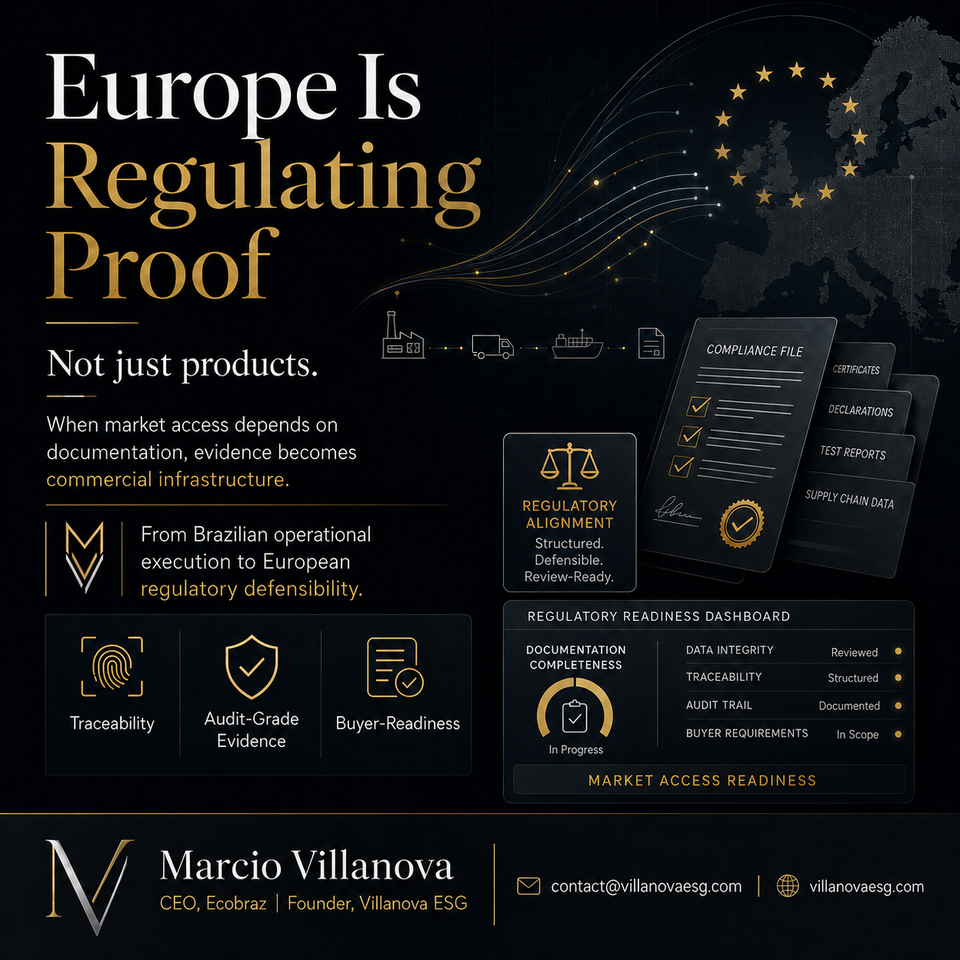
Europe is not only regulating products. It is regulating the evidence behind products.
That distinction matters. A product may be commercially accepted, technically competitive and operationally viable. But if the supplier cannot prove compliance through recognised documentation, official controls, traceability records and buyer-readable evidence, the commercial risk shifts from operational performance to regulatory defensibility.
Risk Layer 01
Country Listing
The EU uses positive lists and approval mechanisms for third countries, regions and product categories. Market access can depend on whether the country or region is authorised for the relevant product flow.
Risk Layer 02
Official Certification
Products of animal origin entering the EU may require official certificates, attestations, competent-authority validation and border controls. Documentation becomes part of the commercial infrastructure.
Risk Layer 03
Buyer Defensibility
European buyers increasingly need evidence they can show internally to compliance, legal, procurement, audit, lenders and boards. Supplier claims are not enough.
Executive Interpretation
The New Question Is Not “Is the Product Good?”
The new question is:
Can the supplier prove, in a European-readable format, that the product, process, documentation and control system are review-ready?
Why This Matters Beyond the Animal-Protein Sector
The antimicrobial case is sector-specific. The strategic pattern is not.
Across Europe-facing supply chains, different regulatory instruments are producing the same commercial effect. CSDDD, EUDR, CBAM, CSRD, Scope 3 reporting, product traceability rules, sanitary controls and sustainability due diligence frameworks all increase the pressure on companies to move from narrative to evidence.
They do not all apply to the same sectors, products or companies. They do not create identical obligations. But they point in the same direction: European market access is becoming evidence-based.
The Supplier Risk Formula
For CFOs, procurement leaders and boards, the risk is not limited to regulatory non-compliance. The financial exposure emerges when a supplier cannot produce credible proof at the moment of review.
Market-Access Risk = Operational Exposure × Evidence Gap × Buyer Dependency
A supplier with operational exposure but strong documentation may be review-ready. A supplier with similar exposure and weak documentation can become a contract-continuity risk.
What European Buyers May Start Asking
For Brazilian suppliers, the critical shift is not only regulatory. It is commercial. European buyers may increasingly ask questions that sit between legal, procurement, ESG, finance and operational control.
- Can the supplier document the origin, process and control chain?
- Can the competent authority, certifier or auditor validate the relevant data?
- Can the buyer rely on the documentation during internal risk review?
- Can the supplier provide evidence before contract renewal, not after an incident?
- Can the evidence be understood by European compliance, legal and board-level stakeholders?
These questions are not soft sustainability questions. They are continuity, margin, onboarding and market-access questions.
CFO Lens
Documentation Is Becoming Commercial Infrastructure
A supplier may treat documentation as administrative cost. A European buyer may treat the same documentation as a condition for risk acceptance.
That mismatch creates financial friction. It can delay onboarding, complicate renewal, increase audit cost, weaken lender confidence and expose procurement teams to supplier-substitution decisions.
The Brazil-Europe Evidence Gap
Brazilian operations often have execution capacity, sector knowledge and cost competitiveness. The gap is frequently not the existence of activity. The gap is whether the activity is translated into evidence architecture that European stakeholders can review.
That is the structural problem Villanova ESG was built to address.
Ecobraz proves operational execution in Brazil. Villanova ESG translates operational proof into European-facing regulatory evidence architecture for CFOs, boards, compliance teams and buyers assessing cross-border supply-chain exposure.
What Brazilian Suppliers Should Avoid
- Generic ESG claims without evidence.
- Unstructured documents spread across departments.
- Late-stage documentation after buyer pressure.
- Assuming domestic acceptance equals European defensibility.
- Treating compliance as communication instead of control evidence.
What European Buyers Should Request
- Traceability documents mapped to product and supplier risk.
- Competent-authority or third-party records where applicable.
- Audit-grade evidence packages before renewal or onboarding.
- Clear supplier responsibility matrices.
- Evidence that can be reviewed by compliance, finance and legal teams.
Decision Trigger for CFOs and Boards
If a supplier is exposed to European buyers, the board should not ask only whether the supplier is operationally capable.
The board should ask whether the supplier can produce evidence that survives European review.
Strategic Interpretation
The antimicrobial case should not be used as alarmism. It should be used as a warning signal.
The European market is not moving toward less documentation. It is moving toward more structured proof. Not every rule applies to every company. Not every supplier faces the same risk. But the direction is clear: evidence gaps are becoming commercial risks.
For Brazil, the opportunity is not to respond with generic sustainability language. The opportunity is to build a stronger evidence layer between operational execution and European regulatory review.
Villanova ESG Position
From Brazilian Execution to European Regulatory Defensibility
Villanova ESG supports companies that need to translate operational proof into European-facing regulatory evidence architecture.
The objective is not to promise risk zero, guaranteed compliance or automatic market access. The objective is to reduce evidence gaps, improve buyer-readiness and support board-level documentation for cross-border supply-chain exposure.
Regulatory Source Trail
- European Commission — Access2Markets: Health and consumer protection for animal and plant products. https://trade.ec.europa.eu/access-to-markets/en/content/health-and-consumer-protection-animal-and-plant-product
- European Commission — Food Safety: Non-EU countries authorised establishments. https://food.ec.europa.eu/food-safety/biological-safety/food-hygiene/non-eu-countries-authorised-establishments_en
- European Commission — Food Safety: Products of animal origin for human consumption. https://food.ec.europa.eu/animals/animal-products-movements/products-animal-origin-human-consumption_en
- EUR-Lex — Commission Implementing Regulation (EU) 2024/2598. https://eur-lex.europa.eu/legal-content/en/ALL/?uri=CELEX:32024R2598
- EUR-Lex — Regulation (EU) 2019/6 on veterinary medicinal products. https://eur-lex.europa.eu/legal-content/EN/TXT/?uri=CELEX:32019R0006
Confidential EU-Brazil Supply Chain Risk Review
For CFOs, boards, procurement leaders and compliance teams assessing Brazilian supplier exposure to European regulatory review, Villanova ESG provides cross-border evidence architecture and buyer-readiness support.
Contact: contact@villanovaesg.com