
Evidence-Based ESG Is Becoming Strategic Infrastructure
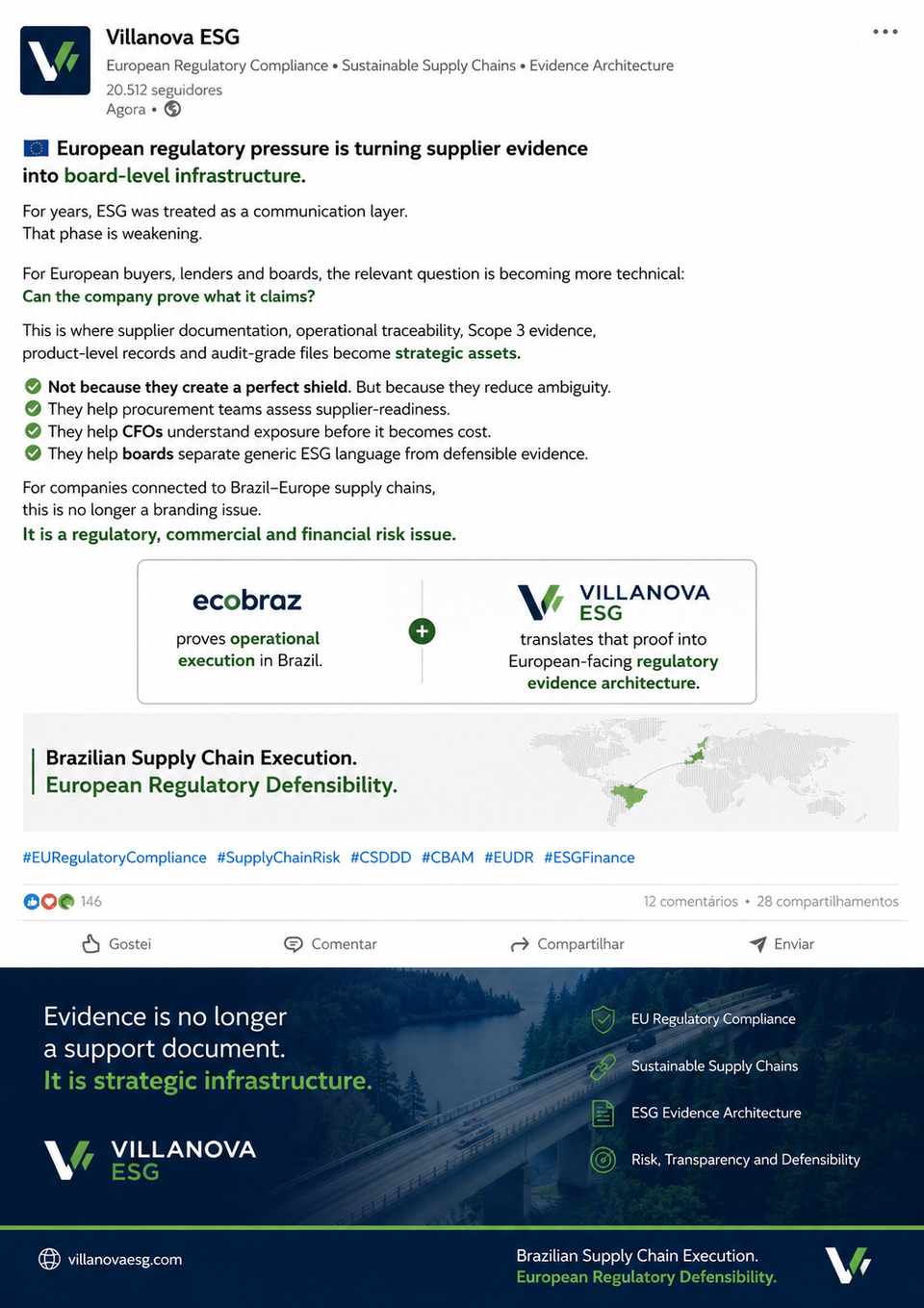
Executive Regulatory Briefing
Evidence-Based ESG Is Becoming Strategic Infrastructure
European regulatory pressure is changing the value of ESG. Generic positioning is losing strategic weight. Evidence, traceability and audit-grade documentation are becoming infrastructure for commercial continuity, supplier acceptance and board-level risk control.
Risk Signal
Supplier evidence is becoming a procurement filter.
CFO Relevance
Documentation gaps can become cost, delay or contract friction.
Board Relevance
Claims without evidence create governance exposure.
The Market Is Moving From ESG Claims to Evidence Discipline
For years, ESG was often treated as a communication layer. That phase is weakening. European buyers, lenders and boards are no longer asking only whether a company has a sustainability narrative. They are asking whether the company can support that narrative with operational proof.
This shift matters for Brazil-Europe supply chains. The issue is not cosmetic. It is commercial, regulatory and financial. A supplier may have operational quality, but if evidence is fragmented, unverifiable or not organized for European-facing review, the buyer may still classify the relationship as higher risk.
Operational Traceability
Evidence must connect activity, supplier, material flow, destination, documentation and responsible parties.
Audit-Grade Documentation
Files must be structured for external review, not only stored for internal administration.
Board-Level Defensibility
Evidence must reduce ambiguity for procurement, finance, legal, compliance and governance teams.
CFO Risk Logic
Weak Evidence Has a Financial Conversion Path
Documentation weakness does not always appear first as a fine. In many cases, it appears earlier as procurement hesitation, contract delay, onboarding friction, lender doubt, buyer-side risk classification or additional verification cost.
Regulatory Exposure Cost = Verification Cost + Delay Cost + Contract Friction + Remediation Cost + Lost Margin Risk
This model requires internal company data. Villanova ESG does not invent values. CFO-grade assessment requires contract value, shipment frequency, documentation maturity, buyer concentration, product category and exposure to EU-facing regulatory demands.
Why European Regulation Raises the Value of Evidence
The direction of travel is clear. European regulation is increasing scrutiny over corporate due diligence, carbon exposure, deforestation-linked commodities, product-level information and supply-chain documentation. The practical consequence is direct: suppliers must be prepared to support buyer questions with organized, verifiable evidence.
- CSDDD reinforces the importance of identifying and addressing human rights and environmental risks across operations and value chains.
- CBAM moves covered imports into a definitive regime from 2026, increasing the relevance of emissions-related information for affected sectors.
- EUDR increases pressure for deforestation-free evidence for relevant commodities and derived products.
- Digital Product Passport developments increase the relevance of product-level data architecture and traceability.
The Brazil-Europe Evidence Gap
Brazilian suppliers may have real operational execution. The problem is that execution alone does not automatically become European-facing regulatory evidence.
This is the gap Villanova ESG addresses: transforming operational proof into structured evidence architecture that can be reviewed by buyers, CFOs, compliance teams, legal departments and boards.
Decision Trigger for CFOs
The Critical Question Is Not “Do We Have ESG?”
The critical question is:
Can the company prove its operational claims under buyer, lender or board-level scrutiny?
If the answer is unclear, the exposure is not only reputational. It may affect commercial continuity, pricing power, onboarding speed, lender confidence and buyer-side risk classification.
What Evidence-Based ESG Requires
1. Evidence Inventory
A clear map of documents, certificates, operational records, supplier files and traceability data.
2. Regulatory Relevance Mapping
Classification of which evidence matters for CSDDD, CBAM, EUDR, CSRD, Scope 3 or product-level scrutiny.
3. Buyer-Ready Structure
Documentation organized in a format that procurement, legal, compliance and finance teams can review.
4. Defensibility Logic
A clear explanation of what the evidence proves, what it does not prove and where additional controls are required.
Regulatory Source Trail
- European Commission — Corporate Sustainability Due Diligence Directive, Directive 2024/1760.
- European Commission — Carbon Border Adjustment Mechanism.
- European Commission — EU Deforestation Regulation implementation guidance.
- European Commission — Ecodesign for Sustainable Products Regulation and Digital Product Passport implementation context.
Villanova ESG
Brazilian Supply Chain Execution. European Regulatory Defensibility.
Ecobraz proves operational execution in Brazil. Villanova ESG translates that proof into European-facing regulatory evidence architecture for buyers, CFOs, compliance teams and boards.
For executive review: contact@villanovaesg.com