
Tier 3 Traceability: How the Lack of Georeferenced Data Paralyzes Logistical Operations
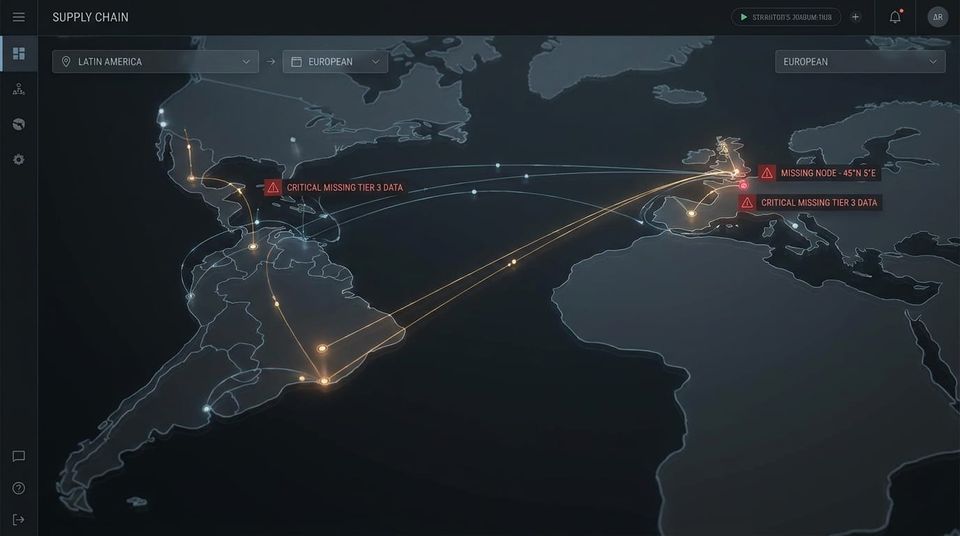
The Illusion of Tier 1 Compliance
For decades, supply chain management operated on a principle of immediate proximity. Knowing your direct (Tier 1) suppliers was considered sufficient risk management. In 2026, under the enforcement regimes of the European Union Deforestation Regulation (EUDR) and the Corporate Sustainability Due Diligence Directive (CSDDD), this operational model is legally obsolete.
European customs authorities do not stop their scrutiny at your direct manufacturing partner. They demand absolute, cryptographic visibility into the exact origin of the raw materials—the Tier 3 suppliers at the very base of the chain. If a Brazilian exporter cannot provide precise geolocation coordinates linking the final exported product to the specific plot of land where it was harvested or extracted, the logistical operation faces immediate paralysis.
The Mechanics of Logistical Paralysis
The European regulatory architecture relies on automated data cross-referencing. When a cargo arrives at a European port, the importer’s Due Diligence Statement is verified against the EU Information System.
- The Geolocation Mandate: For commodities covered by the EUDR, operators must provide exact GPS points. For plots of land larger than 4 hectares, full polygon mapping is a strict legal requirement.
- Customs Retention: If the georeferenced data for a Tier 3 supplier is missing, inaccurate, or overlaps with flagged risk areas, the cargo will not be authorized for release. It is retained indefinitely by customs authorities.
- The Demurrage Hemorrhage: Logistical paralysis instantly attacks the Profit and Loss (P&L) statement. Stranded containers accrue severe daily demurrage and port storage fees. Within weeks, the operational cost of retention can exceed the commercial value of the cargo itself, completely wiping out the EBITDA margin of the operation.
(Source reference: Official European Commission EUDR implementation guidelines regarding geolocation and traceability).
The Blind Spot of Indirect Suppliers
The highest concentration of corporate risk lies in the invisible layers of the supply chain. Many Brazilian exporters rely on intermediaries, cooperatives, or aggregators who mix raw materials from hundreds of unverified Tier 3 sources.
Relying on commercial invoices or self-declared sustainability questionnaires from these intermediaries is a mathematical gamble. European regulators treat unmapped origin data as a presumption of non-compliance. A single unverified hectare deep within your indirect supply base can legally contaminate a multi-million-dollar export shipment, triggering a breach of contract with your European buyer.
The Villanova ESG Shield: Strategic Intervention
At Villanova ESG, we operate on the premise that what you cannot georeference, you cannot legally export to Europe. We eliminate the Tier 3 blind spot through forensic data architecture. We secure your logistical continuity through our four uncompromising pillars:
- Cross-Border Regulatory Shield: We architect traceability systems that penetrate deep into your supply base. We extract the exact georeferenced polygons required by European customs, structuring this data to match the EU Information System protocols flawlessly, preventing border retentions.
- Logistical Reality Audit: We bypass generic supplier questionnaires. We execute aggressive, end-to-end audits down to the Tier 3 level. By mapping the physical and geographical reality of your indirect suppliers, we eliminate the hidden compliance risks that paralyze logistical operations.
- P&L and Revenue Protection: We defend your cash flow from the devastating costs of border paralysis. By guaranteeing continuous market access through verified geolocation data, we protect your revenue lines from catastrophic demurrage fees, cargo confiscation, and lost commercial contracts.
- Cost of Capital Optimization: Deep-tier georeferenced traceability is the exact operational metric demanded by international credit committees. We leverage your audited Tier 3 data to structure Sustainability-Linked Loans (SLLs), converting extreme logistical rigor into a financial lever that actively reduces your Weighted Average Cost of Capital (WACC).
Unmapped indirect suppliers are a direct threat to your logistical continuity and corporate valuation. Do not let missing georeferenced data paralyze your European operations. Contact our risk assessment team immediately to structure your cross-border regulatory shield and audit your Tier 3 reality at contact@villanovaesg.com
Marcio Villanova CEO, Ecobraz | Founder, Villanova ESG