
The Hidden Cost of Being an Unreadable Supplier
EU-Brazil Supplier Evidence Dossier
The Hidden Cost of Being an Unreadable Supplier
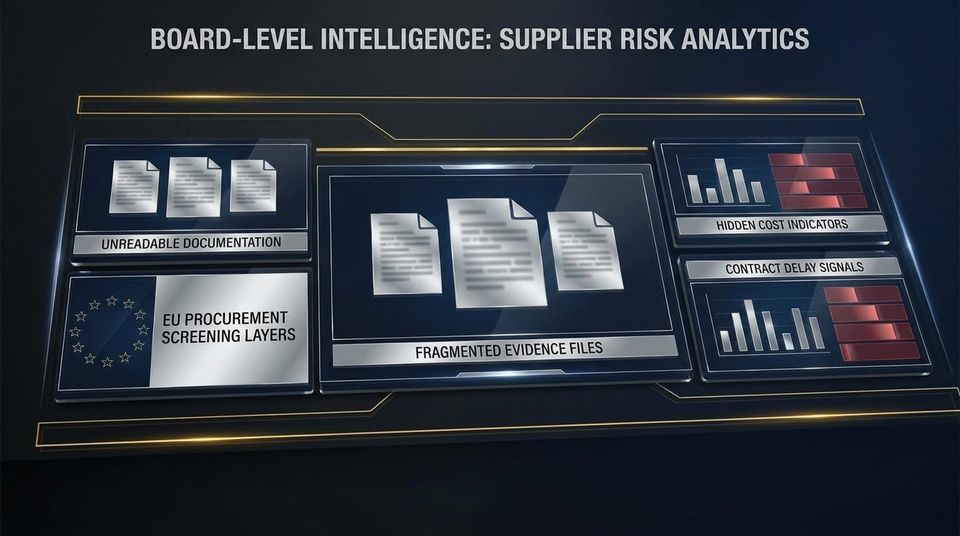
Brazilian suppliers may be operationally capable and still commercially unreadable to European buyers. The hidden cost appears before rejection: in delays, rework, internal friction and declining procurement confidence.
Cost Driver
Rework
Every unclear file forces buyer and supplier teams to rebuild evidence.
Buyer Friction
Delay
Unclear evidence extends onboarding, approval and contract review cycles.
Commercial Signal
Low Control
Unreadable documentation suggests weak internal management discipline.
CFO Exposure
Lost Margin
Evidence friction consumes time, attention and negotiation strength.
Unreadable Does Not Mean Non-Compliant
A Brazilian supplier can have legitimate operations, real controls, technical quality and relevant documentation. Still, from the buyer’s perspective, the supplier may remain unreadable.
Unreadable does not automatically mean illegal. It means difficult to understand, difficult to verify, difficult to compare and difficult to defend inside the buyer’s internal decision process.
That distinction matters because European buyers rarely evaluate supplier evidence in isolation. Procurement, compliance, legal, finance, sustainability and risk teams may all touch the same supplier file. If each function must reinterpret the evidence from zero, the supplier becomes operationally heavy before price is even negotiated.
Unreadable Supplier
An unreadable supplier is not necessarily a weak supplier. It is a supplier whose operational reality cannot be quickly translated into buyer-readable evidence, risk logic and board-level documentation.
The Hidden Cost Structure
The cost of being unreadable does not usually appear as a direct penalty. It appears as friction.
Friction is expensive because it slows decision-making. It forces repeated clarification. It creates internal buyer doubt. It increases the probability that the buyer selects a supplier whose evidence is easier to process.
Direct Friction
- Repeated document requests.
- Longer onboarding cycles.
- Procurement review delays.
- Contract approval interruptions.
- Clarification calls with multiple departments.
Strategic Friction
- Reduced buyer confidence.
- Weaker negotiating position.
- Lower supplier priority.
- Higher perceived replacement risk.
- Lower probability of category expansion.
Finance-Grade Formula: Unreadable Supplier Cost
A practical internal model for estimating the hidden financial cost of unreadable supplier evidence:
USC = (RT × IC × DR) + (OR × LP)
- USC = Unreadable Supplier Cost
- RT = Rework Time required to clarify evidence
- IC = Internal Cost per review cycle
- DR = Delay Risk applied to commercial process
- OR = Opportunity Revenue under buyer review
- LP = Loss Probability linked to evidence friction
This formula requires internal company data. Villanova ESG does not invent financial exposure values. Without review time, buyer-cycle data, contract value and loss probability assumptions, the formula must remain a decision framework rather than a numerical claim.
The Buyer’s Internal Cost Becomes the Supplier’s Commercial Risk
When supplier evidence is unreadable, the buyer carries the interpretation burden.
Procurement must request more documents. Compliance must interpret local evidence. Legal must assess unclear claims. Finance must understand whether risk affects continuity, price or contract terms. Sustainability teams must reconcile supplier data with reporting needs.
The supplier may think the buyer is asking for excessive information. The buyer may think the supplier is creating internal cost.
Where Buyer Cost Converts Into Supplier Risk
- Procurement may deprioritise the supplier.
- Compliance may request enhanced due diligence.
- Legal may delay contract approval.
- Finance may flag continuity uncertainty.
- Risk teams may classify the supplier as difficult to defend.
- The buyer may choose a supplier with cleaner evidence architecture.
Unreadable Evidence Weakens Price Power
Price negotiation is not only about cost. It is also about confidence.
A supplier with weak or unreadable documentation gives the buyer a reason to demand concessions. The buyer may request more guarantees, longer review periods, stricter clauses, smaller initial volumes or additional documentation obligations.
In practice, unreadable evidence can reduce commercial leverage even when the supplier’s product is competitive.
Contract Friction
More clauses, more conditions, more internal review.
Volume Friction
Lower initial allocation until supplier evidence improves.
Margin Friction
Buyer uncertainty can translate into stronger commercial pressure.
Decision Trigger for CFOs
A CFO should treat unreadable supplier evidence as a financial risk when:
- European buyers keep asking for clarification after documents are submitted.
- Supplier onboarding takes longer than expected because evidence is fragmented.
- Commercial teams cannot explain documentation gaps in buyer language.
- Procurement conversations slow down before price negotiation.
- Legal, compliance or sustainability teams request additional supplier controls.
- The company loses opportunities without clear feedback from the buyer.
- Contracts include heavier evidence, audit or termination clauses than expected.
The Strategic Correction
The correction is not to produce more generic ESG content. The correction is to make the supplier readable.
That requires evidence architecture: mapping operational proof, organising documentation, identifying gaps, translating local execution into European buyer logic and preparing a supplier file that can move across procurement, compliance, finance and board review.
The supplier that becomes readable reduces buyer friction. The supplier that remains unreadable forces the buyer to carry the cost of interpretation.
Regulatory Source Trail
This dossier is based on the direction of EU supply-chain due diligence, traceability, product data and carbon documentation frameworks. The commercial implication is clear: suppliers that cannot structure evidence in a buyer-readable format create hidden cost for European procurement systems.
- European Commission — Corporate Sustainability Due Diligence Directive.
- European Commission — Carbon Border Adjustment Mechanism.
- European Commission — EU Deforestation Regulation implementation materials.
- European Commission — Ecodesign for Sustainable Products Regulation.
- European Commission — Digital Product Passport implementation architecture.
- European Commission — Corporate Sustainability Reporting Directive and ESRS supplier-data implications.
EU-Brazil Supply Chain Risk Review
Villanova ESG helps Brazilian suppliers and European-facing companies convert operational proof into buyer-readable evidence for procurement review, supplier due diligence and board-level documentation.
This is not a guarantee of buyer approval, market access, financing access or regulatory clearance. It is a disciplined evidence architecture process designed to reduce documentation gaps, clarify supplier risk and improve regulatory defensibility.
Contact: contact@villanovaesg.com