
From Brazilian Operational Proof to European Procurement Confidence
EU-Brazil Supplier Evidence Dossier
From Brazilian Operational Proof to European Procurement Confidence
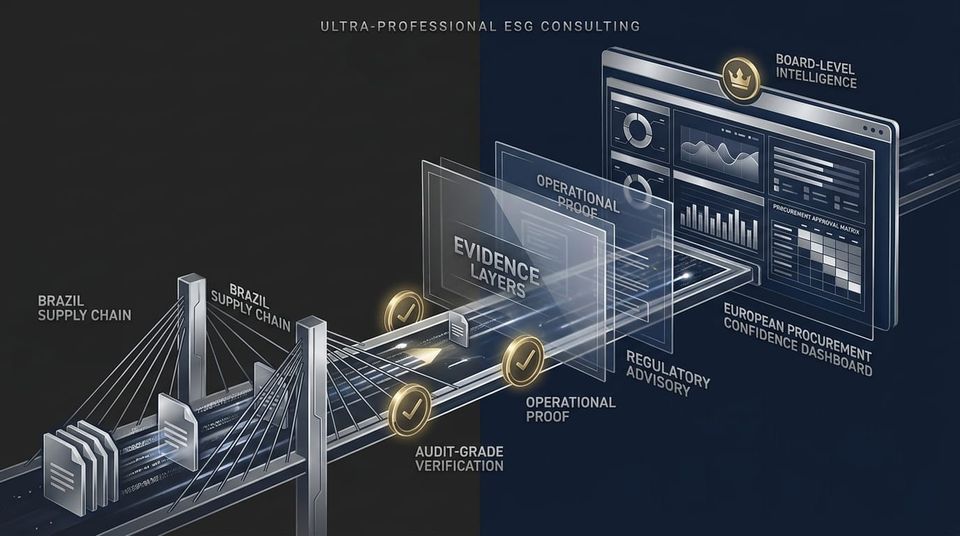
Brazilian execution only becomes European procurement confidence when operational proof is translated into structured, verifiable and buyer-readable evidence.
Brazilian Layer
Execution
Real operations, physical processes, supplier controls and field evidence.
Evidence Layer
Translation
Operational proof must be converted into buyer-readable documentation.
EU Buyer Layer
Confidence
European procurement needs evidence it can verify, compare and defend.
Board Layer
Defensibility
Supplier selection must survive internal governance and risk review.
Operational Proof Is Not the Same as Procurement Confidence
Brazilian suppliers often have real operational substance. They produce, collect, process, transform, transport, document and deliver. They solve physical problems inside complex supply chains.
But European procurement teams do not buy operational substance alone. They need confidence that the supplier can be approved, monitored, explained and defended inside the buyer’s internal governance system.
That confidence does not come from generic ESG language. It comes from evidence architecture.
The commercial gap is not between Brazil and Europe as markets. The gap is between Brazilian operational proof and European buyer-readable evidence.
Procurement Confidence
Procurement confidence is the buyer’s ability to approve, justify and maintain a supplier relationship because the supplier’s evidence is structured, verifiable, risk-aware and usable across internal decision functions.
The Translation Problem
A Brazilian supplier may know exactly how its operation works. Its teams may understand the process, the suppliers, the risks, the documents and the operational controls.
The European buyer does not have that internal context.
The buyer sees documents, claims, declarations, certificates, invoices, technical sheets, supplier responses and risk signals. If those elements are not structured into a clear evidence file, the buyer must reconstruct the supplier’s reality from fragments.
What Brazil Often Has
- Physical execution.
- Local operational knowledge.
- Internal supplier history.
- Technical documentation.
- Process records.
- Field-level evidence.
What Europe Needs
- Buyer-readable evidence.
- Traceability logic.
- Risk classification.
- Documentation hierarchy.
- Source trail.
- Board-level defensibility.
Finance-Grade Formula: Procurement Confidence Index
A practical internal model for evaluating whether Brazilian operational proof can support European procurement confidence:
PCI = (OP × EV × BR × RD) ÷ FG
- PCI = Procurement Confidence Index
- OP = Operational Proof
- EV = Evidence Verifiability
- BR = Buyer Readability
- RD = Risk Disclosure Quality
- FG = Fragmentation Gap
This model requires internal evidence mapping, supplier documentation review and buyer requirement analysis. It should not be used as a numerical claim without company-specific inputs.
Why Procurement Confidence Matters Before Scale
European buyers rarely scale a supplier relationship on technical ability alone. They need to understand whether the supplier can remain defensible as volumes grow, regulatory scrutiny increases and internal reporting obligations expand.
This is why procurement confidence is built before scale.
Where Confidence Is Tested
- Initial supplier screening.
- Due diligence questionnaires.
- Procurement committee review.
- Legal and contract review.
- Carbon or origin data requests.
- Traceability documentation review.
- Supplier risk classification.
- Contract renewal and volume expansion.
The Buyer Does Not Need a Perfect Supplier. It Needs a Defensible Supplier.
This is the central point Brazilian suppliers often miss.
European procurement does not necessarily expect suppliers to have zero gaps. But it does need suppliers to understand their exposure, disclose gaps with discipline and present evidence in a format the buyer can use internally.
A supplier that hides gaps creates mistrust. A supplier that cannot explain gaps creates uncertainty. A supplier that maps gaps and structures evidence creates a stronger basis for procurement confidence.
Operational Proof
Shows that the supplier can execute.
Evidence Architecture
Shows that the supplier can document and explain execution.
Procurement Confidence
Shows that the buyer can defend the supplier relationship.
Decision Trigger for CFOs
A CFO should treat procurement confidence as a strategic priority when:
- The company depends on European buyers or European-facing supply chains.
- Commercial teams receive supplier evidence requests before price negotiation.
- Operational proof exists, but there is no structured buyer-facing evidence file.
- Traceability, origin, product data, carbon or supplier-risk questions are recurring.
- Evidence is dispersed across procurement, operations, legal, finance and ESG teams.
- European buyers delay onboarding because documentation is unclear or incomplete.
- The company wants to convert operational execution into stronger commercial defensibility.
The Strategic Bridge
The strategic advantage is not to make Brazilian suppliers sound more sustainable. The advantage is to make Brazilian suppliers easier to approve, easier to defend and easier to keep inside European procurement files.
That requires a bridge between execution and evidence.
Ecobraz proves what happens in the Brazilian operation. Villanova ESG translates that proof into regulatory evidence European boards, CFOs and compliance teams can use.
From Brazilian execution to European regulatory defensibility, the value is not the claim. The value is the evidence.
Regulatory Source Trail
This dossier is based on the direction of EU supply-chain due diligence, traceability, product evidence, carbon data and supplier-risk frameworks. The commercial implication is clear: operational proof must be translated into buyer-readable evidence before it can support procurement confidence.
- European Commission — Corporate Sustainability Due Diligence Directive.
- European Commission — Carbon Border Adjustment Mechanism.
- European Commission — EU Deforestation Regulation implementation materials.
- European Commission — Ecodesign for Sustainable Products Regulation.
- European Commission — Digital Product Passport implementation architecture.
- European Commission — Corporate Sustainability Reporting Directive and ESRS supplier-data implications.
EU-Brazil Supply Chain Risk Review
Villanova ESG helps Brazilian suppliers and European-facing companies convert operational proof into buyer-readable evidence for procurement confidence, supplier due diligence and board-level regulatory defensibility.
This is not a guarantee of buyer approval, market access, financing approval or regulatory clearance. It is a disciplined evidence architecture process designed to reduce documentation gaps, clarify supplier risk and improve the quality of evidence before European buyers make procurement decisions.
Contact: contact@villanovaesg.com