
The 30-Day Supplier Evidence Review: What Brazilian Companies Should Fix First
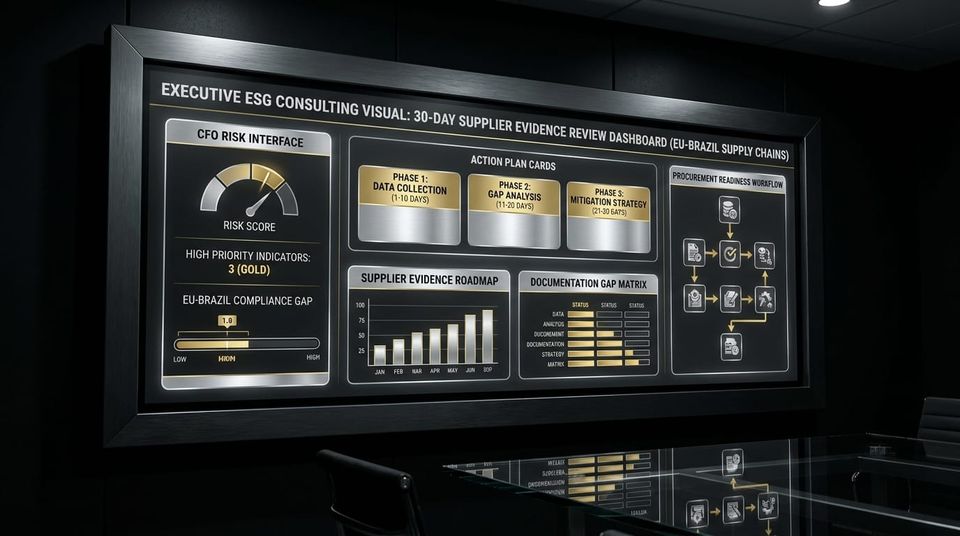
30-Day Supplier Evidence Review
The 30-Day Supplier Evidence Review: What Brazilian Companies Should Fix First
Brazilian suppliers do not need a generic ESG project before approaching European buyers. They need a focused evidence review that identifies what can block buyer confidence, delay contract approval or weaken commercial leverage within the first 30 days.
Commercial Priority
Fix What Blocks Revenue
The first review should focus on evidence gaps that can delay buyer approval, contract signature or purchase order conversion.
CFO Problem
Too Many Documents
Most suppliers do not lack paperwork. They lack evidence architecture, priority order and buyer-readable structure.
Strategic Response
30-Day Review
A focused review creates a short, disciplined path from scattered documentation to buyer-readiness.
The first 30 days should not try to solve everything
Brazilian companies exposed to European buyers often make the same mistake when regulatory pressure appears. They try to build a broad ESG project before solving the specific evidence gap that can affect the next commercial decision.
That approach is too slow for sales, too generic for procurement and too imprecise for CFOs. A company preparing for a European buyer, tender, contract renewal or supplier questionnaire needs a sharper starting point.
The first 30 days should identify the evidence gaps most likely to create buyer friction. Not every gap has the same financial consequence. Not every document has the same commercial value.
The central CFO question
Which evidence gaps could stop, delay or weaken a European buyer decision within the next commercial cycle?
The 30-day review sequence
A 30-day supplier evidence review should follow a strict sequence. The objective is not to create a complete transformation program. The objective is to expose the highest-risk gaps and prepare the company for buyer-facing conversations.
Days 1-3: Define buyer exposure
Identify the European buyer, product category, contract stage, revenue value, buyer dependency, sector exposure and regulatory pressure points. The review must start with the commercial risk, not with a generic document inventory.
Days 4-7: Map evidence requests
List the buyer’s likely questions on origin, traceability, carbon, supplier due diligence, ESG claims, product data, contract clauses and audit rights. If the buyer already sent a questionnaire, use it as the primary risk map.
Days 8-12: Build the evidence inventory
Collect current documents from operations, legal, finance, logistics, quality, commercial, compliance and sustainability teams. The goal is to determine what exists, who owns it and whether it supports buyer claims.
Days 13-17: Separate proof from claims
Identify which supplier statements are fully evidenced, partially evidenced, unsupported or too broad. This step is essential because unsupported claims create buyer distrust and contract risk.
Days 18-22: Score buyer-readiness
Score the evidence using practical criteria: depth, traceability, consistency, buyer readability, regulatory relevance and contract support capacity. Weak areas should be ranked by commercial consequence.
Days 23-26: Build the corrective priority list
Define what must be fixed immediately, what can be explained to the buyer, what requires operational correction and what should not be claimed until evidence improves.
Days 27-29: Prepare the executive file
Structure the buyer-facing evidence file with a concise executive summary, document index, risk notes, gap register and corrective action sequence.
Day 30: Decide the commercial posture
Decide whether the company is ready to approach the buyer, needs a limited correction cycle or should avoid making certain claims until evidence is stronger.
The 30-day evidence priority model
The company should not fix evidence gaps randomly. The first priority should be the gap with the highest commercial consequence.
EPI = EG × BV × AF × TS × CS
EPI = Evidence Priority Index
EG = Evidence Gap Severity
BV = Buyer Value
AF = Approval Friction
TS = Time Sensitivity
CS = Contract Support Relevance
This model does not replace legal, technical or audit review. It helps management decide what to fix first when time, buyer pressure and revenue exposure matter.
What Brazilian companies should fix first
The first corrections should target evidence gaps that can directly affect buyer confidence, contract approval or revenue conversion. In most EU-facing supplier reviews, the priority order is clear.
1. Unsupported buyer claims
Remove, narrow or evidence claims that cannot be supported. Unsupported claims are dangerous because they can trigger buyer distrust and contract exposure.
2. Weak origin and traceability logic
Strengthen the connection between product, origin, supplier chain, shipment, facility and documentation records.
3. Inconsistent questionnaire answers
Align commercial, legal, operations, compliance and sustainability responses before the buyer detects contradictions.
4. Carbon or product data gaps
For CBAM-exposed or carbon-sensitive categories, clarify data sources, boundaries, methodology assumptions and evidence quality.
5. Contract clause misalignment
Compare supplier obligations in buyer contracts with actual evidence capacity before signing broad commitments.
6. No executive evidence summary
Build a concise buyer-readable file showing what is proven, what is partial, what is missing and what is being corrected.
The CFO impact of a 30-day evidence review
A 30-day evidence review does not eliminate risk. It gives management visibility. It helps CFOs understand whether documentation weakness can affect buyer approval, contract timing, revenue probability, margin pressure or board-level confidence.
Revenue protection logic
Review Value = Revenue Exposure × Evidence Gap Reduction × Approval Friction Reduction
Internal company data is required to estimate this properly. Villanova ESG does not infer financial impact without opportunity value, buyer concentration, product category, evidence maturity, contract timing and approval process visibility.
The mistake to avoid: turning the first review into a broad ESG transformation
A broad ESG transformation may be useful in some contexts. But it is not the right starting point when a European buyer is already asking questions, preparing a contract or reviewing supplier risk.
In that moment, the company needs evidence triage. What blocks the buyer? What weakens trust? What creates contract exposure? What should be corrected before the next meeting?
The first 30 days should produce decision clarity, not a generic sustainability roadmap.
Decision Trigger for CFOs and Commercial Directors
A Brazilian company should start a 30-day supplier evidence review when:
- A European buyer has requested supplier evidence, traceability, origin, carbon data, ESG documentation or due diligence responses.
- The company is preparing for a strategic buyer meeting, tender, contract renewal or distributor negotiation.
- The buyer contract includes audit rights, reporting duties, sustainability representations, supplier code commitments or termination clauses.
- The product may be exposed to CSDDD, CBAM, EUDR, CSRD, product traceability or value-chain reporting pressure.
- Documentation exists, but it is fragmented across departments.
- The commercial team is using claims that have not been tested against operational proof.
- The CFO needs to understand whether evidence weakness could affect revenue timing, buyer approval or negotiation leverage.
What Villanova ESG reviews in the first 30 days
Villanova ESG supports Brazilian suppliers, exporters and European-facing companies that need a focused evidence review before buyer scrutiny turns into commercial friction.
The review is not a legal opinion, certification, audit assurance, financial audit or guarantee of buyer acceptance. It is an executive evidence architecture review designed to identify what should be fixed first, what can be explained and what should not be claimed until evidence improves.
Supplier Evidence Readiness Review
30-day assessment of supplier documentation, buyer-readiness, evidence gaps, claim support and corrective priority order.
EU-Brazil Supply Chain Risk Review
Mapping of buyer exposure, regulatory pressure, supply-chain documentation gaps and commercial friction points in EU-Brazil relationships.
Board Evidence File Review
Structuring of the evidence file for executive, board-level and buyer-facing risk review.
Contract Clause Risk Review
Review of whether supplier evidence can support contractual commitments linked to reporting, audits, traceability, cooperation and supplier representations.
Regulatory Source Trail
This analysis is informed by official European regulatory and institutional materials, including:
- European Commission materials on the Corporate Sustainability Due Diligence Directive.
- European Commission materials on the Carbon Border Adjustment Mechanism and its definitive regime from 2026.
- European Commission materials on the Regulation on Deforestation-free Products and its application timeline.
- European Commission materials on Corporate Sustainability Reporting and ESRS-based reporting requirements.
- EFRAG implementation guidance related to value-chain sustainability information.
This article does not provide legal advice, certification, audit assurance, financial audit, buyer approval or regulatory clearance. It provides an executive risk and evidence architecture perspective for commercial decision-making.
The commercial conclusion
Brazilian companies do not need to solve every ESG, compliance or supply-chain issue before approaching European buyers. They need to know which evidence gaps can block the next commercial decision.
A 30-day supplier evidence review gives CFOs, commercial directors and boards a disciplined starting point: what is proven, what is partial, what is missing, what must be fixed first and what should not be claimed until documentation is stronger.
Executive Review
Fix the first evidence gaps before they become buyer objections.
Villanova ESG supports Brazilian suppliers, exporters, European buyers and board-level teams with 30-day Supplier Evidence Readiness Reviews, EU-Brazil Supply Chain Risk Reviews and Board Evidence File assessments.
For an executive review of your supplier evidence position, contact: contact@villanovaesg.com