
How to Estimate Financial Exposure From Weak Supplier Evidence
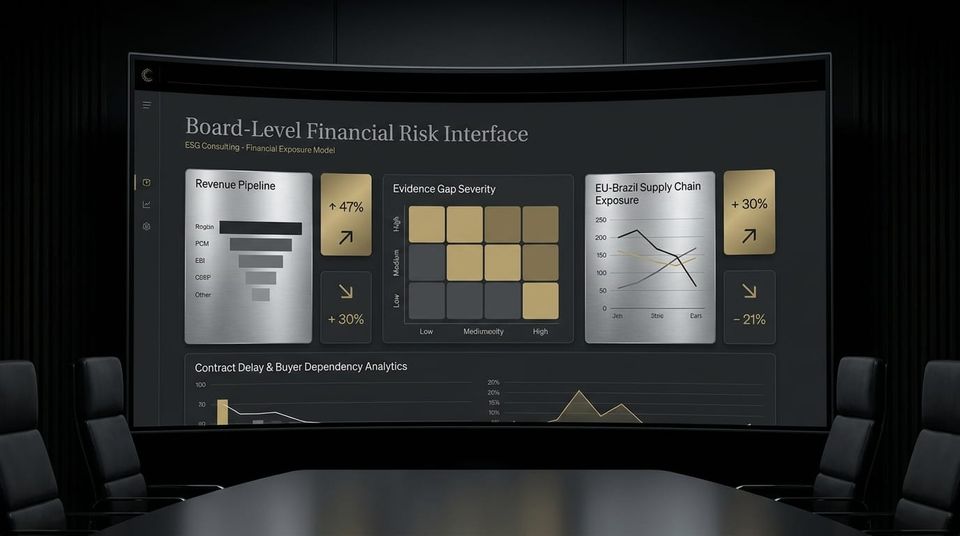
CFO Financial Exposure Model
How to Estimate Financial Exposure From Weak Supplier Evidence
Weak supplier evidence is not only a documentation issue. In EU-Brazil supply chains, it can affect buyer confidence, contract timing, revenue probability, negotiation leverage and board-level risk perception.
Financial Variable
Evidence Gap
Supplier evidence gaps can reduce buyer confidence before pricing, contract or volume discussions reach maturity.
CFO Exposure
Revenue Friction
The impact may appear as delayed onboarding, additional review, weaker leverage, contract caution or supplier substitution risk.
Strategic Response
Exposure Model
CFOs should quantify the commercial exposure before weak evidence becomes a buyer objection.
Weak evidence has a financial cost before it has a legal cost
Many companies treat supplier evidence as a compliance or sustainability file. That is too narrow. In European-facing supply chains, supplier evidence can influence commercial probability before any formal legal consequence appears.
A European buyer exposed to due diligence, deforestation-free product rules, carbon data obligations, sustainability reporting or product traceability expectations may request information from Brazilian suppliers. If the supplier cannot provide buyer-readable evidence, the buyer may slow the process, escalate the file internally or compare alternative suppliers with lower documentation friction.
The CFO should not wait for a penalty, dispute or contract loss to measure the risk. The exposure begins earlier: when evidence weakness reduces the probability that revenue converts on time and at expected margin.
The central CFO question
What portion of expected revenue, contract timing or buyer confidence is exposed because supplier evidence is incomplete, inconsistent or not buyer-readable?
The five financial channels of weak supplier evidence
Weak evidence does not affect the P&L through a single channel. It creates friction across commercial, contractual and operational decision points.
1. Revenue probability loss
The buyer may not reject the product immediately. But weak evidence can reduce the probability that the opportunity converts into a signed contract or purchase order.
2. Approval delay
Procurement may need to escalate the file to compliance, legal, finance or sustainability teams. Each escalation can delay onboarding, contract signature or order release.
3. Margin pressure
A supplier with weak evidence may face greater buyer caution, additional conditions, stronger indemnities or price pressure justified by perceived risk.
4. Contractual exposure
Weak evidence becomes dangerous when the supplier accepts clauses on traceability, reporting, audits, sustainability representations or indemnities without documentation capacity.
5. Supplier replacement risk
If the buyer sees the supplier as difficult to defend internally, the buyer may compare alternative suppliers that offer stronger evidence, even at similar product quality.
6. Working capital uncertainty
Delayed approval can affect shipment timing, inventory planning, production allocation, receivables timing and cash-flow predictability.
The financial exposure formula
The CFO should not estimate exposure with generic assumptions. The calculation needs company-specific data: expected contract value, buyer dependency, evidence maturity, regulatory exposure, approval process and timing sensitivity.
FEE = EV × BD × EGS × AF × TS
FEE = Financial Evidence Exposure
EV = Expected Value of the Opportunity or Contract
BD = Buyer Dependency
EGS = Evidence Gap Severity
AF = Approval Friction
TS = Time Sensitivity
This model does not produce a reliable number without internal data. It should be used as a disciplined exposure structure, not as a speculative estimate. The objective is to quantify where evidence weakness can affect revenue conversion, timing and negotiation leverage.
How to score each variable
Each variable should be scored using internal information, not intuition. The CFO should involve commercial, legal, compliance, operations, logistics and sustainability reporting teams where relevant.
Expected Value
Use expected annual revenue, contract value, order pipeline value or strategic account value. Do not use aspirational pipeline without probability adjustment.
Buyer Dependency
Score concentration risk. A high-dependency buyer creates greater exposure if evidence weakness delays approval or weakens confidence.
Evidence Gap Severity
Score the distance between buyer requests and current documentation. Missing traceability, carbon data, origin evidence or contract support increases severity.
Approval Friction
Score the likelihood that procurement will escalate the file to legal, compliance, sustainability reporting, finance or board-level review.
Time Sensitivity
Score how damaging delay is to revenue recognition, shipment schedules, inventory allocation, renewal timing, tender deadlines or strategic account positioning.
Three exposure levels CFOs should track
A supplier evidence review should separate financial exposure into three levels. This prevents management from treating all documentation gaps as equal.
Level 1: Friction exposure
The buyer requests additional documentation, clarification or questionnaire correction. The commercial process continues, but with added cost and delay.
Level 2: Negotiation exposure
Evidence weakness affects pricing, contractual obligations, audit rights, indemnities, delivery timing or buyer commitment.
Level 3: Revenue-at-risk exposure
The buyer delays approval, reduces volume, moves the supplier to a higher-risk category or evaluates alternative suppliers because the evidence file is not defensible.
Why this model matters for boards
Boards do not need generic statements about ESG readiness. They need to understand which revenue streams depend on buyer confidence, which evidence gaps can slow approval and which contracts may transfer documentation risk downstream.
A board-level discussion should not ask whether the company “has ESG documents.” It should ask whether supplier evidence can defend revenue in European-facing supply chains.
The financial exposure model helps shift the discussion from narrative to decision.
Decision Trigger for CFOs
A company should estimate financial exposure from weak supplier evidence when:
- A European buyer has requested origin, traceability, carbon, ESG, supplier risk or due diligence documentation.
- The company is preparing for a strategic European buyer, tender, distributor agreement or long-term supply contract.
- The buyer contract includes evidence, reporting, audit, cooperation, supplier code or termination clauses.
- The product may be exposed to CSDDD, CBAM, EUDR, CSRD, product traceability or value-chain reporting pressure.
- The company has high revenue concentration in one buyer, region or product category.
- The commercial team cannot clearly explain which claims are proven, partial or unsupported.
- Management suspects that documentation gaps may delay conversion, reduce leverage or increase contract risk.
What Villanova ESG reviews
Villanova ESG supports Brazilian suppliers, exporters and European-facing companies that need to quantify and structure the commercial exposure created by weak supplier evidence.
The review is not a legal opinion, certification, audit assurance, financial audit, valuation report or guarantee of buyer acceptance. It is an executive evidence architecture and exposure review designed to identify documentation gaps, estimate friction points and improve regulatory defensibility.
EU-Brazil Supply Chain Risk Review
Mapping of regulatory exposure, buyer evidence needs, supplier documentation gaps and financial friction points in Brazil-Europe supply chains.
Supplier Evidence Readiness Review
Assessment of whether supplier evidence is complete, consistent, traceable and buyer-readable before it affects revenue probability.
Board Evidence File Review
Structuring of evidence and exposure analysis for executive and board-level discussion.
Contract Clause Risk Review
Review of whether supplier evidence can support contractual commitments that may create financial exposure through reporting, audit, traceability or indemnity obligations.
Regulatory Source Trail
This analysis is informed by official European regulatory and institutional materials, including:
- European Commission materials on the Corporate Sustainability Due Diligence Directive.
- European Commission materials on the Carbon Border Adjustment Mechanism and its definitive regime from 2026.
- European Commission materials on the Regulation on Deforestation-free Products and its application timeline.
- European Commission materials on Corporate Sustainability Reporting and ESRS-based reporting requirements.
- EFRAG implementation guidance related to value-chain sustainability information.
This article does not provide legal advice, certification, audit assurance, financial audit, valuation advice, buyer approval or regulatory clearance. It provides an executive risk and evidence architecture perspective for commercial decision-making.
The commercial conclusion
Weak supplier evidence should be measured before it becomes a buyer objection. The CFO should treat evidence gaps as commercial exposure, not administrative inconvenience.
In EU-Brazil supply chains, documentation weakness can affect revenue probability, contract timing, buyer confidence and negotiation leverage. The companies that quantify the exposure early can correct the evidence file before the buyer prices the risk.
Executive Review
Estimate the exposure before the buyer turns evidence gaps into commercial risk.
Villanova ESG supports Brazilian suppliers, exporters, European buyers and board-level teams with EU-Brazil Supply Chain Risk Reviews, Supplier Evidence Readiness Reviews and Board Evidence File assessments.
For an executive review of your supplier evidence exposure, contact: contact@villanovaesg.com