
Supply Chain Finance (SCF): Punitive Rates for Non-Compliant Suppliers
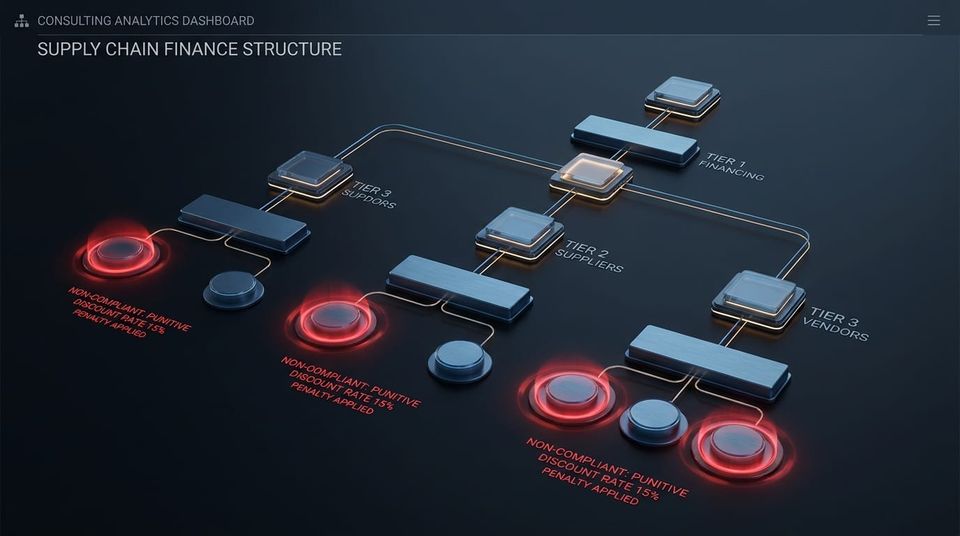
The Weaponization of Working Capital
Historically, Supply Chain Finance (SCF), or reverse factoring, functioned as a mutually beneficial liquidity mechanism. European buyers utilized their superior credit ratings to allow Latin American suppliers access to early invoice payments at low discount rates. In 2026, the architecture of SCF has been completely weaponized. Under the pressure of the Corporate Sustainability Due Diligence Directive (CSDDD), European matrices have transformed early payment programs into aggressive compliance enforcement mechanisms.
European buyers and their international banking partners now deploy ESG-linked SCF programs. Access to liquidity is no longer guaranteed by the commercial invoice alone; it is strictly gated by forensic environmental and social compliance data. If a Brazilian supplier cannot cryptographically prove full alignment with European decarbonization and traceability mandates, they are immediately downgraded within the SCF platform.
The Mathematics of Punitive Discount Rates
The financial impact of an SCF downgrade is immediate and severe, directly attacking the supplier's Cash Conversion Cycle (CCC). The matrix structures these programs into rigid tiers based on audit-proof compliance.
- The Tiered Liquidity Trap: Suppliers providing primary, verified data proving Scope 3 reductions and EUDR compliance are granted "Tier 1" status, accessing early payments at minimal discount rates. Suppliers operating with data voids or unverified sub-tier networks are relegated to "Tier 3."
- Punitive Capital Costs: For Tier 3 suppliers, the discount rate applied to early payments is mathematically punitive, often doubling or tripling the cost of capital. This penalty directly erodes the gross margin of the commercial transaction, destroying the profitability of the export contract.
- Total Exclusion and the Local Credit Squeeze: In severe cases of non-compliance, the European buyer will entirely block the supplier from the SCF platform. The Brazilian exporter is then forced to wait 90 to 120 days for invoice settlement. To survive this working capital hemorrhage, the CFO must turn to local domestic credit markets, absorbing astronomically high domestic interest rates that instantly annihilate the operation's EBITDA.
(Source reference: International Finance Corporation (IFC) guidelines on Sustainable Supply Chain Finance and European banking syndicate ESG integration frameworks).
The "Self-Assessment" Fallacy
Many suppliers attempt to maintain their Tier 1 SCF status by submitting generic self-assessment questionnaires (SAQs) or outdated local environmental licenses. In the current banking ecosystem, this data is obsolete.
International banks underwriting these SCF facilities operate under strict anti-greenwashing regulations (such as the SFDR). They require integration with digital platforms that verify primary supplier data in real-time. If your corporate data cannot interface with these banking algorithms through verified, third-party audited inputs, the system automatically defaults your status to high-risk, applying the maximum punitive discount rate.
The Villanova ESG Shield: Strategic Intervention
At Villanova ESG, we engineer your operational data to command premium liquidity. We do not allow data voids to destroy your working capital. We secure your access to elite Supply Chain Finance through our four uncompromising pillars:
- Cost of Capital Optimization: We architect your compliance data to unlock Tier 1 status in global SCF programs. By providing international banking syndicates with forensic, audit-proof ESG metrics, we guarantee you access to early liquidity at the lowest possible discount rates, structurally reducing your Weighted Average Cost of Capital (WACC).
- Cross-Border Regulatory Shield: We align your operational reporting directly with the CSDDD and EUDR mandates enforced by your European buyers. This ensures seamless interoperability with their ESG-linked finance platforms, neutralizing the threat of punitive rates or exclusion from early payment programs.
- Logistical Reality Audit: We dismantle the reliance on self-assessments. We execute deep-tier, georeferenced audits of your supply network, extracting the exact cryptographic reality required by international banks to underwrite your invoices as zero-risk, highly compliant assets.
- P&L and Revenue Protection: We protect your Cash Conversion Cycle (CCC). By defending your access to low-cost European liquidity, we insulate your balance sheet from the devastating working capital trap and the margin-crushing impact of relying on expensive local credit markets.
Operating without verified supply chain data guarantees punitive financial penalties on your commercial invoices. Do not let unmapped compliance risks destroy your working capital. Contact our risk assessment team immediately to structure your cross-border regulatory shield and optimize your supply chain finance strategy at contact@villanovaesg.com
Marcio Villanova CEO, Ecobraz | Founder, Villanova ESG