
Credit Ratings and the CSDDD: The Reclassification of Sovereign and Corporate Risk in Emerging Markets
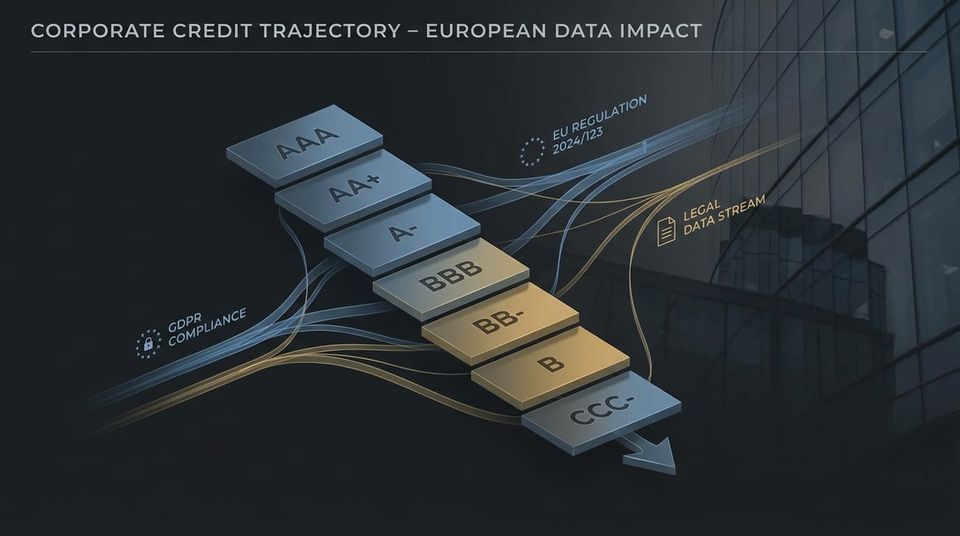
The Recalibration of Global Credit Metrics
The methodology for assessing creditworthiness in emerging markets has undergone a violent recalibration. The major international credit rating agencies—S&P, Moody’s, and Fitch—no longer treat environmental and social governance as supplementary qualitative factors. Under the shadow of the Corporate Sustainability Due Diligence Directive (CSDDD) and the Carbon Border Adjustment Mechanism (CBAM), these metrics have been integrated directly into the core algorithms that determine Probability of Default (PD) and Loss Given Default (LGD).
For Latin American corporations, this means the historical financial indicators—leverage ratios, cash reserves, and historical EBITDA—are no longer sufficient to guarantee an investment-grade rating. If a Brazilian corporation cannot mathematically prove its supply chain complies with European directives, rating agencies calculate a high probability of future severe revenue loss and confiscatory fines. The result is a structural downgrade of the corporate credit profile.
The Mechanics of the Rating Downgrade
The relationship between cross-border regulatory exposure and credit ratings is direct and punitive. Rating agencies evaluate a corporation's exposure to European market exclusions as a systemic liquidity risk.
- The Sovereign Ceiling Trap: The macroeconomic risk profile of the operating country heavily influences corporate ratings. As agencies assess Brazil’s systemic exposure to the EUDR (deforestation risk) or CBAM (carbon intensity), the sovereign rating ceiling faces downward pressure. This macroeconomic penalty automatically cascades down to local corporate issuers, compressing their ratings regardless of individual financial health.
- The ESG Score Penalty: Agencies now issue distinct ESG credit scores that directly impact the main corporate rating. A lack of deep-tier supply chain mapping or the presence of unverified Scope 3 emissions triggers a severe downgrade in the ESG profile. This flags the corporation as a high-risk entity to international debt syndicates.
- The High-Yield Exile: A rating downgrade from investment grade to high yield (junk status) is financially catastrophic. Institutional investors bound by strict fiduciary mandates are automatically forced to sell off the company’s bonds. This illiquidity instantly inflates the risk premium, making refinancing corporate debt prohibitively expensive.
(Source reference: Standard & Poor's, Moody's, and Fitch Ratings updated methodologies on integrating ESG credit factors and transition risks).
The Data Void as a Default Indicator
When credit analysts evaluate a corporation prior to a debt issuance or an annual rating review, they demand forensic proof of supply chain resilience. They look for the same georeferenced data and audited carbon metrics required by European customs.
Attempting to secure a favorable credit rating while operating with a data void—relying on estimated metrics or unmapped Tier 3 suppliers—is interpreted by the agencies as a gross governance failure. The assumption is that the company is mathematically guaranteed to collide with European enforcement mechanisms, triggering a sudden collapse in debt servicing capacity.
The Villanova ESG Shield: Strategic Intervention
At Villanova ESG, we engineer your operational data to clear the aggressive thresholds of international credit rating agencies. We prevent corporate downgrades by proving structural resilience against European regulatory shocks. We secure your capital structure through our four uncompromising pillars:
- Cost of Capital Optimization: An investment-grade rating is the ultimate lever for lowering the cost of debt. By providing credit analysts with forensic, audit-proof data proving your CSDDD and CBAM compliance, we defend your credit rating, ensuring continuous access to premium capital markets and structurally reducing your Weighted Average Cost of Capital (WACC).
- Cross-Border Regulatory Shield: We map your operational reality against the exact criteria utilized by global rating agencies to assess transition and physical risks. By aligning your corporate data architecture with European mandates, we neutralize the threat of sudden ESG-driven rating downgrades and protect your bond valuations.
- Logistical Reality Audit: We eliminate the data voids that trigger analyst red flags. We execute deep-tier, georeferenced audits of your physical supply network, delivering the primary data required to mathematically prove your operational continuity to international credit committees.
- P&L and Revenue Protection: We protect your balance sheet from the devastating financial impacts of a high-yield exile. By maintaining a robust credit rating through verified cross-border compliance, we defend your EBITDA margins from punitive refinancing rates and forced institutional divestments.
A lack of audited supply chain data is a direct trigger for a corporate rating downgrade. Do not leave your credit profile exposed to unquantified European regulatory risks. Contact our risk assessment team immediately to structure your cross-border regulatory shield and defend your corporate credit rating at contact@villanovaesg.com
Marcio Villanova CEO, Ecobraz | Founder, Villanova ESG