
Supplier Evidence Failure: Why One Weak File Can Contaminate Multiple EU Buyer Relationships
Villanova ESG | Executive Regulatory Dossier
Supplier Evidence Failure: Why One Weak File Can Contaminate Multiple EU Buyer Relationships
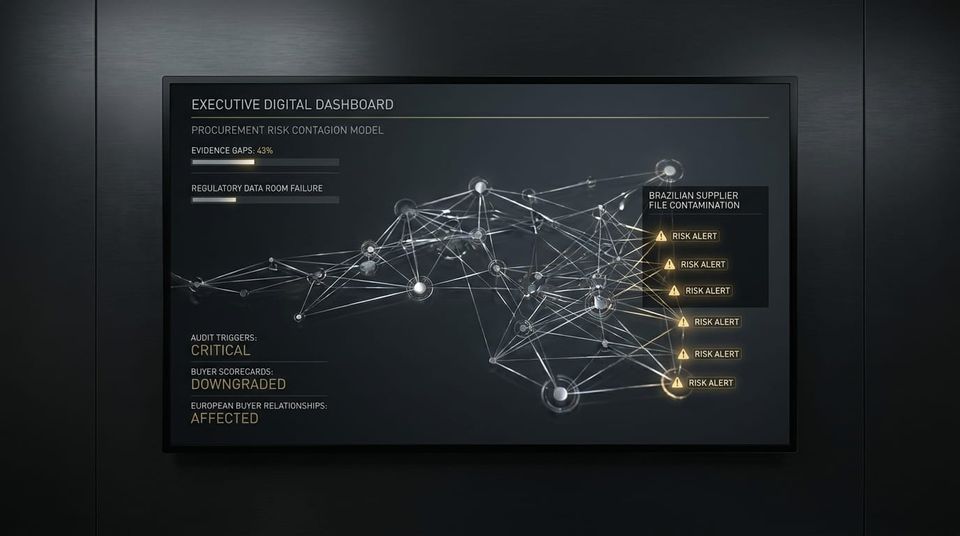
A supplier evidence failure is rarely isolated. When a Brazilian supplier provides weak, inconsistent or unsupported documentation to one European buyer, the same weakness can reappear across questionnaires, audits, contract renewals, supplier scorecards and regulatory reviews with other buyers. The financial risk is not only one account. It is credibility contagion across the European-facing customer base.
Risk Vector
Evidence Contagion
The same weak documentation can affect multiple buyers because questionnaires, audits and contract clauses often test similar evidence categories.
Financial Exposure
Multi-Customer Risk
One evidence gap can affect several contracts, increasing audit cost, remediation urgency, renewal risk and margin pressure.
Board Relevance
Credibility Loss
Boards need to know whether evidence weakness is account-specific or systemic across the supplier’s European exposure.
The Strategic Change
European-facing buyers are increasingly using similar control mechanisms: supplier questionnaires, due diligence requests, audit rights, reporting data requests, emissions data requests, traceability evidence, corrective action plans and contract clauses. These mechanisms differ by company. But they often test the same underlying supplier capability: can the supplier prove what it claims?
This creates contagion risk. A weak evidence file does not stay inside one customer relationship. If the supplier cannot prove chain-of-custody, emissions data, waste handling, supplier controls, corrective actions or policy execution for one buyer, the same weakness may surface with another buyer. The problem is not the form. The problem is the evidence architecture behind the form.
Board-Level Interpretation
Evidence failure becomes systemic when the same unsupported claim, missing record or weak control appears across multiple European buyer files. CFOs should treat this as portfolio risk, not account noise.
Why Brazilian Suppliers Are Exposed
Brazilian suppliers often respond to each European buyer separately. Sales handles one questionnaire. Legal reviews one contract. Operations sends one certificate. ESG prepares one explanation. Finance sees the issue only when cost appears. This fragmented response model hides systemic evidence risk.
The same evidence weakness may be repeated across buyers without management recognizing the pattern. A weak Scope 3 data methodology, an incomplete supplier file, a poor chain-of-custody record or an unsupported compliance claim can travel through several customer files. Once one buyer challenges it, others may expose the same vulnerability.
Contamination Channels
- Repeated questionnaire answers unsupported by evidence.
- Same certificate used across buyers without operational linkage.
- Same emissions estimate submitted without clear methodology.
- Same supplier policy referenced without implementation proof.
- Same traceability gap appearing across contracts and audits.
Buyer Reaction Signals
- Audit requests after inconsistent questionnaire answers.
- Corrective action plans requested across multiple accounts.
- Supplier score downgraded due to documentation gaps.
- Contract renewal delayed pending evidence review.
- Buyer teams requesting proof already requested by another customer.
Finance-Grade Risk Formula
Evidence Contagion Exposure Model
Evidence Contagion Exposure = Shared Evidence Gap × Number of EU Buyers Affected × Contract Value × Audit Probability
This is a management risk model, not a statutory formula. To quantify it, a company needs internal data: evidence categories reused across buyers, revenue by European customer, contract values, renewal dates, audit history, questionnaire overlap, remediation cost and buyer sensitivity.
The CFO Problem: One Weak File Can Multiply Cost
CFOs should not evaluate supplier evidence failure only at account level. A single weak evidence category can multiply cost across the customer portfolio. If five European buyers ask for similar proof, one documentation gap can produce five rounds of legal review, operational reconstruction, buyer communication and remediation work.
This is why evidence architecture must be centralized. Without a central evidence room, each buyer request becomes a separate emergency. With a controlled evidence model, the company can identify shared gaps, prioritize remediation once and reduce the marginal cost of future buyer requests.
CFO Diagnostic Question
Does the company know which evidence gaps are repeated across multiple European customers — or is each buyer request still being treated as a separate administrative issue?
What a Contagion-Control Review Should Include
A contagion-control review should identify which evidence weaknesses are systemic. The goal is not to answer one buyer faster. The goal is to prevent the same weakness from damaging multiple buyer relationships.
1. Evidence Reuse Map
Identification of documents, metrics, claims, certificates, methodologies and supplier files reused across multiple European buyer relationships.
2. Buyer Overlap Matrix
Mapping of which customers request similar evidence, which forms overlap and which contract clauses test the same documentation categories.
3. Systemic Gap Register
Central register of weak evidence categories, affected buyers, financial exposure, remediation owners, deadlines and verification status.
4. Portfolio Remediation Plan
Remediation plan that fixes evidence architecture at source, reducing repeated cost across buyer requests, audits and renewals.
CFO Portfolio Formula
Multi-Buyer Evidence Risk
Multi-Buyer Risk = Σ [Buyer Revenueᵢ × Evidence Gap Severityᵢ × Renewal Sensitivityᵢ] + Shared Remediation Cost
The model should be applied across the European customer portfolio, not only by individual account. A low-cost evidence upgrade may protect several buyer relationships at once if the underlying gap is shared.
Brazil-Europe Evidence Bridge
Where Ecobraz and Villanova ESG Fit
Ecobraz proves what happens in the Brazilian operation. Villanova ESG translates that proof into regulatory evidence European boards, CFOs, procurement, legal and compliance teams can use.
In evidence contagion control, the value is centralization. Brazilian operational proof becomes stronger when it is mapped once, structured properly and reused consistently across European buyer files.
Decision Trigger for CFOs and Commercial Teams
A supplier evidence contagion review should be triggered when at least one of the following conditions exists:
- Multiple European buyers request similar evidence, data or supplier documentation.
- The same certificate, claim or methodology is reused across several buyer files.
- One buyer has challenged evidence that other buyers also rely on.
- Questionnaire answers are prepared account by account without central control.
- Audit findings reveal gaps that may affect other contracts.
- Finance cannot quantify how one evidence weakness affects total European customer exposure.
Executive Position
Evidence failure is not always local. One weak file can contaminate a portfolio of buyer relationships. CFOs should identify shared evidence gaps before multiple European customers discover them independently.
Regulatory Source Trail
This dossier is based on official and institutional due diligence references. The contagion-risk models presented here are executive financial models, not statutory formulas, legal opinions or assurance methodologies. Company-specific assessment requires buyer files, questionnaires, contracts, evidence inventories, audit history, renewal dates, revenue exposure, remediation cost and jurisdiction-specific review.
- European Commission — Corporate sustainability due diligence: official CSDDD page.
- European Commission — EU Due Diligence Navigator: official CSDDD navigator page.
- OECD — Due Diligence Guidance for Responsible Business Conduct: official OECD guidance page.
Executive Review
Control Supplier Evidence Before One Weak File Damages Multiple EU Buyer Relationships
Villanova ESG supports companies that need to translate Brazilian operational evidence into European-facing regulatory documentation. The objective is not one-off buyer response. The objective is evidence centralization, portfolio-risk reduction and board-level defensibility.
For confidential executive reviews: contact@villanovaesg.com