
Scope 3 and Brazilian Suppliers: Why Indirect Emissions Become Procurement Risk
Villanova ESG | Executive Regulatory Dossier
Scope 3 and Brazilian Suppliers: Why Indirect Emissions Become Procurement Risk
Scope 3 emissions change how companies evaluate suppliers. For Brazilian companies connected to European buyers, emissions data is no longer only an environmental metric. It can become a procurement filter, a reporting dependency and a cost-of-capital variable.
Risk Vector
Indirect Emissions
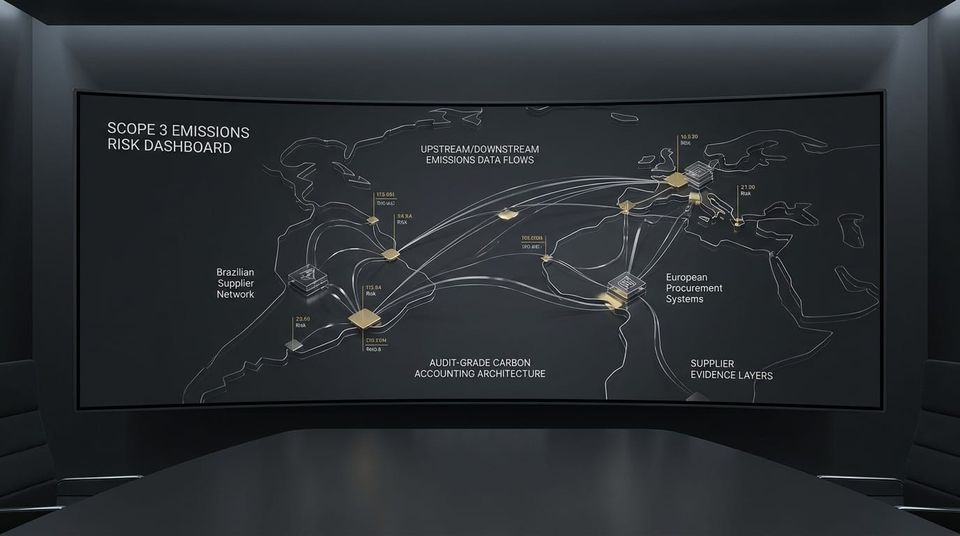
Scope 3 connects a company’s climate exposure to emissions generated across upstream and downstream value-chain activities.
Financial Exposure
Procurement Pressure
Weak supplier emissions data can create friction in onboarding, reporting, contract renewal, lender review and buyer risk scoring.
Board Relevance
Carbon Evidence
The board-level question is whether supplier emissions data is reliable enough to support financial, reporting and commercial decisions.
The Strategic Change
Scope 3 emissions are often the hardest part of corporate climate accounting because they depend on value-chain data. That makes suppliers financially relevant to climate reporting. A company may control its own facilities, but it does not directly control every upstream supplier, logistics provider, waste vendor, distributor or product-use scenario.
For Brazilian suppliers, the exposure is usually indirect. A European buyer may need emissions data to support corporate reporting, lender requirements, transition planning, procurement scoring or internal decarbonization targets. When the supplier cannot provide credible data, the buyer’s uncertainty increases. That uncertainty can become commercial pressure.
Board-Level Interpretation
Scope 3 converts supplier emissions data into a procurement risk signal. The supplier with stronger carbon evidence may become easier to retain, finance and defend inside European-facing value chains.
Why Brazilian Suppliers Are Exposed
Brazilian suppliers can be commercially exposed even when they are not directly subject to a specific European reporting statute. The pressure moves through contracts. European buyers, multinational groups and financial institutions increasingly ask for emissions information that supports broader climate accounting and risk management.
The operational gap is usually not bad intention. It is data architecture. Emissions-relevant information may exist, but it is fragmented across energy bills, fuel records, logistics invoices, supplier files, production volumes, waste manifests and operational spreadsheets. Fragmented data is not finance-grade evidence.
Supplier Emissions Data Gap
- Activity data not mapped by emission source.
- Fuel, electricity, logistics and waste records stored separately.
- Emission factors applied inconsistently or without documentation.
- Supplier responses based on estimates without confidence scoring.
- Operational data not connected to customer-specific reporting needs.
European Buyer Concern
- Can supplier emissions data be used in Scope 3 reporting?
- Can the methodology be explained and reviewed?
- Can estimates be separated from measured data?
- Can emissions reductions be tracked over time?
- Can the buyer defend procurement choices under reporting pressure?
Finance-Grade Risk Formula
Scope 3 Procurement Exposure Model
Scope 3 Procurement Exposure = EU Customer Dependency × Emissions Data Gap × Category Materiality × Buyer Decarbonization Pressure
This is a board-level risk model, not a statutory formula. To quantify it, a company needs internal data: revenue by European customer, product category, emissions-relevant activity data, supplier category exposure, buyer questionnaires, decarbonization targets, contract renewal windows and remediation cost.
The CFO Problem: Emissions Data Becomes Commercial Risk
CFOs should not classify Scope 3 as a sustainability department problem. Scope 3 data can influence procurement acceptance, credit analysis, customer retention and transition-risk assessment. If the supplier cannot provide usable emissions evidence, the buyer carries higher reporting uncertainty.
That uncertainty may return through commercial mechanisms: additional questionnaires, third-party verification requests, buyer audits, price pressure, contract clauses, preferred-supplier downgrades or substitution by suppliers with stronger emissions documentation. The risk is not theoretical. It is a cash-flow exposure that can emerge before any formal regulatory enforcement.
CFO Diagnostic Question
If a European customer requested supplier emissions evidence for Scope 3 reporting within ten business days, could the company deliver activity data, methodology, emission factors and confidence levels — or only a generic estimate?
What a Scope 3-Ready Evidence File Should Include
A Scope 3-ready supplier file should not be a climate marketing document. It should be a structured evidence package capable of supporting buyer reporting, lender review and internal procurement decisions.
1. Activity Data Inventory
Identification of emissions-relevant activity data, including energy, fuel, logistics, purchased inputs, waste, production volumes and transport flows.
2. Methodology and Emission Factors
Documentation of calculation methods, assumptions, emission factors, data boundaries, exclusions and confidence levels.
3. Customer-Specific Data Mapping
Ability to connect emissions-relevant data to products, customers, contracts, shipments or supplier categories where commercially necessary.
4. Reduction and Verification Logic
Evidence showing how emissions reductions are tracked, how data is validated and how improvements can be verified over time.
Brazil-Europe Evidence Bridge
Where Ecobraz and Villanova ESG Fit
Ecobraz proves what happens in the Brazilian operation. Villanova ESG translates that proof into regulatory evidence European boards, CFOs, compliance teams and financial stakeholders can use.
In Scope 3-exposed value chains, the value is not broad climate language. The value is evidence architecture. The objective is to organize Brazilian operational data into a structure that can support buyer reporting, procurement confidence and finance-grade risk analysis.
Decision Trigger for CFOs
A CFO should trigger a Scope 3 evidence review when at least one of the following conditions exists:
- The company supplies European customers with formal climate or sustainability reporting obligations.
- Buyers request emissions data, supplier questionnaires or decarbonization plans.
- Revenue depends on customers with net-zero, Scope 3 or transition-plan commitments.
- Emissions-relevant data is fragmented across operations, logistics, procurement and finance.
- The company cannot distinguish measured data from estimates.
- Commercial teams cannot quantify how carbon-data weakness affects contract renewal or buyer preference.
Executive Position
Scope 3 turns supplier emissions data into a market signal. The supplier that can provide defensible carbon evidence may become easier to retain in European-facing procurement decisions.
Regulatory Source Trail
This dossier is based on official and institutional climate accounting references. The analysis does not create legal, financial or assurance advice and does not guarantee acceptance by buyers, lenders or regulators. Company-specific assessment requires operational data, customer exposure, emissions methodology, supplier records, verification readiness and jurisdiction-specific review.
- GHG Protocol — Corporate Value Chain Scope 3 Standard: official Scope 3 Standard page.
- GHG Protocol — Technical Guidance for Calculating Scope 3 Emissions: official calculation guidance.
- IFRS Foundation — IFRS S2 Climate-related Disclosures: official IFRS S2 page.
- GHG Protocol — Statement on ISSB Scope 3 disclosure requirements: institutional statement.
Executive Review
Assess Scope 3 Evidence Before Supplier Emissions Become Procurement Risk
Villanova ESG supports companies that need to translate Brazilian operational evidence into European-facing regulatory and finance-grade documentation. The objective is not climate communication. The objective is emissions-data defensibility, supplier-risk clarity and board-level documentation.
For confidential executive reviews: contact@villanovaesg.com