
From Compliance Cost to Financing Signal: How Evidence Changes the CFO Conversation
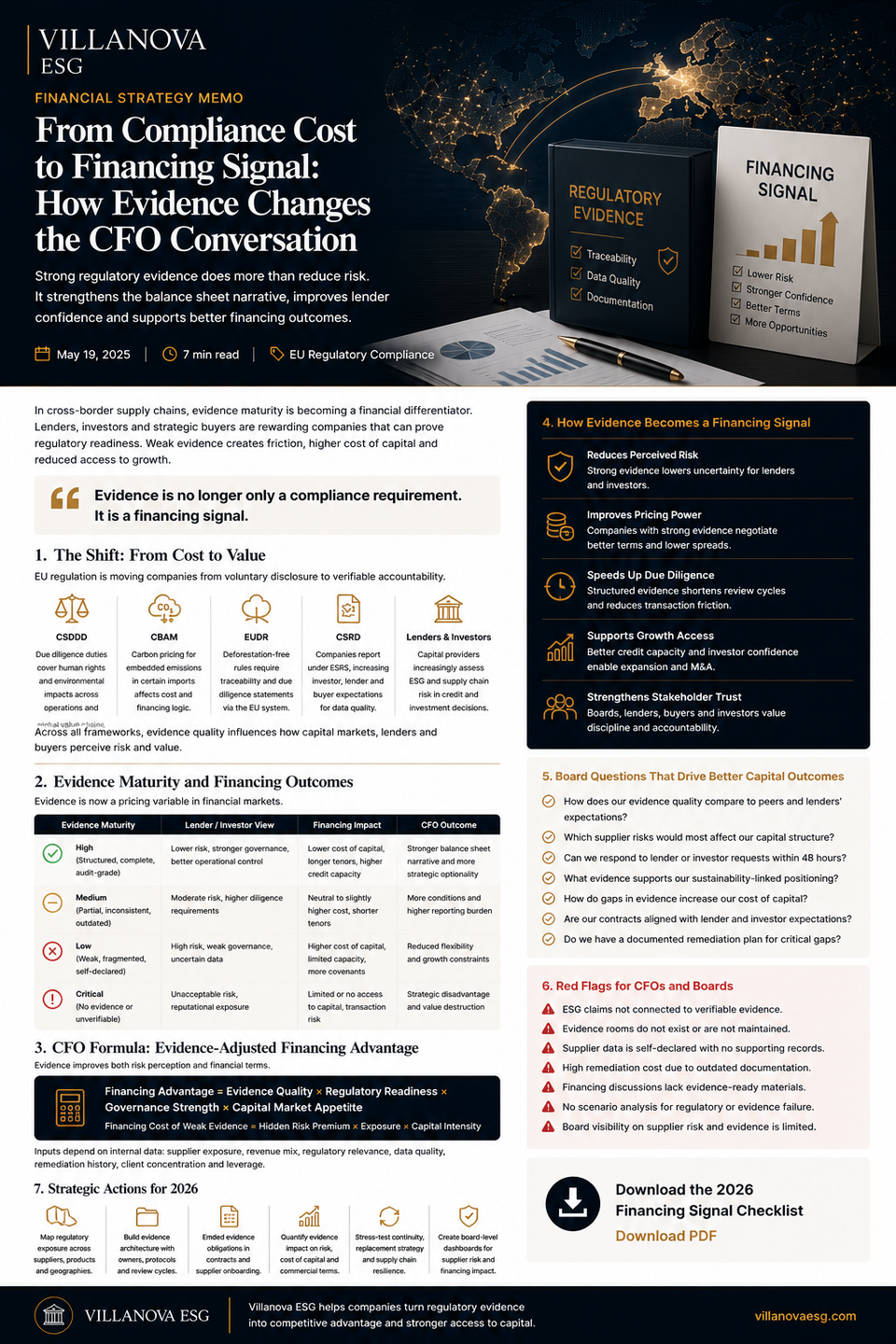
Financial Strategy Memo
From Compliance Cost to Financing Signal: How Evidence Changes the CFO Conversation
Regulatory evidence does more than reduce compliance friction. When structured correctly, it becomes a financing signal that improves lender confidence, investor review and capital-market readiness.
CFO Shift
Cost to Signal
Capital Relevance
Lender Confidence
Board Value
Financing Readiness
Executive Thesis
CFOs often treat regulatory evidence as a compliance cost. That view is too narrow.
In Brazil-Europe supply chains, evidence quality can influence how lenders, investors, buyers and strategic partners assess operational discipline, governance maturity and exposure management.
Evidence is not only a cost of compliance. It is a signal of financial discipline.
The CFO conversation changes when evidence becomes structured, current, traceable and reviewable. The company moves from defending ESG claims to demonstrating risk control.
Why Evidence Matters to Capital Providers
The EU regulatory environment is increasing the financial relevance of sustainability and supply-chain evidence. The Corporate Sustainability Due Diligence Directive entered into force on 25 July 2024 and aims to foster responsible corporate behaviour across operations, subsidiaries and global value chains. This places value-chain risk governance inside a wider corporate accountability framework.
CBAM also makes evidence relevant to import economics. The European Commission defines CBAM as a system to confirm that a carbon price has been paid for embedded carbon emissions generated in the production of certain goods imported into the EU.
CSRD increases the reporting relevance of sustainability risks, impacts and opportunities. Companies subject to CSRD must report according to European Sustainability Reporting Standards. This creates greater pressure for structured, consistent and reviewable information.
From the banking side, the European Banking Authority’s loan origination and monitoring guidelines aim to ensure robust and prudent standards for credit risk taking, management and monitoring. The EBA’s ESG risk guidelines also connect ESG risks to governance, risk management and prudential supervision. Evidence quality therefore matters because it affects risk perception, not because it guarantees financing.
Evidence Maturity and Financing Outcomes
Evidence maturity can change the lender or investor conversation. It does not guarantee better terms. It can improve the quality of the risk file.
| Evidence Maturity | Lender / Investor View | Financing Impact | CFO Outcome |
|---|---|---|---|
| High | Structured evidence, clear governance, traceable data and accountable owners. | Lower perceived uncertainty and faster due diligence review. | Stronger financing narrative and better strategic optionality. |
| Medium | Partial documentation, inconsistent updates or fragmented ownership. | Higher diligence burden and more lender questions. | More conditions, slower review and weaker confidence. |
| Low | Self-declared data, weak traceability, outdated documents or no evidence room. | Higher perceived risk and limited credibility in sustainability-linked discussions. | Reduced flexibility and possible strategic disadvantage. |
| Critical | No reliable evidence, no governance owner and unverifiable supplier claims. | Transaction risk, reputational concern or lender refusal to rely on ESG positioning. | Loss of credibility and weaker capital access narrative. |
How Evidence Becomes a Financing Signal
1. Reduces Perceived Risk
Strong evidence reduces uncertainty around supplier exposure, reporting quality and operational control.
2. Speeds Up Due Diligence
Structured evidence shortens review cycles and reduces the need for emergency data reconstruction.
3. Strengthens Governance Narrative
Lenders and investors can see that risk is governed, owned, documented and monitored.
4. Supports Sustainability-Linked Positioning
Evidence can support the credibility of sustainability-linked discussions when metrics, baselines and controls are documented.
5. Improves Buyer and Investor Confidence
Strong documentation reduces the gap between what the company claims and what stakeholders can verify.
6. Protects Strategic Optionality
Better evidence can support refinancing, M&A preparation, buyer qualification, supplier renewal and capital-market readiness.
CFO Formula: Evidence-Adjusted Financing Advantage
Evidence does not automatically reduce financing cost. But it can reduce uncertainty, shorten diligence and strengthen the financing file.
Financing Signal Strength = Evidence Quality × Regulatory Readiness × Governance Control × Capital Market Relevance
This calculation requires internal company data. Inputs include revenue exposure, supplier criticality, evidence maturity, governance ownership, reporting relevance, lender profile, debt structure, margin volatility and capital intensity.
Financing Cost of Weak Evidence = Hidden Risk Premium × Exposure × Capital Intensity
If the CFO cannot explain the evidence behind the ESG position, the financing conversation remains exposed to skepticism.
Board Questions That Drive Better Capital Outcomes
- How does our evidence quality compare to what lenders and investors expect?
- Which supplier risks could materially affect our capital structure or refinancing discussions?
- Can we respond to lender or investor evidence requests within 48 hours?
- What evidence supports our sustainability-linked positioning?
- Which evidence gaps could increase our cost of capital or diligence burden?
- Are our contracts aligned with supplier evidence obligations and audit rights?
- Do we have a documented remediation plan for critical gaps?
- Can the board defend the financing narrative with evidence rather than claims?
Red Flags for CFOs and Boards
- ESG claims are not connected to verifiable evidence.
- Evidence rooms do not exist or are not maintained.
- Supplier data is self-declared with no supporting records.
- Sustainability-linked financing discussions rely on narrative rather than documentation.
- No scenario analysis exists for regulatory or evidence failure.
- Evidence gaps have no owner, remediation budget or timeline.
- Board visibility on supplier risk and evidence quality is limited.
Decision Trigger for CFOs
Do not treat evidence as a compliance cost only.
Treat evidence as part of the capital narrative: risk control, governance maturity, financing readiness and strategic optionality.
The CFO’s opportunity is to convert evidence from a defensive file into a financial signal. That requires structure, ownership, traceability and consistency.
Villanova ESG Position
Villanova ESG helps companies convert regulatory evidence into a stronger CFO conversation with lenders, investors, buyers and boards.
The objective is not to promise cheaper financing, guarantee access to capital or certify compliance. The objective is to structure the evidence architecture that supports stronger risk perception, faster due diligence and more disciplined financing discussions.
In capital markets, unsupported ESG claims create skepticism. Structured evidence creates credibility.
Regulatory Source Trail
- European Commission — Corporate Sustainability Due Diligence Directive: Directive 2024/1760 entered into force on 25 July 2024 and aims to foster responsible corporate behaviour across companies’ own operations, subsidiaries and global value chains.
- European Commission — Carbon Border Adjustment Mechanism: CBAM is designed to confirm that a carbon price has been paid for embedded carbon emissions generated in the production of certain goods imported into the EU.
- European Commission — Corporate Sustainability Reporting: companies subject to CSRD report according to European Sustainability Reporting Standards.
- European Banking Authority — Guidelines on loan origination and monitoring: the guidelines aim to ensure robust and prudent standards for credit risk taking, management and monitoring.
- European Banking Authority — ESG Risk Guidelines: EBA guidance connects ESG risks with governance, risk management and prudential supervision.
Executive Review
Turn regulatory evidence into a financing signal.
Villanova ESG supports CFOs, Boards and leadership teams with regulatory evidence architecture, lender-ready documentation and capital-readiness risk frameworks for Brazil-Europe supply chains.
For private board-level briefings: contact@villanovaesg.com