
EUDR Country-Risk Assessment: How to Build Supply-Chain Controls
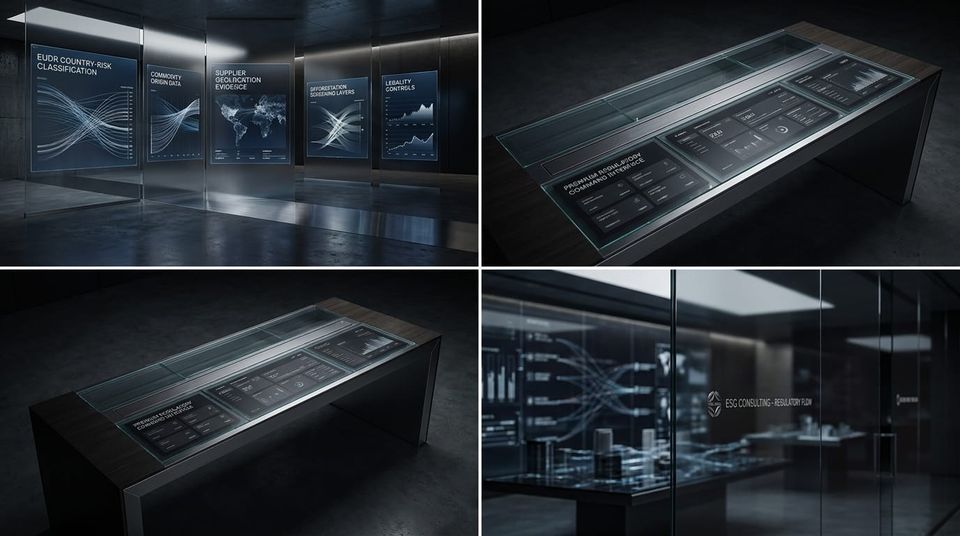
Executive Dossier · EUDR Country-Risk Assessment
The EUDR country-risk system converts sourcing geography into a compliance variable. For exporters and corporate buyers, the risk rating is not a shortcut. It is the starting point for commodity-level evidence control.
This dossier is written from the executive perspective of Marcio Villanova, CEO of Ecobraz and Founder of Villanova ESG. The analysis treats EUDR country-risk assessment as a procurement-control and cash-flow protection issue. The financial question is direct: can the company prove that sourcing decisions, supplier screening, legality evidence and geolocation data are strong enough before EU market access is challenged?
Legal Base
Regulation (EU) 2023/1115
Benchmarking
Low, standard and high risk
Core Commodities
Cattle, cocoa, coffee, palm oil, rubber, soya, wood
Control Exposure
Country risk, plot data, legality, DDS evidence
Country Risk Is an Input, Not a Compliance Conclusion
The EUDR benchmarking system classifies countries according to the risk that covered commodities produced there are not deforestation-free. The categories are low risk, standard risk and high risk. This classification affects how operators and competent authorities calibrate due diligence and control intensity.
But country classification does not prove that a specific shipment is compliant. It does not prove that a farm, plot, cooperative, plantation, processor or intermediary is free from deforestation risk. It only establishes a regulatory risk context.
Board Risk Signal
A low-risk country does not transform weak supplier evidence into EUDR-compliant evidence.
For CFOs, the risk is false comfort. Sourcing from a lower-risk jurisdiction may reduce regulatory friction. It does not eliminate the need for geolocation, legality evidence, traceability and due diligence statement controls.
The EUDR Country-Risk Architecture
The Commission’s benchmarking system is designed to support EUDR implementation and enforcement. It classifies countries based on an objective assessment methodology and supports differentiated due diligence and competent-authority checks. The Commission’s Green Forum confirms that the classification was adopted through an implementing act and accompanied by a Staff Working Document setting out the benchmarking methodology.
01 · Low Risk
Lower regulatory risk context. Still requires structured evidence and compliance with EUDR conditions.
02 · Standard Risk
Baseline risk category where full due diligence discipline remains commercially and operationally critical.
03 · High Risk
Higher scrutiny environment. Supplier evidence, mitigation records and buyer confidence become materially more important.
The board should treat country classification as the first variable in the risk model, not the final decision.
The Seven Commodity Channels
EUDR country-risk assessment only matters when it is connected to the commodity channels covered by the Regulation and to the relevant products listed in Annex I.
EUDR Commodity Risk Channels
Cattle
Cocoa
Coffee
Oil Palm
Rubber
Soya
Wood
Corporate risk mapping must therefore connect country rating, commodity type, relevant product, CN code, supplier, plot origin, processing stage and EU customer exposure. A country score without commodity and product mapping is insufficient for board use.
Country Risk Must Be Integrated into Procurement Before Contract Signature
The biggest operational failure is late screening. Companies often assess EUDR exposure after purchase orders are issued or after goods enter the export pipeline.
That is financially weak.
Country-risk assessment must happen before contract signature, when the company still has leverage to reject, reprice, demand evidence, change origin, split supply or add contractual protections.
Pre-Contract Country-Risk Gate
Country Classification
Confirm the risk category of the production country and identify whether reclassification risk exists.
Commodity Mapping
Link the product to EUDR commodities, Annex I product coverage and CN code exposure.
Supplier Evidence
Validate geolocation, legality records, production dates, plot data and chain-of-custody documentation.
Commercial Decision
Accept, mitigate, reprice, require remediation, split volume or reject before cash is trapped.
When country-risk screening happens after procurement commitment, the company is no longer managing risk. It is managing damage.
The Supplier-Level Risk Model
Country classification must be translated into supplier-level risk. A supplier operating in a standard-risk country may still be low risk because of strong evidence and controlled sourcing. A supplier in a low-risk country may still be exposed if traceability is weak, aggregation is opaque or legality evidence is incomplete.
The supplier model should assign risk scores across seven dimensions:
- country classification;
- commodity and product risk;
- geolocation completeness;
- deforestation proximity and land-use history;
- legality evidence quality;
- chain-of-custody integrity;
- supplier responsiveness and auditability.
Control Principle
EUDR risk is not national. It is plot-level, supplier-level and shipment-level.
The CFO should not accept a risk matrix that stops at country name. Market-access risk is embedded in the specific supply chain.
Financial Exposure Model
A CFO-grade country-risk model should translate sourcing geography and evidence gaps into P&L exposure.
EUDR Country-Risk Formula Stack
Revenue at Risk = EU Contract Revenue × Probability of Origin Evidence Failure × Delay or Suspension Period / Contract Period
Supplier Remediation Cost = Supplier Count × Evidence Gap Cost + Geolocation Recovery + Legal Review + Verification Cost
Inventory Exposure = Affected Lot Value × Discount, Diversion or Rejection Cost
Working-Capital Drag = Blocked Invoice Value × Delay Days × Cost of Capital / 365
The exact values must be calculated with internal data. A responsible model requires EU revenue exposure, commodity volumes, supplier count, origin quality, buyer deadlines, affected lot values, cost of capital and supplier substitution options.
Country Classification Can Change
The country-risk list should not be treated as static. The EUDR benchmarking framework allows classification to be reviewed, and countries may challenge or seek reassessment based on new information, national controls or updated data.
For exporters, this creates regulatory-change risk. A sourcing strategy that is acceptable under one classification may become more expensive or more scrutinised if classification changes.
Classification Drift
Country risk categories may change as data, policy controls or Commission assessment evolves.
Buyer Reaction
EU customers may tighten sourcing requirements before official enforcement pressure materialises.
Margin Impact
Higher scrutiny can increase verification cost, documentation cost and supplier substitution cost.
The board should require a country-risk monitoring calendar and contingency sourcing plan for material EU revenue categories.
Low-Risk Countries Still Need Evidence
Low-risk classification may reduce certain due diligence intensity. It does not remove the basic requirement that products placed on or exported from the EU must be deforestation-free, legally produced and covered by the required due diligence statement where applicable.
Companies should not use low-risk status as a reason to remove supplier controls. They should use it to calibrate control depth.
The minimum control file should still include:
- country classification reference;
- commodity and Annex I product mapping;
- supplier identity and production site data;
- geolocation data where required;
- legality evidence from the country of production;
- chain-of-custody and lot traceability records;
- due diligence statement reference or workflow evidence;
- contractual representations and document retention obligations.
Low-risk classification is not a substitute for document control.
Standard-Risk Countries Require Full Procurement Discipline
Standard-risk countries will represent a major part of global commodity sourcing. For boards, this is the operational core of EUDR compliance.
The company must build scalable controls rather than treating every request as an emergency.
Standard-risk control architecture should include:
- supplier segmentation by commodity and region;
- mandatory geolocation evidence before purchase commitment;
- legality-document checklist by country;
- deforestation screening protocol;
- audit trigger for high-risk suppliers inside standard-risk countries;
- customer data package templates;
- contract clauses for evidence delivery and indemnity;
- dashboard tracking lots, DDS references and buyer requests.
Standard risk does not mean average risk. It means the company must make its own supplier-level risk assessment.
High-Risk Countries Require Board-Level Sourcing Decisions
High-risk classification should trigger board-level sourcing review when EU revenue is material. The issue is not automatic exclusion. The issue is whether the company has enough evidence, leverage and economic justification to continue sourcing.
CFO Decision Rule
High-risk sourcing should not proceed without a quantified margin defense, verified origin evidence and buyer-approved mitigation plan.
The board should compare three options: continue with enhanced controls, shift origin, or exit supplier exposure. The decision must be priced.
Contract Clauses Must Reflect Country Risk
Supplier contracts should not use generic ESG language for EUDR exposure. They must reflect country-risk classification, commodity risk and evidence obligations.
Contracts should address:
- country and production-origin disclosure;
- geolocation data delivery before shipment;
- legality representations under the law of the country of production;
- deforestation-free representations tied to EUDR criteria;
- audit rights over farms, plots, aggregators, intermediaries and processors where commercially feasible;
- immediate notification of origin change, supplier substitution or land-use risk;
- document retention and evidence production deadlines;
- price adjustment, rejection and suspension rights for evidence failure;
- indemnity for false or incomplete origin or legality data where enforceable;
- flow-down obligations to upstream suppliers and cooperatives.
The contract must make the evidence burden enforceable before goods are purchased.
Country Risk and Sustainability-Linked Finance
Country-risk controls can support financing discussions when the evidence is robust. Lenders and trade-finance providers care about market access, contract continuity and regulatory exposure.
A company with controlled EUDR country-risk assessment can defend lower risk across:
- EU revenue continuity;
- commodity sourcing resilience;
- traceability data quality;
- contractual risk allocation;
- regulatory-change preparedness;
- buyer diligence response speed.
But weak country-risk controls can undermine sustainability-linked finance. Claims about responsible sourcing are not credit-positive if they cannot survive EUDR evidence review.
The Villanova ESG Control Architecture
Villanova ESG operates exclusively at the intersection between European regulatory risk and cash-flow protection for cross-border supply chains. For EUDR country-risk assessment, the objective is not to monitor a country list. The objective is to protect EU revenue with supplier-level evidence that can survive buyer, authority and lender scrutiny.
01 · Country-Risk Map
Map sourcing countries against the EUDR benchmarking categories and relevant commodity exposure.
02 · Commodity Exposure Matrix
Connect cattle, cocoa, coffee, palm oil, rubber, soya and wood exposure to products, CN codes and EU customers.
03 · Supplier Evidence File
Build geolocation, legality, deforestation-screening, chain-of-custody and DDS documentation by supplier and lot.
04 · Contract Shield
Insert origin disclosure, evidence delivery, audit rights, suspension triggers and indemnity into supplier contracts.
05 · CFO Risk Model
Quantify revenue at risk, supplier remediation cost, inventory exposure, working-capital drag and sourcing substitution cost.
06 · Board Dashboard
Translate country-risk exposure into sourcing decisions, customer risk, margin protection and financing evidence.
Decision Trigger for CFOs
The CFO should escalate EUDR country-risk exposure when any of the following signals appear:
- EU-bound products contain cattle, cocoa, coffee, palm oil, rubber, soya or wood inputs;
- supplier risk assessment stops at country classification and does not reach plot or lot-level evidence;
- procurement commits to sourcing before geolocation and legality evidence are validated;
- country classification changes could affect material EU revenue;
- standard-risk sourcing is treated as low-risk sourcing without supplier-level testing;
- high-risk sourcing continues without board-approved margin and mitigation analysis;
- contracts lack origin disclosure, audit rights, evidence deadlines and suspension rights;
- the company cannot link DDS references to invoices, shipments, suppliers and lots;
- management cannot quantify inventory exposure, buyer delay or working-capital drag from evidence failure.
These are not sourcing details. They are market-access and cash-flow risk indicators.
Regulatory Source Trail
This dossier relies on official EU regulatory materials and implementation resources verified for the current EUDR country-risk position:
- European Commission — Regulation on Deforestation-free Products
- European Commission Green Forum — EUDR benchmarking and country classification
- European Commission Green Forum — Country Classification List
- EUR-Lex — Regulation (EU) 2023/1115
- European Commission Green Forum — Information System of the Deforestation Regulation
Closing CTA · EUDR Country-Risk Defense
If your country-risk assessment cannot connect sourcing geography to supplier evidence, EU market access is already exposed.
Villanova ESG structures the regulatory shield required to protect EU revenue, preserve cash flow and convert EUDR country-risk controls into finance-grade evidence for boards, buyers, authorities and lenders.
For a board-level EUDR country-risk exposure review, contact contact@villanovaesg.com.