
Contract Renewal Risk: Why European Buyers May Reprice Brazilian Suppliers Before Replacing Them
Villanova ESG | Executive Regulatory Dossier
Contract Renewal Risk: Why European Buyers May Reprice Brazilian Suppliers Before Replacing Them
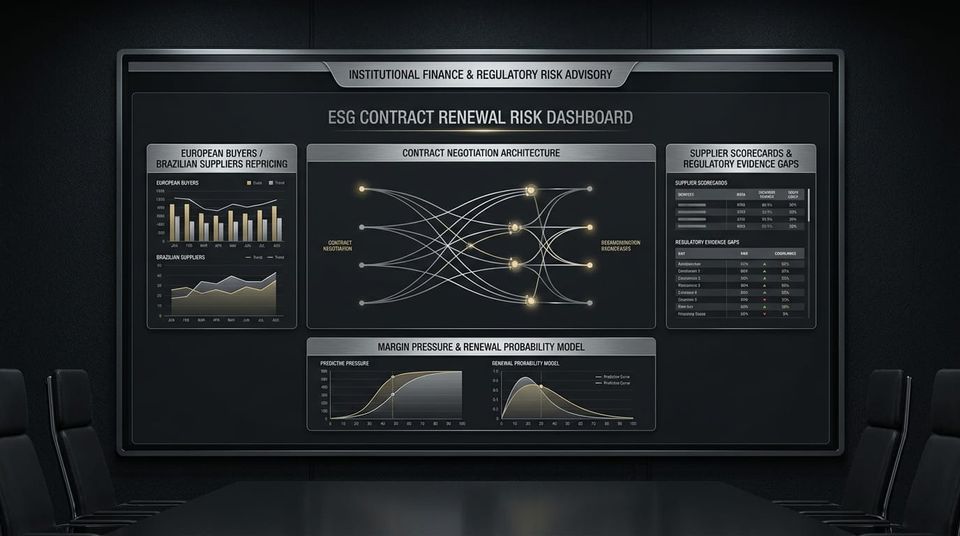
European buyers do not always replace a supplier immediately when regulatory evidence is weak. They may first reprice the risk. For Brazilian suppliers, this means weaker renewal terms, additional audit rights, pricing pressure, remediation obligations and reduced commercial leverage before formal substitution occurs.
Risk Vector
Renewal Leverage
Buyers may use regulatory uncertainty to renegotiate terms, expand audit rights or demand remediation before contract renewal.
Financial Exposure
Margin Repricing
Weak evidence can reduce pricing power even when the supplier remains commercially necessary to the buyer.
Board Relevance
Renewal Probability
CFOs need to quantify how evidence gaps affect renewal probability, renewal price and contract burden.
The Strategic Change
European regulatory pressure is not only a market-access issue. It is also a renewal issue. When buyers face due diligence, reporting, carbon, traceability or supplier-risk obligations, they may reassess existing suppliers before renewing contracts. The supplier may keep the account but lose economic quality.
That distinction matters for CFOs. Replacement is a visible event. Repricing is quieter. It appears as price concessions, additional compliance work, shortened contract terms, stricter clauses, more frequent audits, delayed expansion or reduced preferred-supplier status. The supplier may report the same customer as retained while margin is already deteriorating.
Board-Level Interpretation
Contract renewal risk is not binary. The buyer may not walk away. The buyer may stay, reprice the relationship and transfer more regulatory cost to the supplier.
Why Brazilian Suppliers Are Exposed
Brazilian suppliers often assume that the main risk is losing the European customer. That is incomplete. The more probable first-stage risk may be economic deterioration inside the existing relationship. The buyer keeps the supplier but changes the economics of the contract.
This happens because the buyer may still need the supplier’s product, volume, technical capability or regional access. But regulatory uncertainty gives procurement and legal teams a basis to demand more control. If the supplier lacks evidence, it negotiates from a weaker position.
Repricing Mechanisms
- Price discounts justified by compliance burden.
- Supplier-funded audits or verification requests.
- Shorter renewal periods and conditional extensions.
- Expanded audit, information and termination clauses.
- Corrective action plans required before volume expansion.
Supplier Weakness Signals
- Evidence is built only after buyer requests.
- Questionnaire answers are inconsistent across customers.
- Certificates exist but chain-of-custody is weak.
- Legal accepts clauses without cost-to-serve review.
- Finance does not model margin impact of regulatory workload.
Finance-Grade Risk Formula
Contract Renewal Repricing Model
Renewal Repricing Exposure = Contract Value × Evidence Gap × Buyer Leverage × Regulatory Requirement Intensity
This is a management risk model, not a statutory formula. To quantify it, a company needs internal data: contract value, gross margin, renewal date, buyer concentration, evidence maturity, clause burden, audit history, pricing elasticity and buyer substitution options.
The CFO Problem: Retention Can Hide Margin Loss
CFOs should not measure European customer risk only by retention. A retained customer can become less profitable. The contract may renew, but with heavier compliance obligations, more data requests, stricter audit terms, weaker pricing and higher internal workload.
The correct metric is not only renewal. The correct metric is renewal quality. A supplier should ask whether the renewed contract improves or weakens net contribution after regulatory cost-to-serve. If compliance workload increases faster than price, the contract is being repriced against the supplier.
CFO Diagnostic Question
Are European contracts being renewed with the same economic quality — or is the company retaining revenue while accepting lower margin, higher evidence burden and weaker contractual leverage?
What a Renewal Risk Review Should Include
A renewal risk review should begin before the buyer opens negotiations. The supplier must understand evidence gaps, clause exposure, remediation cost and buyer leverage early enough to defend price and scope.
1. Renewal Calendar Risk Map
Identification of EU-linked contracts by renewal date, revenue dependency, margin contribution, buyer risk pressure and evidence-readiness status.
2. Evidence Leverage Assessment
Evaluation of which supplier claims can be defended before negotiation and which weak points may be used by the buyer to reprice risk.
3. Clause Burden Review
Analysis of audit rights, reporting obligations, remediation duties, termination triggers, indemnity language and supplier-funded verification costs.
4. Renewal Quality Model
Comparison of expected net contribution before and after new regulatory workload, pricing concessions, evidence maintenance and remediation obligations.
CFO Renewal Formula
Renewal Quality Index
Renewal Quality Index = Net Contribution After Renewal ÷ Net Contribution Before Renewal
If the index falls below 1.0, the supplier retained the customer but accepted economic deterioration. The analysis should include price, volume, compliance workload, audit cost, remediation obligations, clause burden and expected management time.
Brazil-Europe Evidence Bridge
Where Ecobraz and Villanova ESG Fit
Ecobraz proves what happens in the Brazilian operation. Villanova ESG translates that proof into regulatory evidence European boards, CFOs, procurement, legal and compliance teams can use.
In contract renewal, evidence is negotiation leverage. A supplier with structured proof can defend scope, price and proportionality. A supplier without evidence may be forced to accept the buyer’s risk repricing.
Decision Trigger for CFOs and Commercial Teams
A contract renewal risk review should be triggered when at least one of the following conditions exists:
- European buyer contracts are approaching renewal within the next 6 to 12 months.
- Buyer questionnaires, audits or evidence requests have increased since the previous contract cycle.
- Renewal terms include new due diligence, reporting, audit or remediation clauses.
- Commercial teams are accepting discounts to protect the account without pricing compliance workload.
- Evidence gaps are known but not corrected before negotiation begins.
- Finance cannot compare net contribution before and after the proposed renewal terms.
Executive Position
Replacement is not the first warning. Repricing is. CFOs should monitor whether European buyer relationships are being renewed at lower economic quality because supplier evidence is weak.
Regulatory Source Trail
This dossier is based on official and institutional due diligence and reporting references. The renewal-risk models presented here are executive financial models, not statutory formulas, legal opinions or assurance methodologies. Company-specific assessment requires contracts, renewal dates, buyer requirements, evidence files, pricing data, margin data, audit history, clause analysis and jurisdiction-specific legal review.
- European Commission — Corporate sustainability due diligence: official CSDDD page.
- European Commission — Corporate sustainability reporting: official CSRD and sustainability reporting page.
- OECD — Due Diligence Guidance for Responsible Business Conduct: official OECD guidance page.
Executive Review
Assess Contract Renewal Risk Before European Buyers Reprice Supplier Uncertainty
Villanova ESG supports companies that need to translate Brazilian operational evidence into European-facing regulatory and financial risk models. The objective is not reactive contract defense. The objective is renewal leverage, margin protection and board-level evidence defensibility.
For confidential executive reviews: contact@villanovaesg.com