Water Liabilities in Brazil: The Next Breaking Point for Heavy Industry M&A
The Illusion of Infinite Resources
A persistent and dangerous misconception among foreign investment committees evaluating Brazilian assets is the assumption of infinite hydrological abundance. While Brazil possesses vast water resources, industrial access to this water is heavily regulated, geographically constrained, and increasingly volatile. For Mergers and Acquisitions (M&A) targeting water-intensive sectors—such as pulp and paper, mining, metallurgy, and large-scale agribusiness—water is not merely an environmental metric; it is the ultimate operational constraint.
In the 2026 climate and regulatory environment, acquiring a heavy industrial asset without executing forensic, georeferenced due diligence on its water matrix is a fiduciary gamble. If the target company possesses historical groundwater contamination, or if its legal right to extract water (the Outorga) is vulnerable to revocation due to basin scarcity, the physical asset becomes mathematically unviable. Unmapped water liabilities represent the next critical breaking point for Foreign Direct Investment (FDI) in Latin America.
The Mathematics of Water-Driven Capital Destruction
The financial modeling approved by the acquiring Board of Directors collapses instantaneously if the physical water supply is interrupted or if hidden contamination is discovered post-acquisition.
- The Zero-Revenue Event: Heavy industry cannot function without water. If a state water agency suspends the extraction Outorga due to severe drought or compliance failures, industrial production falls to zero. Fixed costs and debt servicing continue, triggering a catastrophic cash bleed that obliterates the target company’s EBITDA.
- The "Propter Rem" Contamination Trap: Under Brazilian federal law, environmental damage is attached directly to the property (propter rem). When a European M&A fund acquires an industrial plant, it inherits full financial responsibility for any historical aquifer contamination. The mandatory remediation Capex, often running into tens of millions of dollars, acts as a massive, unbudgeted liability that destroys the transaction's projected yield.
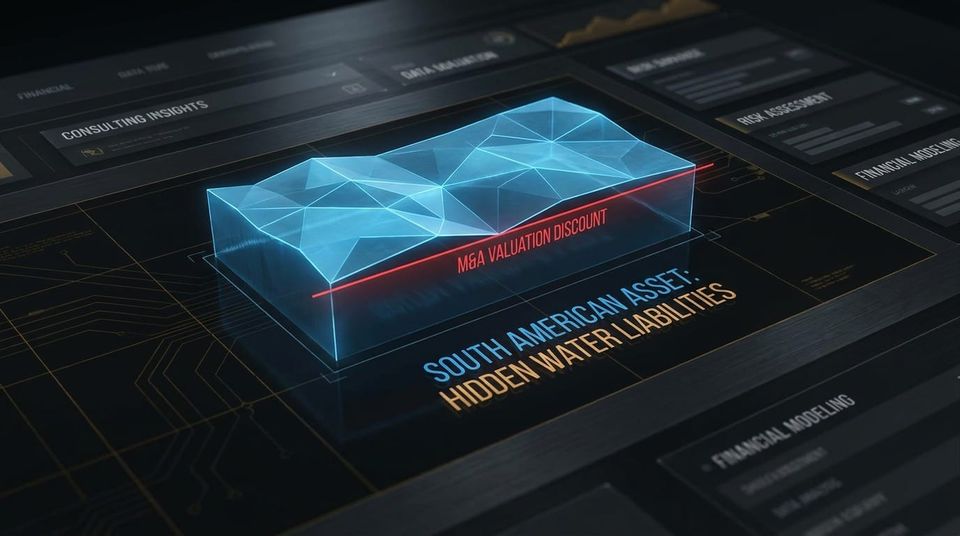
- The Valuation Discount (Deságio): Savvy acquiring CFOs who preemptively map these water risks utilize the data to apply severe valuation discounts (deságio) to the purchase price. Conversely, sellers who fail to audit and secure their own water matrices before entering M&A negotiations will watch their enterprise valuation plummet at the negotiation table.
(Source reference: Brazilian National Water Resources Policy Law 9.433/97 on water usage rights and strict environmental liability mechanisms).
The Danger of the "Desktop" Water Audit
Many international M&A due diligence processes rely entirely on "desktop audits," where lawyers verify the existence of a valid water extraction license (Outorga) in a virtual data room. This approach relies on a fatal flaw: paper rights do not guarantee physical water.
Climate transition risks are actively altering hydrological cycles across Brazilian basins. A target company may hold a legally flawless Outorga that permits the extraction of 1,000 cubic meters per hour. However, if the physical river basin is entering structural deficit, the regulatory agency will mathematically reduce or suspend that right to prioritize human consumption. Valuing an asset based on paper licenses rather than forensic hydrological reality guarantees a catastrophic operational shock.
The Villanova ESG Shield: Strategic Intervention
At Villanova ESG, we view water as a core financial vulnerability in the M&A process. We replace legal assumptions with physical, georeferenced certainty, protecting your invested capital from the devastating impact of water liabilities. We secure your transaction through our four uncompromising pillars:
- Logistical Reality Audit: We dismantle the illusion of the desktop audit. We deploy forensic environmental engineering and hydrological modeling to audit the physical reality of the target asset's water matrix. We map groundwater contamination risks and physical basin scarcity, providing the acquiring CFO with the precise mathematical data needed to enforce protective valuation discounts or establish escrow accounts.
- Cost of Capital Optimization: An industrial asset with an audited, structurally secure water matrix is a highly valuable, low-risk collateral. We leverage our forensic due diligence to prove the asset's resilience against climate transition risks, utilizing this data to structure Sustainability-Linked Loans (SLLs) and Green Bonds that actively reduce the acquiring matrix's Weighted Average Cost of Capital (WACC).
- Cross-Border Regulatory Shield: We map the target company's water usage against the strict requirements of European directives, such as the CSRD and CSDDD. We ensure that the acquired asset’s water matrix will not trigger European audit failures or expose the acquiring board to international civil liability regarding resource depletion.
- P&L and Revenue Protection: We protect the target asset's operational continuity. By identifying and mitigating water licensing vulnerabilities and physical scarcity risks prior to the transaction, we ensure the uninterrupted flow of industrial production, shielding the corporate EBITDA from zero-revenue events and catastrophic remediation Capex.
Acquiring a water-intensive Brazilian asset without forensic hydrological data is a direct mechanism for capital destruction. Do not let hidden water liabilities destroy your M&A valuation. Contact our risk assessment team immediately to structure your cross-border regulatory shield and execute forensic due diligence on your target assets at contact@villanovaesg.com
Marcio Villanova CEO, Ecobraz | Founder, Villanova ESG