
The Procurement Playbook for EU Buyers Sourcing From Brazil
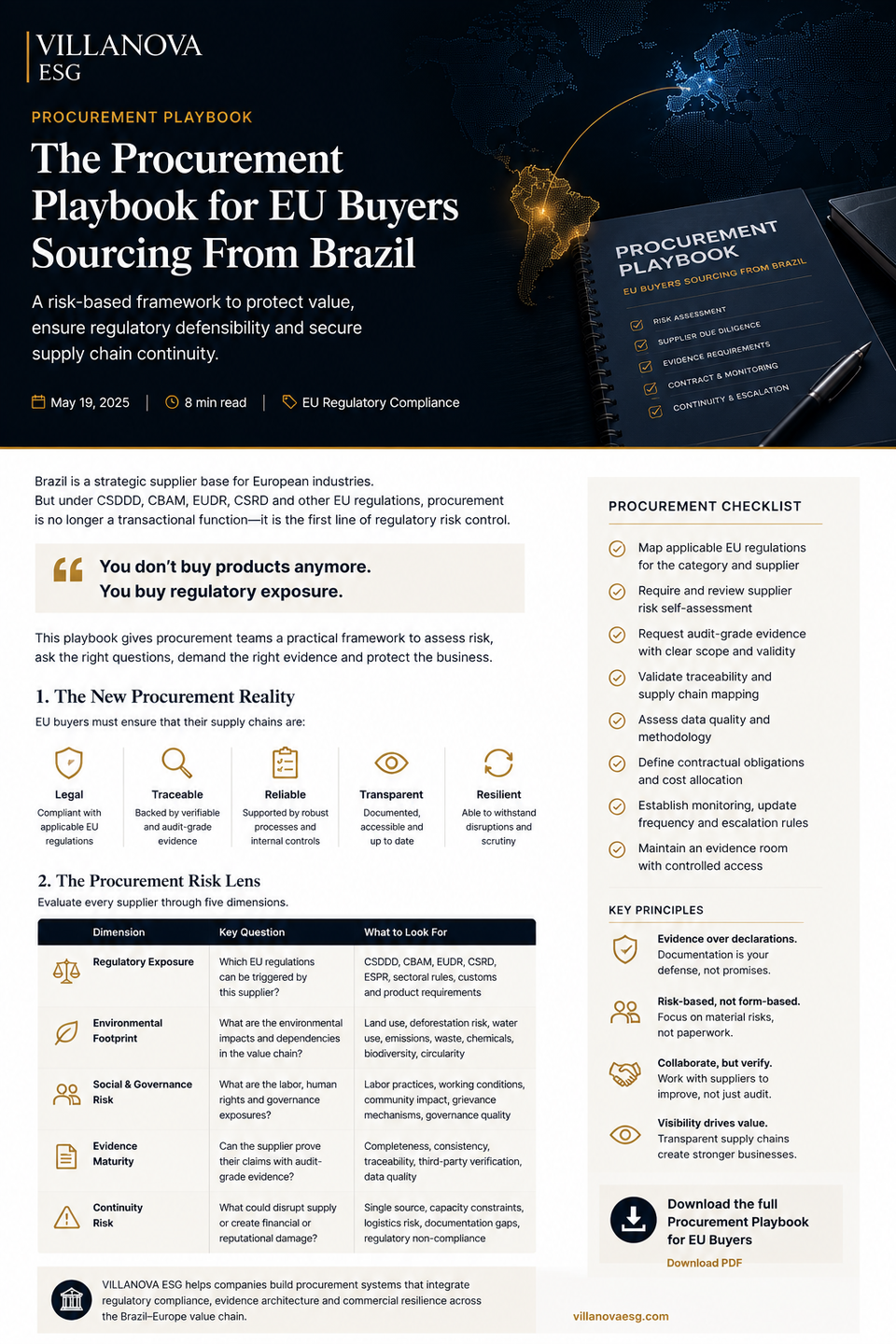
Procurement Playbook
The Procurement Playbook for EU Buyers Sourcing From Brazil
EU buyers do not only buy products, inputs or capacity from Brazil. They also import supplier evidence quality, traceability maturity and regulatory exposure.
Buyer Function
Risk Filter
Supplier Standard
Evidence Over Claims
Governance Lens
Continuity Control
Executive Thesis
Procurement teams in Europe are being pushed into a new role. They are no longer only negotiating price, delivery and supplier reliability. They are becoming the first line of regulatory risk control.
For EU buyers sourcing from Brazil, this shift is material.
A supplier is not approved when it signs a declaration. A supplier is approved when its evidence can be defended.
The procurement function must therefore evaluate suppliers through five lenses: regulatory exposure, traceability, documentation quality, continuity risk and contractual leverage.
Why EU Procurement Has Changed
The EU regulatory environment is moving buyer accountability closer to the supply chain. The Corporate Sustainability Due Diligence Directive entered into force on 25 July 2024 and is intended to address human rights and environmental impacts across companies’ operations, subsidiaries and global value chains.
CBAM creates reporting and pricing pressure around embedded emissions in certain imported goods. For procurement, this means supplier data quality may affect cost, reporting and import economics.
EUDR requires operators and traders to submit and manage due diligence statements through the EU Information System. That makes upstream traceability and evidence control a procurement issue.
CSRD requires companies in scope to report according to European Sustainability Reporting Standards. Value-chain information can therefore become relevant to sustainability reporting, investor review, lender scrutiny and customer expectations.
The Procurement Risk Lens
Every Brazilian supplier should be assessed through a structured procurement risk lens before approval, renewal or expansion.
| Risk Dimension | Core Question | Evidence Required |
|---|---|---|
| Regulatory Exposure | Which EU rules may be triggered by this supplier, product or input? | Regulatory mapping, product classification, import exposure and buyer dependency analysis. |
| Traceability | Can the supplier prove origin, movement and control? | Chain-of-custody records, source documentation, logistics records and operational trace files. |
| Documentation Quality | Are the documents audit-grade or merely commercial declarations? | Current, consistent, reviewable and verifiable documentation with responsible owners. |
| Continuity Risk | What happens if evidence fails, shipments are delayed or the supplier must be replaced? | Replacement lead time, supplier concentration, customer exposure and remediation cost model. |
| Contract Leverage | Can the buyer demand updates, audits, remediation or suspension? | Contract clauses covering evidence duties, access rights, cost allocation and escalation triggers. |
The Supplier Approval Checklist
Procurement should not approve an exposed supplier until these controls are documented.
- Applicable EU frameworks mapped: CSDDD, CBAM, EUDR, CSRD, ESPR, sector rules or buyer-specific reporting duties.
- Supplier evidence owner identified: one accountable person or function responsible for documentation quality.
- Traceability file reviewed: origin, chain of custody, movement, processing and responsible parties.
- Evidence freshness checked: documents must be current and updated when operations, sourcing or regulation changes.
- Data methodology reviewed: especially when emissions, land use, deforestation exposure or product composition is relevant.
- Contract clauses aligned: evidence obligations, audit rights, remediation cost and escalation mechanisms.
- Continuity plan defined: replacement options, inventory buffer, customer exposure and financial impact.
- Internal escalation path established: procurement, legal, finance, compliance and sustainability teams aligned before approval.
CFO Formula for Procurement Risk
Procurement risk should be converted into financial exposure before supplier approval.
Procurement Exposure = Supplier Criticality × Evidence Gap × Replacement Lead Time × Financial Impact
This formula requires internal buyer data. Supplier spend, dependency ratio, margin contribution, inventory buffer, replacement timing, customer commitments and contract leverage are necessary inputs.
Supplier Approval Score = Evidence Maturity − Regulatory Exposure − Continuity Risk
A low supplier price does not reduce risk if the evidence gap is high. It usually means the risk has not yet been priced.
What Procurement Should Ask Brazilian Suppliers
1. Origin and Traceability
Can you prove where the relevant materials, inputs or products originate and how they move through the supply chain?
2. Regulatory Relevance
Which EU frameworks could affect this product, input, category or buyer relationship?
3. Documentation Control
Who owns the documentation internally, how often is it updated and how is document consistency checked?
4. Environmental and Operational Exposure
What environmental, land-use, emissions, waste, logistics or operational risks are connected to the supplier’s activity?
5. Data Quality
Are emissions, traceability, origin or product data based on measured information, estimates, third-party records or supplier self-declaration?
6. Remediation Capacity
If evidence gaps are found, how quickly can the supplier correct them without interrupting supply?
Red Flags for EU Buyers
- The supplier treats EU regulation as a future issue rather than a current buyer requirement.
- Documents exist, but no one can explain how they support regulatory defensibility.
- Traceability depends on spreadsheets, email chains or verbal explanations.
- Supplier questionnaires are completed by commercial teams without operational evidence review.
- The supplier cannot identify which evidence is current, expired, estimated or third-party verified.
- There is no defined response process for customer, lender, auditor or regulator information requests.
- The contract does not allocate evidence costs, remediation costs or delay consequences.
Decision Trigger for Procurement Leaders
Do not approve a supplier because the price is right.
Approve the supplier only when the price, evidence, traceability and continuity risk can be defended together.
Procurement is the gatekeeper. If the evidence is weak at the purchasing stage, the financial exposure will appear later in legal, logistics, reporting, customer retention or cash flow.
Villanova ESG Position
Villanova ESG helps companies build procurement risk frameworks for Brazil-Europe supply chains.
The objective is not to promise legal certainty, guarantee compliance or replace legal counsel. The objective is to help buyers organize supplier evidence, structure regulatory defensibility and make procurement decisions that can withstand CFO, Board, lender, customer and compliance review.
In the new procurement reality, evidence is not administrative. Evidence is commercial infrastructure.
Regulatory Source Trail
- European Commission — Corporate Sustainability Due Diligence Directive: Directive 2024/1760 entered into force on 25 July 2024 and is intended to address adverse human rights and environmental impacts across operations, subsidiaries and global value chains.
- European Commission — Carbon Border Adjustment Mechanism: CBAM is designed to ensure that a carbon price has been paid for embedded emissions generated in the production of certain goods imported into the EU.
- European Commission — EUDR Information System: operators and traders use the system to submit and manage due diligence statements.
- European Commission — Corporate Sustainability Reporting: companies subject to CSRD report according to European Sustainability Reporting Standards.
- OECD — Due Diligence Guidance for Responsible Business Conduct: reference framework for risk-based due diligence across operations, supply chains and business relationships.
Executive Review
Turn procurement into the first line of regulatory risk control.
Villanova ESG supports EU buyers and Brazilian suppliers with evidence architecture, procurement risk mapping and board-level documentation for cross-border supply chains.
For private board-level briefings: contact@villanovaesg.com