Human Rights Due Diligence: Aligning with UNGPs and OECD Guidelines
Human rights due diligence under UNGPs and OECD Guidelines is now a financial control system. CFOs must manage supplier severity, grievance data, remediation reserves, contract rights, buyer evidence and lender scrutiny before human rights risk becomes revenue and credit exposure.
EUDR Impact on Animal Feed: Supply-Chain Traceability for Soy and Corn
EUDR directly affects soy-derived animal feed inputs, while corn is not a covered commodity. CFOs must control feed formulas, soy geolocation, batch reconciliation, DDS linkage, supplier contracts and buyer evidence requests before feed traceability failure becomes livestock revenue risk.
EU Energy Efficiency Directive: Hidden Obligations in Data Centers
The EU Energy Efficiency Directive turns data center performance into a regulatory and financial control issue.
EU ESG Market Abuse Regulation: Insider Trading and Sustainability Disclosures
There is no separate EU ESG Market Abuse Regulation. ESG exposure sits inside MAR when sustainability information becomes price-sensitive.
CBAM Calculation Methodology: Carbon Cost per Ton for Steel, Cement and Aluminium
CBAM calculation methodology turns embedded emissions into carbon cost per ton for steel, cement and aluminium.
EUDR and Agro-Supply Chains: Deforestation Risk for Food and Beverage
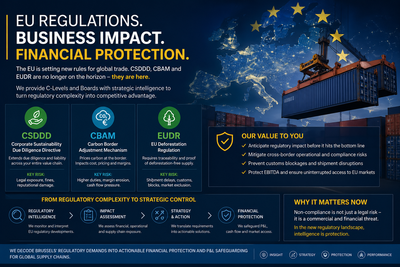
EUDR turns agro-commodity origin into market-access risk for food and beverage companies. CFOs must control SKU-to-commodity mapping, farm-level geolocation, legality evidence, aggregation risk, DDS workflows and inventory exposure before EU buyers challenge the product chain.
CSDDD Penalties: Calculating Fines and Director Liability
CSDDD penalties require more than a 3% turnover calculation. CFOs must model expected penalty exposure, national enforcement, commercial loss, director oversight risk, disclosure consistency and board defense evidence before due diligence failure becomes financial damage.
LkSG Risk-Analysis Tools: Quantitative Models for Supply-Chain Audits
LkSG risk analysis is the operating core of German supply-chain due diligence. CFOs must use quantitative models to prioritize supplier audits, weight human rights and environmental risks, allocate remediation budgets and protect German revenue before supplier failure becomes cash-flow exposure.
CSRD Materiality Mapping: Integrating Double Materiality into Governance
CSRD materiality mapping is a governance control, not a workshop output. CFOs must integrate double materiality into IRO mapping, board oversight, value-chain evidence, financial exposure and assurance-ready documentation before reporting risk becomes capital friction.
EU Waste Electrical and Electronic Equipment (WEEE) Recast: Producer Liabilities
The EU WEEE Recast turns electronic equipment sales into producer-liability exposure. CFOs must control SKU classification, registration, EPR fees, take-back obligations, treatment evidence and back-compliance risk before e-waste costs erode margin.