
Supply Chain Evidence Rooms: Why CFOs Need a Board-Ready Regulatory Data Room
Villanova ESG | Executive Regulatory Dossier
Supply Chain Evidence Rooms: Why CFOs Need a Board-Ready Regulatory Data Room
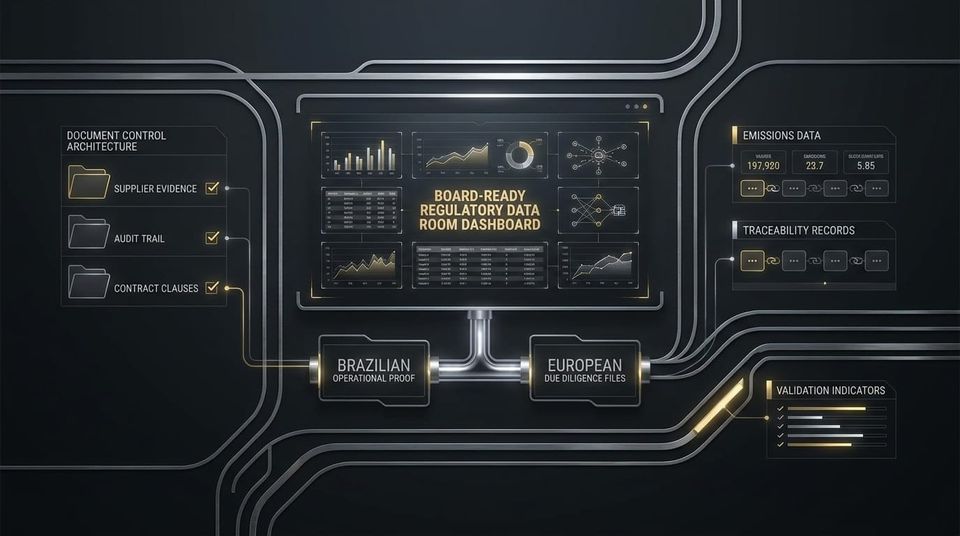
European-facing supply-chain risk cannot be managed through scattered folders, certificates, emails and reactive questionnaire responses. CFOs need a board-ready evidence room that connects operational proof, supplier documentation, contract obligations, reporting data and regulatory exposure into a controlled decision file.
Risk Vector
Evidence Control
A regulatory data room organizes documents by risk, customer, supplier, contract, product, evidence owner and review purpose.
Financial Exposure
Response Cost
Fragmented evidence increases audit cost, buyer response time, legal review, remediation effort and management escalation.
Board Relevance
Decision Readiness
Boards need evidence that can be reviewed quickly, challenged logically and connected to financial exposure.
The Strategic Change
European regulatory pressure is increasing the operational value of documentation. Due diligence, sustainability reporting, buyer questionnaires, emissions requests, product traceability, contract clauses and supplier audits all depend on one core asset: evidence that can be located, understood, tested and defended.
The problem is not always absence of documents. The problem is absence of architecture. Many suppliers have certificates, invoices, service orders, audit records, operational logs, transport documents and supplier declarations. But those records are often disconnected. A board-ready evidence room converts scattered proof into a reviewable regulatory file.
Board-Level Interpretation
A supply-chain evidence room is not document storage. It is a governance instrument that allows CFOs and boards to see which evidence exists, which evidence is weak and which gaps can affect revenue, margin and regulatory defensibility.
Why Brazilian Operations Need an Evidence Room
Brazilian operations often generate proof through daily execution. Collection records, destination documents, logistics files, technical reports, environmental records, supplier contracts and customer communications may all exist. But when a European buyer requests a defensible file, the company must answer a different question: can this evidence be assembled into a coherent regulatory position?
A board-ready evidence room reduces response friction. It prevents sales teams from improvising answers. It prevents legal teams from reviewing clauses without knowing whether operational evidence exists. It gives finance visibility over the cost of gaps. It gives executives a structured view of exposure before the buyer, auditor or lender asks for it.
Fragmented Evidence Risk
- Certificates stored without supporting chain-of-custody records.
- Supplier files separated from contract obligations.
- Questionnaire answers not linked to evidence attachments.
- Operational proof stored by department, not by buyer risk.
- Evidence gaps discovered only after audit or renewal pressure begins.
Board-Ready Evidence Logic
- Documents organized by customer, risk theme and financial exposure.
- Clear ownership for each evidence category.
- Version control and submission history for buyer-facing answers.
- Gap register with remediation cost and priority.
- Executive summary connecting evidence quality to contract risk.
Finance-Grade Risk Formula
Evidence Room Readiness Model
Evidence Room Readiness = Evidence Completeness × Traceability × Version Control × Review Speed × Financial Linkage
This is a management risk model, not a statutory formula. To quantify it, a company needs internal data: document inventory, buyer requirements, contract clauses, supplier records, audit history, response time, evidence owners, remediation cost and revenue exposure by customer.
The CFO Problem: Evidence Without Architecture Becomes Cost
CFOs should treat evidence architecture as a cost-control mechanism. Every hour spent searching for documents, reconstructing proof, validating old answers or responding to buyer escalation is cost. When evidence is fragmented, regulatory cost-to-serve increases.
The financial effect is measurable. A weak evidence room increases legal review time, audit response cost, buyer friction, management escalation and remediation uncertainty. A strong evidence room reduces the marginal cost of each new buyer request. That makes evidence architecture a margin-protection tool.
CFO Diagnostic Question
If a European buyer requested a complete supplier evidence file tomorrow, would the company open a controlled data room — or start searching through emails, folders and department archives?
What a Board-Ready Evidence Room Should Include
A regulatory evidence room must be structured for decision-making, not for document accumulation. Its purpose is to show what can be defended, what requires remediation and what cannot be claimed without risk.
1. Evidence Index
Master index linking documents to regulatory themes, buyer requests, contract clauses, supplier risks, products, customers and responsible owners.
2. Buyer Response Archive
Version-controlled record of questionnaires, submitted answers, supporting evidence, review approvals and submission dates.
3. Gap and Remediation Register
Prioritized list of missing evidence, weak records, unsupported claims, corrective actions, deadlines, owners and estimated remediation cost.
4. Board-Level Exposure Summary
Executive dashboard connecting evidence maturity to revenue at risk, margin exposure, customer dependency, audit probability and contract renewal.
CFO Control Model
Evidence Response Cost
Evidence Response Cost = Search Time + Validation Time + Legal Review + Evidence Reconstruction + Buyer Escalation Cost
A controlled evidence room reduces search time and reconstruction cost. It does not eliminate compliance obligations. It reduces friction by making the company faster, more consistent and more defensible when buyer pressure appears.
Brazil-Europe Evidence Bridge
Where Ecobraz and Villanova ESG Fit
Ecobraz proves what happens in the Brazilian operation. Villanova ESG translates that proof into regulatory evidence European boards, CFOs, procurement, legal and compliance teams can use.
In supply-chain evidence rooms, the value is control. Brazilian operational records become commercially stronger when they are indexed, interpreted and connected to European buyer requirements before the request arrives.
Decision Trigger for CFOs and Boards
A board-ready evidence room should be built when at least one of the following conditions exists:
- European buyers are requesting recurring questionnaires, audits, evidence files or supplier documentation.
- Evidence is stored across departments without a single controlled index.
- Commercial teams answer buyer questions without attaching validated evidence.
- Legal reviews contract clauses without visibility over operational proof.
- Compliance cost is rising because documents must be reconstructed under deadline pressure.
- The board needs a clear view of which evidence gaps could affect revenue, margin or contract renewal.
Executive Position
Evidence rooms are not administrative repositories. They are regulatory control systems. CFOs who build them early reduce response cost, negotiation friction and board-level uncertainty.
Regulatory Source Trail
This dossier is based on official and institutional due diligence and reporting references. The evidence-room model presented here is an executive governance model, not a statutory formula, legal opinion or assurance methodology. Company-specific assessment requires document inventory, contracts, buyer requirements, supplier records, operational evidence, data governance review and jurisdiction-specific analysis.
- European Commission — Corporate sustainability due diligence: official CSDDD page.
- European Commission — Corporate sustainability reporting: official CSRD and sustainability reporting page.
- OECD — Due Diligence Guidance for Responsible Business Conduct: official OECD guidance page.
Executive Review
Build a Board-Ready Evidence Room Before Buyer Requests Become Audit Pressure
Villanova ESG supports companies that need to translate Brazilian operational evidence into European-facing regulatory data rooms. The objective is not document accumulation. The objective is evidence control, response speed, buyer-risk reduction and board-level defensibility.
For confidential executive reviews: contact@villanovaesg.com