
Recycling Is Not a Claim: It Is an Evidence Architecture
Villanova ESG Executive Dossier
Recycling Is Not a Claim: It Is an Evidence Architecture
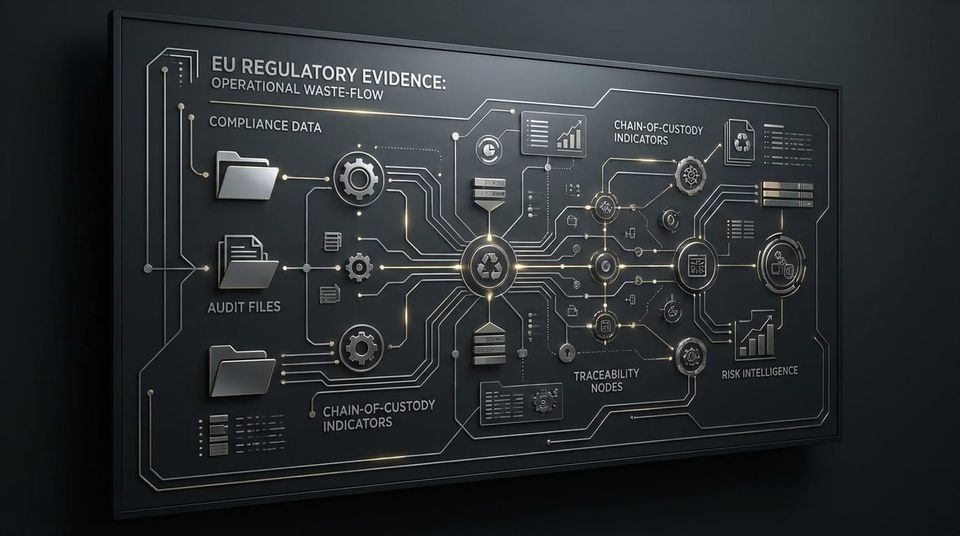
Recycling is losing value as a corporate statement when it is not supported by traceability, documentation and operational proof. For European-facing companies, circularity must be defensible as evidence, not presented as a slogan.
Risk Class
Circularity claim, waste-flow and documentation exposure.
Financial Channel
Buyer confidence, audit cost, reputational exposure and contract defensibility.
Evidence Trigger
Chain-of-custody, destination proof, supplier records and audit-grade recycling documentation.
Executive Signal
Recycling has been overused as a corporate claim.
For European-facing companies, that period is ending.
The strategic issue is no longer whether a company says it recycles. The issue is whether the company can document what was collected, how it was handled, where it went, who processed it and which evidence supports the claim.
This changes recycling from a communications asset into a compliance and governance file.
The companies that treat recycling as a generic ESG statement will create exposure. The companies that treat recycling as evidence architecture will be better positioned for buyer review, audit scrutiny and board-level risk control.
The CFO Problem
A CFO does not manage recycling as a slogan. A CFO manages liability, cost, reputational exposure and evidence quality.
When recycling claims are unsupported, the risk moves beyond sustainability. It can reach procurement, legal, compliance, investor relations and board governance.
- Recycling claims may be challenged if operational proof is weak.
- Buyers may request traceability and destination documentation.
- Audit teams may reject generic certificates or incomplete supplier files.
- Waste-flow opacity may create environmental and reputational exposure.
- Supplier weakness may transfer risk back to the corporate generator.
- Circularity claims may become commercially fragile when documentation is not defensible.
The issue is not whether recycling occurred in some form. The issue is whether the company can prove the chain with enough precision to withstand scrutiny.
Why Recycling Is an Evidence-Sensitive Category
Recycling sits at the intersection of environmental liability, supplier quality, operational traceability, data integrity and circularity claims.
That makes it highly sensitive.
A weak recycling chain can create a false sense of risk transfer. A company may believe responsibility ended at collection, while the evidence trail remains incomplete, fragmented or commercially unusable.
Recycling is defensible only when the operational chain can be converted into traceable, auditable and buyer-readable evidence.
In the EU circular economy agenda, waste is not treated as an isolated back-office issue. It is connected to product design, resource efficiency, secondary materials, waste prevention and market accountability.
That means the documentation layer will matter more, not less.
The Recycling Evidence Gap
Many companies have recycling suppliers. Fewer have recycling evidence architecture.
This distinction matters.
A supplier invoice, collection receipt or generic certificate may not be enough to defend a circularity claim or environmental-risk position.
The evidence gap appears when the company cannot connect operational facts into a coherent file:
- what material was collected;
- where it was collected;
- who handled it;
- how it was segregated;
- where it was processed;
- what documentation proves the destination;
- which residual risks remained in the chain.
When this chain is weak, recycling becomes a claim. When it is structured, recycling becomes defensible evidence.
Financial Risk Formula
Recycling exposure can be structured as a financial-risk model.
Recycling Evidence Exposure
REE = CV × SQ × EG × RI
- CV = Commercial value exposed to recycling or circularity claims.
- SQ = Supplier quality and operational traceability risk.
- EG = Evidence gap across documentation, destination and chain-of-custody.
- RI = Reputational and audit impact if the claim is challenged.
This formula cannot be calculated responsibly without internal company data.
Required inputs include waste volume, material type, supplier qualification, destination documentation, buyer exposure, ESG claims, audit history, contract language, regulatory scope, circularity reporting and reputational sensitivity.
The logic is direct: when commercial value depends on circularity claims and evidence quality is weak, recycling becomes a governance and cash-flow exposure.
The Buyer-Readiness Test
A company becomes recycling evidence-ready when it can demonstrate the operational chain without improvisation.
The essential questions are direct:
- Material Scope: Which waste streams or recyclable materials are included?
- Operational Traceability: Can the company document collection, handling and destination?
- Supplier Quality: Are recycling suppliers properly assessed and documented?
- Chain-of-Custody: Can material movement be evidenced from generation to destination?
- Claim Integrity: Are public recycling or circularity claims supported by records?
- Residual Risk: Are non-recyclable fractions, hazardous fractions or data-bearing assets controlled?
- Governance: Can the evidence be used by procurement, compliance, legal, auditors and the board?
The company that can answer these questions has more than a recycling supplier.
It has a defensible evidence file.
Decision Trigger for CFOs
A CFO should escalate recycling evidence exposure when one or more of the following conditions exist:
- The company makes recycling, circularity or waste-diversion claims.
- Recycling evidence depends on generic supplier certificates.
- Waste flows include electronics, data-bearing assets, hazardous fractions or mixed materials.
- Destination proof is incomplete, inconsistent or difficult to verify.
- European buyers request environmental or circularity documentation.
- Procurement relies on low-cost suppliers without audit-grade documentation.
- ESG reports mention recycling performance without operational traceability.
- The board cannot review a clear evidence file for waste and recycling claims.
The trigger is not the collection event. The trigger is the absence of defensible proof after collection.
The Strategic Role of Villanova ESG
Villanova ESG does not replace legal counsel, waste regulators, auditors or licensed operational providers.
Its role is to translate operational recycling evidence into European-facing regulatory and board-level documentation.
Where Brazilian execution is relevant, Ecobraz can provide the operational proof layer: collection, segregation, handling, destination evidence and traceable documentation within the limits of the executed service.
Villanova ESG translates that operational proof into a buyer-readable evidence architecture for companies facing European scrutiny.
The objective is not to promise risk elimination. The objective is to improve regulatory defensibility, claim integrity and evidence discipline.
That distinction matters. Recycling is not defended by intention. It is defended by documentation.
What Companies Should Prepare
Preparation should begin before a buyer, auditor or board committee challenges the recycling claim.
Once the claim is questioned, the company is already defending from a weaker position.
- Waste-stream and material-scope map.
- Supplier qualification and documentation review.
- Collection, transport, handling and destination records.
- Chain-of-custody evidence.
- Residual waste and non-recyclable fraction documentation.
- Data-bearing asset control records where applicable.
- Claim-to-evidence reconciliation for ESG reports and public statements.
- Buyer-facing evidence package.
- Board-readable recycling risk memorandum.
- Corrective action plan for evidence gaps.
This preparation is not environmental decoration. It is governance infrastructure.
Regulatory Source Trail
This dossier is based on official and institutional regulatory references, including:
- European Commission — Circular Economy Action Plan.
- European Commission — Waste and circular economy policy materials.
- European Commission — Product lifecycle and secondary materials policy direction.
- Official EU materials on waste prevention, product design, resource efficiency and recycling-linked circularity.
No legal, environmental or regulatory guarantee is implied. Company-specific conclusions require review of waste flows, supplier documentation, destination evidence, public claims, buyer exposure and applicable regulatory scope.
Executive Review
Recycling is not a claim. It is an evidence architecture.
The companies that treat recycling as a communications statement will remain exposed. The companies that treat it as traceability, documentation and operational proof will be better positioned.
Villanova ESG supports companies that need to translate Brazilian operational reality into European-facing regulatory evidence, board-level documentation and buyer-readiness architecture.
contact@villanovaesg.com