
The New Brazil-Europe Standard
Executive Dossier · Trust Engineering Series
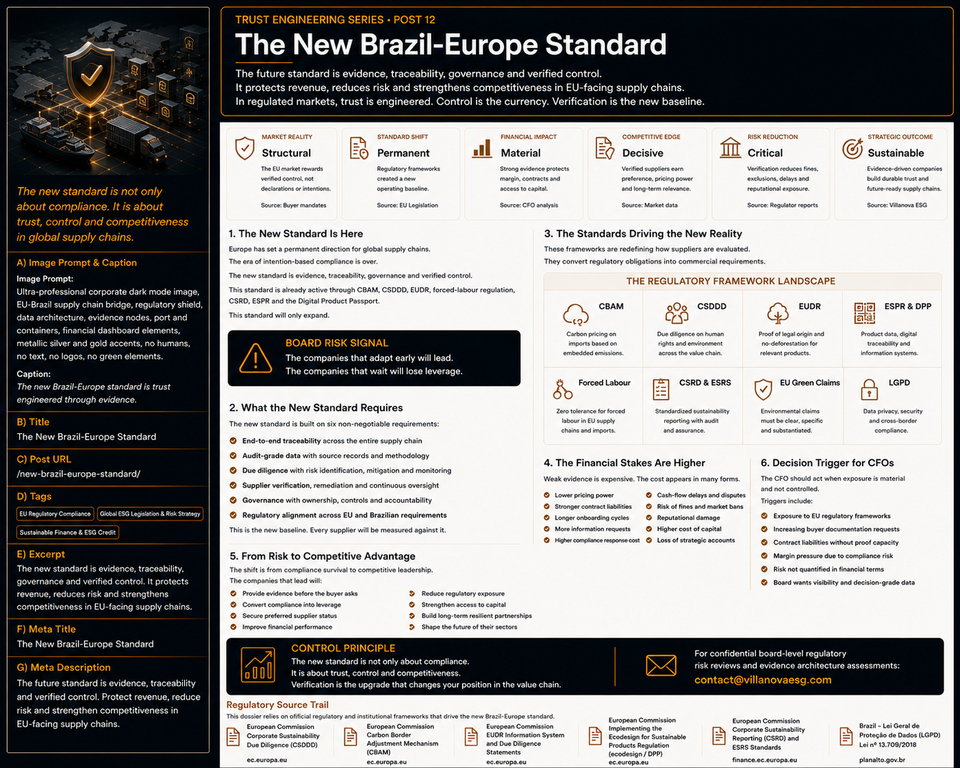
The new Brazil-Europe standard is evidence, traceability, governance and verified control. In regulated markets, trust is no longer assumed. It is engineered, tested and defended.
This dossier is written from the executive perspective of Marcio Villanova, CEO of Ecobraz and Founder of Villanova ESG. The future of Brazil-Europe trade will not be built on cultural confidence, commercial history or unsupported ESG narratives. It will be built on proof by design.
Market Reality
The EU market rewards verified control, not declarations of intention.
Standard Shift
Regulatory frameworks created a new operating baseline.
Financial Impact
Strong evidence protects margin, contracts and access to capital.
Strategic Outcome
Evidence-driven companies will become the preferred counterparties.
The New Standard Is Here
Europe has set a permanent direction for global supply chains.
The era of intention-based compliance is over. The new standard is evidence, traceability, governance and verified control.
This standard is already visible across CBAM, CSDDD, EUDR, forced-labour regulation, CSRD, ESPR and Digital Product Passport architecture.
The common thread is clear: companies connected to Europe must prove what they claim, control what they report and defend what they sell.
Board Risk Signal
The companies that adapt early will lead. The companies that wait will lose leverage before they lose market access.
What the New Standard Requires
The new Brazil-Europe standard is built on six non-negotiable requirements.
- End-to-end traceability across the supply chain.
- Audit-grade data with source records, methodology and ownership.
- Due diligence with risk identification, mitigation and continuous monitoring.
- Supplier verification with remediation and accountability.
- Governance with controls, approvals, access rules and Board visibility.
- Regulatory alignment across EU and Brazilian requirements.
This is the new baseline. Every supplier will be measured against it.
New Standard Formula
EU-Brazil Market Trust = Evidence Architecture × Traceability × Regulatory Alignment × Governance Control × Financial Resilience
This formula requires internal company data. A real assessment depends on export exposure, buyer concentration, supplier maturity, product scope, emissions data, due-diligence files, contracts, governance controls and revenue-at-risk modelling.
The Standards Driving the New Reality
These frameworks are redefining how suppliers are evaluated.
They convert regulatory obligations into commercial requirements.
Regulatory Framework Landscape
CBAM
Carbon pricing and import exposure linked to embedded emissions, emissions methodology and buyer cost sensitivity.
CSDDD
Corporate due diligence pressure over human-rights and environmental risks across global value chains.
EUDR
Deforestation-risk control, due diligence statements and proof of origin for relevant products and commodities.
ESPR & DPP
Product data, lifecycle information, traceability and digital product-passport infrastructure for regulated product categories.
Forced-Labour Regulation
Zero-tolerance logic for products made with forced labour, creating market-access and customs exposure.
CSRD & ESRS
Sustainability reporting requirements that increase pressure for structured, material and defensible corporate information.
The Financial Stakes Are Higher
Weak evidence is expensive. The cost appears in many forms.
- lower pricing power;
- stronger contractual liabilities;
- longer onboarding cycles;
- more information requests;
- higher compliance response cost;
- cash-flow delays and disputes;
- risk of fines, exclusions and market bans;
- reputational damage;
- higher cost of capital;
- loss of strategic accounts.
These are not abstract ESG issues. They are P&L exposure points.
Control Principle
The new standard is not only about compliance. It is about trust, control and competitiveness.
From Risk to Competitive Advantage
The shift is from compliance survival to competitive leadership.
The companies that lead will:
- provide evidence before the buyer asks;
- convert compliance into leverage;
- secure preferred supplier status;
- improve financial performance;
- reduce regulatory exposure;
- strengthen access to capital;
- build long-term resilient partnerships;
- shape the future of their sectors.
The companies that delay will negotiate from weakness.
Decision Trigger for CFOs
The CFO should act when European exposure is material and not controlled through evidence architecture.
A new-standard readiness review becomes urgent when:
- the company depends on European buyers or EU-linked supply chains;
- buyer documentation requests are increasing;
- contracts transfer regulatory exposure upstream;
- supplier evidence is incomplete or fragmented;
- emissions, deforestation, product or human-rights data cannot be verified;
- compliance risk is not quantified in P&L terms;
- the Board wants visibility before expanding into Europe.
The Villanova ESG New Standard Framework
Villanova ESG operates at the intersection between European regulatory risk and cash-flow protection for cross-border supply chains.
The role is to help companies move from reactive compliance to engineered trust.
The framework includes:
- EU exposure diagnosis: identify applicable frameworks, buyer requirements and revenue-at-risk.
- Evidence architecture design: structure proof across products, suppliers, emissions, due diligence, contracts and data governance.
- Traceability implementation: connect operational reality to source records, custody trails and buyer-facing claims.
- Regulatory alignment: map evidence to CBAM, CSDDD, EUDR, CSRD, ESPR, DPP, forced-labour regulation and LGPD.
- Financial-risk modelling: translate regulatory gaps into margin exposure, contract risk, cash-flow delay and capital credibility.
- Board dashboard: provide decision-grade visibility for CFOs, C-Levels and directors.
Regulatory Source Trail
This dossier relies on official regulatory and institutional frameworks that drive the new Brazil-Europe standard:
- European Commission — Corporate Sustainability Due Diligence
- European Commission — Carbon Border Adjustment Mechanism
- European Commission — EUDR Information System and Due Diligence Statements
- European Commission — Implementing the Ecodesign for Sustainable Products Regulation
- Directive (EU) 2026/470 — Amendments to CSRD and CSDDD Reporting Requirements
Closing CTA · Build the New Brazil-Europe Standard
The future of Brazil-Europe trade will be built on proof by design.
EU-facing companies cannot depend on inherited trust, commercial history or unsupported ESG language. They need evidence architecture, traceability, governance and financial-risk control capable of defending market access and protecting cash flow.
Schedule a confidential new-standard readiness review with our advisory team at contact@villanovaesg.com.