Legislative Conflicts (BR vs. EU): Managing Double Regulatory Exposure
The Jurisdictional Collision
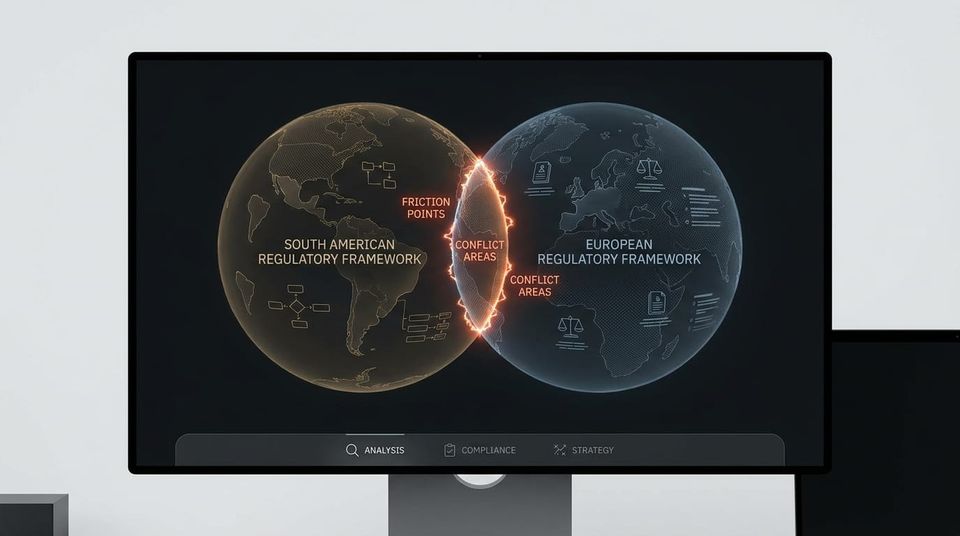
Multinational corporations and Brazilian exporters are currently navigating a severe jurisdictional collision. Operating a cross-border supply chain in 2026 requires balancing the local requirements of Brazilian federal law against the aggressive extraterritorial mandates of the European Union.
When these legal frameworks conflict, C-Level executives face a mathematical and operational trap: "Double Regulatory Exposure." Relying on the legality of an action under Brazilian jurisdiction does not grant immunity from European sanctions. In fact, strict compliance with local laws can inadvertently trigger catastrophic customs blockades and civil liability in the European Common Market.
The Trap of "Legal" Deforestation
The most critical friction point exists between the Brazilian Forest Code (Código Florestal) and the European Union Deforestation Regulation (EUDR).
- The Local Baseline: Brazilian law permits legal suppression of native vegetation under specific parameters—for instance, allowing up to 80% clearing in certain areas of the Cerrado biome, provided the operator holds a valid suppression authorization from local environmental agencies.
- The European Override: The EUDR mathematically rejects this local legality. The European framework enforces a strict cut-off date of December 31, 2020. Any commodity produced on land deforested after this date—regardless of whether the deforestation was fully authorized and legal under Brazilian law—is permanently banned from the European market.
- The Financial Fallout: A Brazilian exporter who relies on local environmental licenses to clear land and expand production will find their entire harvest locked out of Europe. The cargo will be blocked at the port, triggering immediate demurrage fees, contract terminations, and the destruction of the projected ROI on the agricultural expansion.
(Source reference: Brazilian Forest Code Law 12.651/2012 vs. Official European Commission EUDR regulatory text).
The Asymmetry of Corporate Liability
The conflict extends beyond physical commodities into corporate governance. Under the Corporate Sustainability Due Diligence Directive (CSDDD), European matrices are legally bound to enforce European human rights and environmental standards across their entire global value chain.
When a Brazilian subsidiary operates under local labor standards that fall short of CSDDD mandates, the European headquarters absorbs the legal liability. European NGOs and affected communities can now bypass local Brazilian courts and file civil litigation directly in European jurisdictions, targeting the matrix's global turnover for infractions committed by the Latin American subsidiary. This asymmetry forces the CFO to manage two entirely different risk ledgers simultaneously.
The Villanova ESG Shield: Strategic Intervention
At Villanova ESG, we engineer the operational architecture necessary to survive this jurisdictional collision. We eliminate double regulatory exposure by enforcing the strictest denominator across your supply chain. We secure your cross-border operations through our four uncompromising pillars:
- Cross-Border Regulatory Shield: We map the exact friction points between Brazilian compliance and European directives. We architect a unified operational protocol that surpasses local legal minimums, guaranteeing that your operation is structurally shielded from EUDR customs blockades and CSDDD civil litigation.
- Logistical Reality Audit: We bypass the illusion of local paperwork. We execute deep-tier, georeferenced audits of your supply chain to identify "legal" local practices that constitute fatal flaws under European law. We extract the primary data required to prove absolute compliance with the European standard.
- P&L and Revenue Protection: We protect your cash flow from the trap of conflicting legislation. By ensuring your export volume complies with the uncompromising European cut-off dates and due diligence standards, we defend your revenue lines from border retentions, confiscatory fines, and the loss of international off-takers.
- Cost of Capital Optimization: International credit syndicates penalize jurisdictional uncertainty. We leverage your audited, cross-border compliance data to prove your operation is free from double exposure. This verified risk mitigation is utilized to secure Sustainability-Linked Loans (SLLs), actively reducing your Weighted Average Cost of Capital (WACC).
Relying on local legality is no longer a defense against European enforcement. Do not let jurisdictional conflicts destroy your market access and corporate valuation. Contact our risk assessment team immediately to structure your cross-border regulatory shield and neutralize your double exposure at contact@villanovaesg.com
Marcio Villanova CEO, Ecobraz | Founder, Villanova ESG