Joint Liability in Agricultural Supply Chains: The Risk Mapped by European Institutional Investors
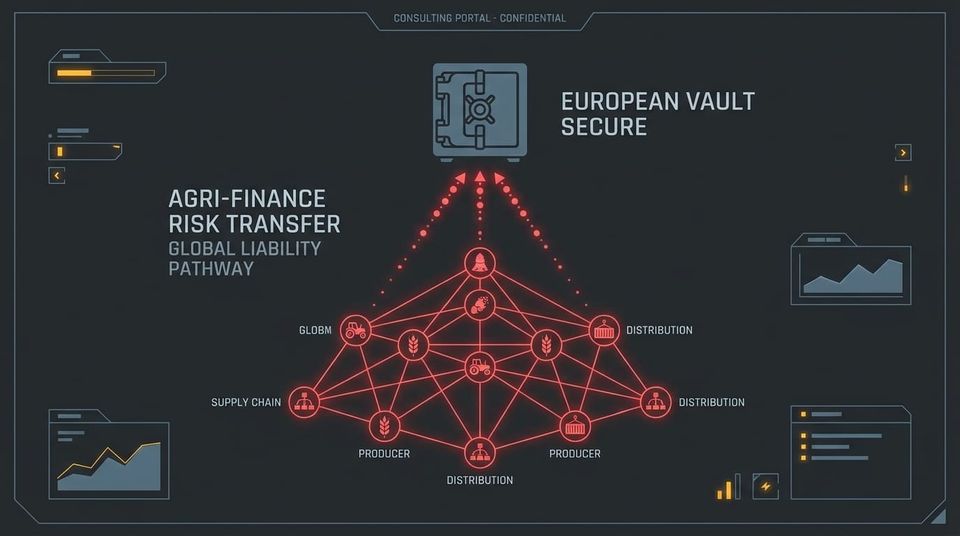
The Contagion of Strict Liability in Agribusiness
For European institutional investors deploying Foreign Direct Investment (FDI) into the Brazilian agricultural sector, the traditional risk-return calculus has been violently upended by a specific mechanism of Brazilian environmental law: Strict and Joint Liability (Responsabilidade Civil Objetiva e Solidária).
In the Brazilian legal framework, environmental damage and severe labor infractions do not solely penalize the direct perpetrator. Liability travels aggressively up the supply chain. If an exporter, a multinational trading company, or an investment fund profits from commodities produced on illegally deforested land or under embargoed conditions, Brazilian prosecutors possess the legal authority to target the "deep pockets" at the top of the chain. For European asset managers, an unmapped Brazilian agricultural supply chain is no longer just an ESG negative; it is an unquantifiable, systemic legal hazard.
The Mathematics of Legal Contagion
When institutional capital evaluates a Brazilian agribusiness for M&A, equity injection, or debt structuring, the investment committee applies ruthless financial modeling to the concept of joint liability.
- Asset Freezing (Sisbajud): If the Brazilian Federal Public Ministry (MPF) initiates a civil inquiry against an unverified Tier 3 supplier, they can legally include the exporting matrix as a co-defendant. This frequently results in the immediate, preventative freezing of corporate bank accounts and assets to guarantee future remediation payouts, instantaneously paralyzing the corporation's working capital.
- The "Deságio" of the Unknown: Because joint liability attaches the financial penalty of environmental remediation directly to the buyer or off-taker, European M&A funds apply massive valuation discounts (deságio) to target companies that cannot forensically map their indirect suppliers. The assumption is maximum legal exposure.
- The Exclusion from Premium Capital: Under the European Sustainable Finance Disclosure Regulation (SFDR), institutional funds cannot allocate capital to entities facing severe, unmitigated legal risks regarding environmental degradation. A Brazilian agricultural operation heavily exposed to joint liability is mathematically excluded from premium European liquidity, forcing the CFO into highly expensive secondary credit markets.
(Source reference: Brazilian National Environmental Policy Law 6.938/81 establishing strict liability, and European SFDR fiduciary mandates).
The "Aggregator" Blind Spot
The most critical vector for joint liability contagion is the indirect supplier—specifically, the cooperative, the local silo, or the grain aggregator.
Corporate boards frequently rely on contracts that stipulate the aggregator must only supply "clean" commodities. However, aggregators physically mix grains from dozens of unverified Tier 2 and Tier 3 farms. Under the principle of joint liability, if 1% of the soy inside a silo originates from an embargoed, deforested plot, the entire 100% volume purchased by the exporting matrix is legally contaminated. Relying on contractual warranties from aggregators without executing forensic, georeferenced audits is a direct breach of fiduciary duty by the buying corporation's executive board.
The Villanova ESG Shield: Strategic Intervention
At Villanova ESG, we engineer structural defenses against the financial contagion of Brazilian environmental law. We do not allow deep-tier local infractions to destroy foreign capital. We secure your FDI and corporate valuation through our four uncompromising pillars:
- Logistical Reality Audit: We dismantle the aggregator blind spot. We deploy forensic satellite tracking and geospatial intelligence to audit the physical reality of indirect agricultural suppliers. We isolate and eliminate contaminated nodes before their joint liability can travel up the supply chain and infect your balance sheet.
- Cross-Border Regulatory Shield: We architect a data baseline that satisfies both the aggressive demands of Brazilian prosecutors (MPF) and the rigid fiduciary requirements of European institutional investors (SFDR, CSDDD). We prove mathematically that your operation is insulated from local strict liability, securing your cross-border market access.
- Cost of Capital Optimization: An agricultural supply chain verified as free from joint liability is a premium, highly liquid asset. We leverage this forensic proof of structural safety to attract top-tier European FDI and secure Sustainability-Linked Loans (SLLs), transforming rigorous risk management into a tool that aggressively reduces your Weighted Average Cost of Capital (WACC).
- P&L and Revenue Protection: We defend your working capital from preventative asset freezing and catastrophic civil litigation. By guaranteeing the legal integrity of your supply chain, we protect your EBITDA margins from unpredictable remediation Capex and safeguard the enterprise valuation in M&A scenarios.
Joint liability ensures that the environmental failures of a hidden supplier become your direct financial burden. Do not expose European capital to unmapped Brazilian agricultural risks. Contact our risk assessment team immediately to structure your cross-border regulatory shield and audit your supply chain at contact@villanovaesg.com
Marcio Villanova CEO, Ecobraz | Founder, Villanova ESG