
Industrial Inputs: The Hidden Compliance Risk in EU-Brazil Trade
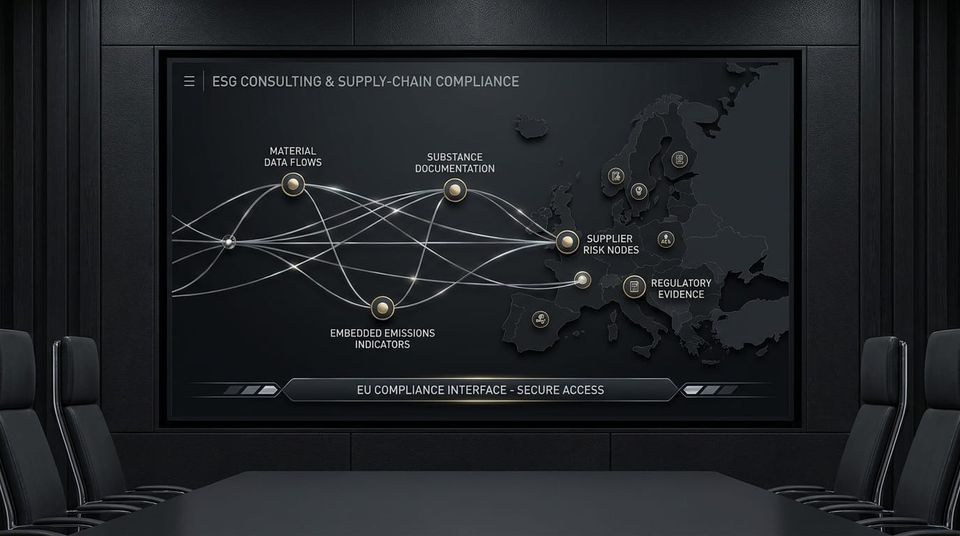
Villanova ESG Executive Dossier
Industrial Inputs: The Hidden Compliance Risk in EU-Brazil Trade
Industrial inputs are often invisible to the end customer. But for European-facing supply chains, chemicals, fertilisers, metals, components and intermediate materials can carry hidden regulatory exposure. The decisive question is whether the supplier can document substance, carbon, origin, safety and due diligence evidence before the buyer escalates the file.
Risk Class
Industrial input, chemical, component and intermediate-material exposure.
Financial Channel
Buyer qualification, customs friction, product continuity, margin pressure and contract defensibility.
Evidence Trigger
Substance data, safety documentation, embedded emissions, supplier records and product-flow traceability.
Executive Signal
Industrial inputs are rarely the most visible part of a product.
That is exactly why they create hidden compliance risk.
A chemical additive, fertiliser, metal input, coating, resin, component, packaging input or processing material may sit deep inside a supply chain. But when the finished product reaches a European buyer, the regulatory questions can move backwards through the chain.
The buyer may need substance information, emissions data, supplier declarations, safety documentation, origin evidence or due diligence records.
If those records are incomplete, the supplier becomes a risk variable even when the product itself performs commercially.
The CFO Problem
A CFO does not manage industrial inputs as technical details. A CFO manages exposure embedded in procurement, revenue, margin, contract continuity and buyer trust.
When input documentation is weak, the financial risk can surface late, under buyer pressure, audit pressure or customs pressure.
- European buyers may request substance, safety or product-composition evidence.
- CBAM-sensitive inputs may create embedded emissions and carbon-cost questions.
- Chemical inputs may require stronger documentation under EU chemical safety expectations.
- Supplier records may become material under value-chain due diligence pressure.
- Contract negotiations may include tighter documentation and audit clauses.
- Documentation gaps may delay product onboarding, shipment approval or buyer renewal.
The financial problem is not the existence of regulation in the abstract. The financial problem is discovering missing evidence after the commercial relationship is already under review.
Why Industrial Inputs Are Evidence-Sensitive
Industrial inputs create layered risk because they often sit upstream from the visible product.
They may affect safety, emissions, product composition, restricted substances, production route, environmental profile, supplier risk and technical conformity.
This makes industrial inputs highly sensitive for EU-facing buyers.
In industrial trade, the hidden input often becomes visible only when the buyer asks for evidence.
REACH places chemical substance risk under a structured EU regulatory framework. CBAM connects certain industrial imports to embedded emissions. CSDDD increases the strategic importance of supplier and value-chain due diligence for companies in scope.
These regimes are different. They should not be collapsed into one generic compliance topic.
The common operational implication is evidence discipline.
The Industrial Input Evidence Gap
Many suppliers know what they produce. Fewer can prove what the buyer needs to defend.
This distinction matters.
Industrial input evidence may sit inside safety data sheets, technical specifications, supplier declarations, purchase orders, bills of materials, production records, emissions data, customs classification files, laboratory reports, ERP systems and internal engineering documents.
But European-facing buyers may need that information structured into a clear, current and defensible evidence file.
The evidence gap appears when a supplier can deliver the input but cannot explain its regulatory profile.
That gap can become a commercial obstacle before any formal regulatory finding exists.
Financial Risk Formula
Industrial input exposure can be structured as a revenue and documentation-risk model.
Industrial Input Exposure
IIE = ER × DS × CE × BT
- ER = EU-facing revenue exposed to industrial input supply.
- DS = Documentation shortage across substance, safety, composition, emissions or origin records.
- CE = Compliance exposure linked to chemical, carbon, product or value-chain requirements.
- BT = Buyer tolerance level before delay, substitution, audit escalation or renegotiation.
This formula cannot be calculated responsibly without internal company data.
Required inputs include revenue by product line, buyer concentration, product classification, chemical substance profile, safety documentation, emissions data, supplier tiers, customs classification, contract obligations, technical conformity files and buyer-specific evidence requests.
The logic is direct: when EU-facing revenue is material and input documentation is weak, hidden compliance exposure becomes a cash-flow and buyer-continuity risk.
The Buyer-Readiness Test
An industrial input supplier becomes buyer-ready when it can support the buyer’s regulatory file without improvisation.
The essential questions are direct:
- Product Scope: Which industrial inputs, chemicals, materials or components are connected to EU-facing buyers?
- Classification: Are product, customs, substance and technical classifications clear?
- Substance Data: Can chemical composition, safety and restriction-related information be documented?
- Carbon Data: If relevant, can embedded emissions and production-route data be explained?
- Supplier Evidence: Are upstream suppliers mapped and documentation-controlled?
- Contract Exposure: Do buyer contracts include audit, compliance, reporting or data clauses?
- Governance: Can the evidence be reviewed by procurement, legal, compliance, finance and board stakeholders?
The supplier that prepares this evidence early reduces buyer friction.
That is where technical documentation becomes commercial leverage.
Decision Trigger for CFOs
A CFO should escalate industrial input evidence exposure when one or more of the following conditions exist:
- The company supplies chemicals, fertilisers, metals, components, coatings, resins, additives, packaging inputs or intermediate materials into EU-facing chains.
- European buyers request substance, safety, emissions, origin or supplier documentation.
- Product data is dispersed across technical, commercial, procurement and logistics teams.
- Safety data sheets, technical files or supplier declarations are incomplete, outdated or inconsistent.
- The product may be connected to CBAM-sensitive categories, chemical restrictions or buyer due diligence obligations.
- Contracts include audit, compliance, traceability or data-sharing clauses.
- Buyer concentration is material and evidence readiness is weak.
- The board cannot review a clear industrial input exposure file.
The trigger is not only regulatory enforcement. The trigger is missing evidence before buyer escalation.
The Strategic Role of Villanova ESG
Villanova ESG does not replace legal counsel, chemical safety specialists, REACH consultants, customs advisors, technical laboratories, auditors, certification bodies or regulatory authorities.
Its role is to translate industrial input and supplier information into European-facing evidence architecture that can be understood by buyers, CFOs, procurement teams, compliance officers and boards.
For industrial inputs, this means structuring documentation around product scope, substance data, safety files, supplier records, embedded emissions, buyer exposure, contract obligations and financial-risk interpretation.
The objective is not to promise regulatory approval, buyer acceptance or customs clearance. The objective is to improve regulatory defensibility, buyer-readiness and evidence discipline.
Industrial inputs will not be defended by technical familiarity alone. They will be defended by structured documentation.
What Industrial Suppliers Should Prepare
Preparation should begin before a European buyer sends an urgent technical or compliance questionnaire.
Once the buyer controls the evidence timeline, the supplier is already reacting from a weaker position.
- EU-facing industrial input exposure map.
- Revenue and buyer concentration by product line.
- Product, customs and technical classification review.
- Substance, safety and technical documentation inventory.
- Supplier declaration and upstream documentation review.
- Embedded emissions and production-route evidence where relevant.
- Contract review for audit, reporting and data obligations.
- Evidence gap analysis by product category.
- Buyer-facing industrial input evidence package.
- Board-readable industrial input exposure memorandum.
This preparation is not administrative excess. It is commercial continuity infrastructure.
Regulatory Source Trail
This dossier is based on official and institutional regulatory references, including:
- European Commission — REACH Regulation official materials.
- European Commission — Corporate Sustainability Due Diligence Directive.
- European Commission — Carbon Border Adjustment Mechanism official materials.
- European Commission — CBAM sectors, including cement, aluminium, fertilisers, iron and steel, hydrogen and electricity.
- Official EU materials on chemical substance safety, value-chain due diligence and embedded carbon emissions.
No legal, chemical-safety, customs, technical-certification, buyer-approval or market-access guarantee is implied. Company-specific conclusions require review of product classification, substance profile, safety documentation, supplier data, emissions evidence, contracts, buyer exposure and applicable regulatory scope.
Executive Review
Industrial inputs are often hidden inside the product. Their risk is not hidden from European compliance systems.
The companies that treat input documentation as a technical back-office issue will remain exposed. The companies that treat it as buyer-readiness infrastructure will be better positioned.
Villanova ESG supports companies that need to translate industrial input and supplier information into European-facing regulatory evidence, board-level documentation and buyer-readiness architecture.
contact@villanovaesg.com