
How Weak Supply Chain Evidence Can Affect Valuation and Deal Risk
M&A & Valuation Risk Memo
How Weak Supply Chain Evidence Can Affect Valuation and Deal Risk
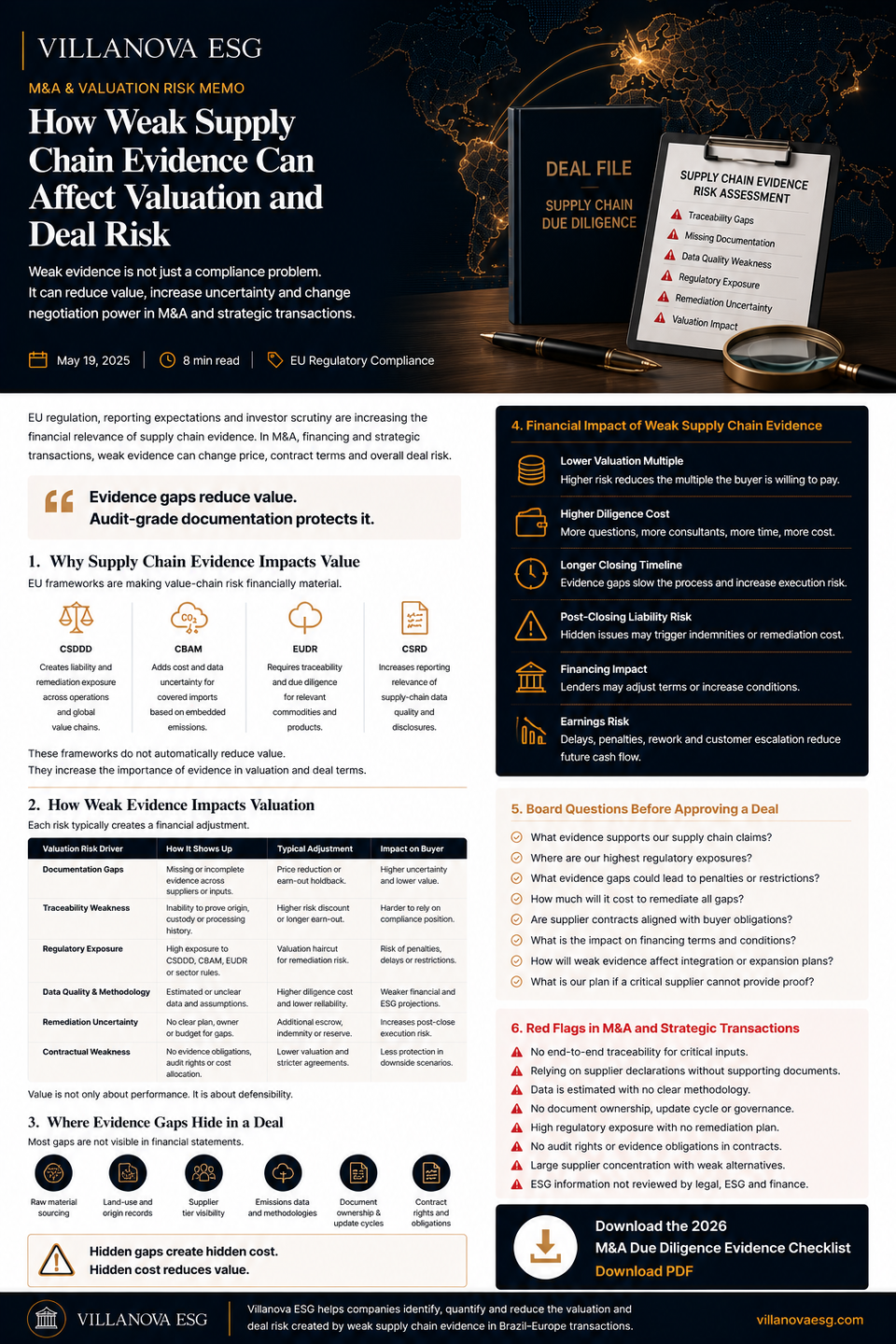
Weak evidence is not only a compliance problem. It can reduce value, increase uncertainty and change negotiation power in M&A, financing and strategic transactions.
Deal Variable
Evidence Quality
Valuation Risk
Discount + Escrow
Board Output
Deal Defensibility
Executive Thesis
Valuation is not driven only by revenue, EBITDA, growth and market positioning. In regulated supply chains, valuation also reflects uncertainty, documentation strength and post-closing exposure.
When supply-chain evidence is weak, buyers, lenders and investors may apply discounts, request stronger indemnities, demand escrow, delay closing or reprice risk through deal terms.
Hidden evidence gaps create hidden cost. Hidden cost reduces value.
For companies exposed to Brazil-Europe supply chains, evidence architecture is not only a compliance function. It is a value protection layer.
Why Evidence Impacts Valuation
CSRD increases the relevance of sustainability information in capital markets because companies subject to the directive must report according to European Sustainability Reporting Standards. For investors and buyers, weak value-chain information can increase review burden and reduce confidence in reported risk. :contentReference[oaicite:0]{index=0}
The European Banking Authority’s ESG risk guidance requires institutions to identify, measure, manage and monitor ESG risks within governance and risk-management frameworks. This reinforces the role of evidence quality in lender and investor risk perception.
OECD due diligence guidance helps businesses understand and implement risk-based due diligence for responsible business conduct, including supply-chain and business relationship risk. In transactions, that makes traceability, supplier evidence and remediation planning financially relevant. :contentReference[oaicite:1]{index=1}
Sustainability-linked finance also depends on information credibility. ICMA states that sustainability-linked instruments rely on structuring features, disclosure and reporting. Weak evidence can therefore weaken financing narratives and increase transaction scrutiny. :contentReference[oaicite:2]{index=2}
How Weak Evidence Impacts Valuation
Each documentation weakness can become a valuation adjustment.
| Valuation Risk Driver | How It Shows Up | Typical Deal Adjustment | Buyer Concern |
|---|---|---|---|
| Documentation Gaps | Missing, incomplete or inconsistent supplier evidence. | Price reduction, holdback or closing condition. | Unknown remediation cost and weak defensibility. |
| Traceability Weakness | Inability to prove origin, custody, upstream exposure or chain of control. | Higher risk discount or stronger warranties. | Harder to rely on supplier continuity and market access. |
| Regulatory Exposure | High relevance to CSDDD, CBAM, EUDR, CSRD or sector rules. | Valuation haircut for remediation or future cost. | Risk of penalties, delays, buyer rejection or restrictions. |
| Data Quality Weakness | Estimated data, unclear methodology or unsupported assumptions. | Additional diligence, conditions precedent or reporting covenant. | Unreliable reporting and weak ESG performance claims. |
| Remediation Uncertainty | No clear owner, budget, timeline or remediation plan. | Escrow, indemnity or deferred consideration. | Post-closing cost and execution risk. |
| Contractual Weakness | No evidence obligations, audit rights, cost allocation or supplier remedies. | Lower valuation and stricter deal protections. | Limited downside protection after closing. |
Where Evidence Gaps Hide in a Deal
1. Raw Material Sourcing
Origin, custody, commodity exposure, subcontracting and source records may be incomplete or undocumented.
2. Supplier Tier Visibility
First-tier supplier data may exist while upstream tiers remain opaque, unverified or commercially unmanaged.
3. Emissions Data
Carbon data may be estimated, unsupported, inconsistent across facilities or not linked to product categories.
4. Documentation Ownership
Documents may exist, but no owner controls validity, update cycle, evidence gaps or remediation status.
5. Contract Rights
Supplier contracts may lack evidence obligations, audit rights, remediation duties and cost allocation.
6. Post-Closing Integration
The acquirer may inherit documentation gaps that require immediate remediation after closing.
CFO Formula for Deal Risk Exposure
Evidence weakness should be translated into valuation and transaction-risk logic.
Deal Risk Exposure = Evidence Gap × Regulatory Exposure × Remediation Cost × Post-Closing Impact
This model requires internal deal and operating data: revenue exposure, EBITDA contribution, supplier dependency, evidence maturity, remediation budget, closing timeline, contract leverage and lender sensitivity.
Valuation Protection Score = Evidence Quality + Traceability + Contract Control + Remediation Plan − Unresolved Exposure
If unresolved exposure is high, the buyer will usually seek protection through price, structure or contract terms.
Board Questions Before Approving a Deal
- What evidence supports the target’s supply-chain claims?
- Where are the highest regulatory exposures?
- What evidence gaps could lead to penalties, buyer rejection or remediation cost?
- How much will it cost to remediate the gaps after closing?
- Are supplier contracts aligned with buyer obligations?
- What is the impact on financing terms and lender conditions?
- How will weak evidence affect integration, expansion or renewal plans?
- What is the plan if a critical supplier cannot provide proof?
Red Flags in M&A and Strategic Transactions
- No end-to-end traceability for critical inputs.
- Reliance on supplier declarations without supporting documents.
- Data is estimated with no clear methodology.
- No document ownership, update cycle or governance.
- High regulatory exposure with no remediation plan.
- No audit rights or evidence obligations in contracts.
- Large supplier concentration with weak alternatives.
- ESG information not reviewed by legal, ESG and finance together.
Decision Trigger for CFOs and Deal Teams
Do not approve valuation until supply-chain evidence has been tested.
Evidence quality should inform price, escrow, warranties, indemnities, closing conditions, financing assumptions and post-closing remediation.
The CFO’s role is to ensure that supply-chain evidence is not treated as a secondary ESG file. In M&A, weak evidence can become purchase price risk.
Villanova ESG Position
Villanova ESG helps companies identify, quantify and reduce valuation and deal risk created by weak supply-chain evidence in Brazil-Europe transactions.
The objective is not to provide legal, tax or investment advice. The objective is to structure regulatory evidence architecture, supplier documentation and board-level risk visibility so deal teams can evaluate exposure before value is negotiated away.
In transactions, evidence does not only protect compliance. It protects value.
Regulatory Source Trail
- European Commission — Corporate Sustainability Reporting: companies subject to CSRD must report according to European Sustainability Reporting Standards.
- European Banking Authority — ESG Risk Guidelines: EBA guidance connects ESG risks to governance, risk management and prudential supervision.
- OECD — Due Diligence Guidance for Responsible Business Conduct: institutional reference for risk-based due diligence across operations, supply chains and business relationships.
- ICMA — Sustainability-Linked Bond Principles: the principles address structuring features, disclosure and reporting for sustainability-linked instruments.
Executive Review
Protect valuation before weak evidence becomes deal risk.
Villanova ESG supports CFOs, Boards and deal teams with supply-chain evidence review, regulatory risk documentation and transaction defensibility for Brazil-Europe exposure.
For private board-level briefings: contact@villanovaesg.com