
EU Critical Raw Materials Act: Mitigating Supply-Chain Risk for Rare Earths
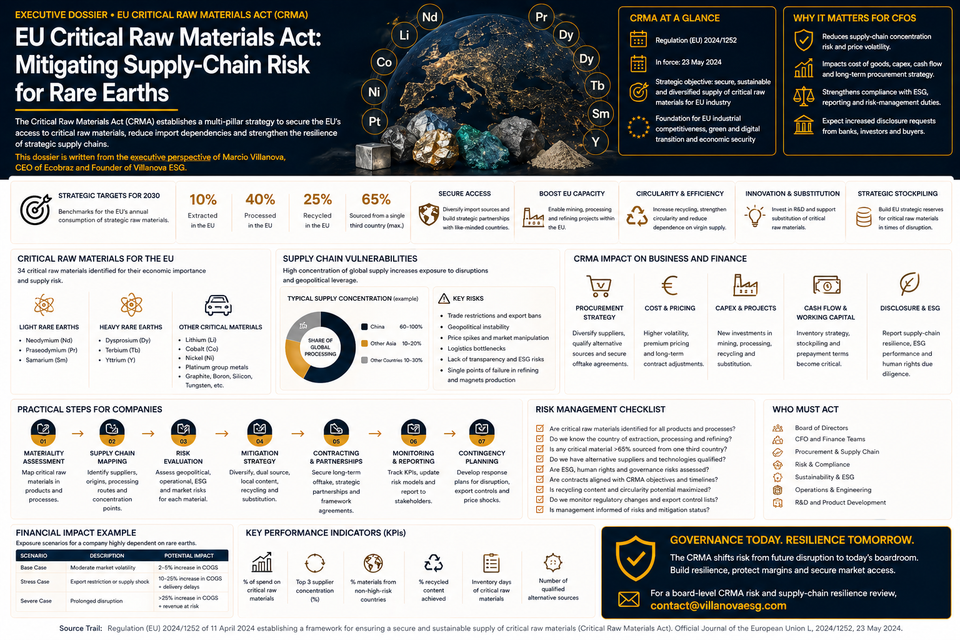
Executive Dossier · EU Critical Raw Materials Act
The EU Critical Raw Materials Act turns rare earths and strategic minerals into a supply-chain resilience test. For CFOs, the exposure sits in supplier concentration, price volatility, production continuity, capex planning and lender confidence.
This dossier is written from the executive perspective of Marcio Villanova, CEO of Ecobraz and Founder of Villanova ESG. The analysis treats critical raw materials as a cash-flow and industrial-continuity control issue. The board question is direct: can the company prove where its exposure to rare earths and strategic raw materials sits before price shocks, export controls, supplier disruption or buyer due diligence compress margins?
Legal Basis
Regulation (EU) 2024/1252
2030 EU Extraction Benchmark
10% of annual needs
2030 Processing Benchmark
40% of annual needs
2030 Recycling Benchmark
25% of annual needs
Critical Raw Materials Are Now a Financial Control Issue
The EU Critical Raw Materials Act establishes a framework to secure and diversify the supply of critical and strategic raw materials. These materials are essential for renewable energy, digital technologies, aerospace, defence, batteries, permanent magnets, electronics and industrial equipment.
For boards and CFOs, the relevant issue is not only whether a material is listed by the EU. The financial issue is whether the company depends on raw materials that can create price shocks, production disruption, supplier concentration, inventory stress or contract exposure.
Rare earths sit at the center of this risk. They are used in magnets, motors, wind turbines, electronics, medical devices, defence systems and high-performance industrial applications. A minor input by mass can become a major constraint in production continuity.
Board Risk Signal
If a critical raw material represents a small cost line but a large production dependency, procurement reports will understate the real financial exposure.
The CFO should treat critical raw materials as industrial-continuity inputs, not commodity procurement items.
The CRMA Benchmarks Are a Strategic Risk Map
The CRMA sets 2030 EU capacity benchmarks for strategic raw materials: 10% extraction, 40% processing and 25% recycling, measured against the EU’s annual consumption needs. It also seeks to reduce excessive dependence on any single third country for each strategic raw material.
These benchmarks are not corporate obligations for every exporter. They are policy signals. They indicate where the EU expects supply vulnerability and where industrial buyers, lenders and public authorities will push for diversification, recycling, strategic projects and evidence of resilience.
01 · Extraction
The 10% benchmark signals the EU’s need to reduce exposure to fragile external extraction chains.
02 · Processing
The 40% benchmark reflects the strategic bottleneck in refining, separation, processing and material conversion.
03 · Recycling
The 25% benchmark turns circularity, recovery and end-of-life material flows into industrial resilience tools.
The board should use the CRMA benchmarks as a stress-test framework for supplier concentration and material continuity.
The 65% Dependency Benchmark Changes Procurement Logic
The CRMA’s diversification logic is especially important for strategic raw materials. By 2030, the EU aims not to depend on any single third country for more than 65% of its supply for each strategic raw material.
For companies, this benchmark should trigger concentration-risk analysis. If one country, refiner, processor, trader or supplier cluster controls a critical input, the company has a hidden single-point-of-failure risk.
Critical Material Concentration Map
Country Concentration
Identify where extraction, processing, refining or separation depends on one dominant jurisdiction.
Supplier Concentration
Map whether one supplier or trading channel controls a material needed for a high-revenue product line.
Processing Bottleneck
Separate extraction risk from processing risk. The bottleneck often sits after mining, not before it.
Procurement should not report only supplier names and unit prices. It should report material dependency, substitution feasibility, processing origin and disruption probability.
Rare Earth Exposure Is Often Hidden Inside Components
Many companies do not buy rare earth oxides directly. They buy components, subassemblies, motors, magnets, sensors, batteries, electronics, machinery or finished equipment that contain rare earths or other critical raw materials.
This creates a data problem. Tier 1 suppliers may not disclose material composition, processing origin or upstream dependency. The CFO may believe exposure is low because direct spend on rare earths is zero. That is a false comfort.
Critical Raw Materials Financial Formula Stack
Material Dependency Exposure = Product Revenue × Critical Material Dependency Factor × Probability of Supply Disruption
Price Shock Exposure = Annual Material-Linked Spend × Price Increase Scenario × Pass-Through Failure Rate
Production Continuity Risk = Affected Output Value × Disruption Days / Production Cycle Days
Supplier Concentration Risk = Critical Input Dependency × Single-Source Share × Substitution Lead Time
The exact values require internal company data. A responsible model needs bill of materials, supplier tiers, country of extraction, processing origin, substitution options, inventory days, product revenue, pass-through clauses, lead times and cost of capital.
Strategic Projects Change the Opportunity Map
The European Commission approved strategic projects under the CRMA in 2025. Projects located in the EU were approved on 25 March 2025, and projects outside the EU were approved on 4 June 2025.
For companies, this matters because strategic projects can influence future offtake agreements, public-private finance, alternative sourcing, permitting speed, supplier relationships and strategic partnerships. CFOs should not treat these projects as policy news only. They can change future input availability and financing strategy.
Offtake Strategy
Strategic projects may create opportunities for long-term sourcing, volume commitments and price-risk management.
Finance Strategy
Projects may attract public support, bank interest, industrial partnerships and resilience-linked financing structures.
Supplier Strategy
Approved projects can help companies identify alternative processors, recyclers, miners and material recovery partners.
The CFO should ask whether strategic projects can reduce concentration risk or support preferred-supplier positioning.
CRMA Risk Is Also an ESG and Human Rights Risk
Critical raw materials are exposed to environmental, social and governance risk. Mining, refining and processing can involve land-use impacts, water stress, waste, hazardous substances, labour issues, community conflict and governance concerns.
This connects CRMA exposure with CSDDD, CSRD, buyer due diligence and sustainable finance. A company that diversifies sourcing without controlling ESG risk may solve one problem and create another.
CFO Decision Rule
Do not diversify critical raw materials sourcing only by price and geography. Diversification without ESG due diligence can become a liability transfer.
The stronger model combines source diversification, supplier due diligence, recycled-content strategy, substitution analysis and contractual control.
Contract Controls Must Cover Critical Inputs
Supply contracts should not treat critical raw materials as generic inputs. If a rare earth or strategic mineral is essential to production, the contract should define the data, continuity and allocation rules.
Contracts should address:
- critical material identification in products and components;
- country of extraction, processing and refining where available;
- notification obligations for export controls, sanctions or disruption;
- price adjustment and pass-through mechanisms;
- minimum inventory or buffer-stock obligations;
- alternative source qualification requirements;
- recycled-content and substitution development obligations;
- ESG, labour, environmental and community-risk evidence;
- audit rights or traceability evidence for high-risk materials;
- force majeure, allocation and priority supply provisions.
The company should not discover critical-material dependency after the supplier invokes shortage, export restriction or price escalation.
Critical Materials and Sustainability-Linked Finance
Critical raw materials resilience can support financing when it reduces disruption risk and improves strategic credibility. Banks and investors want to know whether the borrower can maintain production, manage transition risk, diversify inputs and avoid hidden ESG liabilities.
Finance-grade indicators may include:
- percentage of critical material exposure mapped by product family;
- share of critical inputs with at least two qualified sources;
- single-country dependency ratio for strategic raw materials;
- share of critical material spend covered by ESG due diligence;
- inventory coverage days for high-risk materials;
- percentage of critical materials supported by recycled or secondary sources;
- number of alternative material or substitution projects qualified;
- critical-input disruption exposure as a percentage of EU revenue.
The financing value is resilience. A company that can prove controlled exposure to critical materials can negotiate with stronger evidence.
CRMA Finance Readiness Map
Supply Resilience
Evidence that critical inputs are mapped, diversified and monitored across product lines and suppliers.
ESG Control
Evidence that alternative sourcing does not create unmanaged human rights, environmental or governance exposure.
Capital Strategy
Material resilience indicators can support lender review, investment planning and Sustainability-Linked Loan discussions.
Exporter Scenario Planning
Critical raw material exposure should be modelled through price, sourcing and production-disruption scenarios. A standard supplier-risk matrix is too weak because the bottleneck may sit in extraction, separation, processing, refining, component manufacturing or logistics.
Critical Raw Materials Risk Scenarios
Base Case
Critical inputs are mapped by product family, with supplier alternatives, inventory buffers and material-risk monitoring.
Stress Case
A dominant processing source raises prices or restricts allocation, compressing margins and delaying production.
Severe Case
A rare earth magnet, battery input or strategic mineral becomes unavailable, forcing product redesign, customer delays and revenue loss.
The scenario output should include price shock exposure, production delay cost, affected revenue, substitution cost, inventory buffer cost, contract penalty exposure and supplier replacement timeline.
The Villanova ESG Control Architecture
Villanova ESG operates exclusively at the intersection between European regulatory risk and cash-flow protection for cross-border supply chains. For critical raw materials, the objective is not to produce a sourcing memo. The objective is to build a supply-chain resilience file that protects margins, production continuity, buyer confidence and financing credibility.
01 · Material Exposure Map
Map strategic and critical materials by product family, bill of materials, supplier tier, revenue dependency and substitution feasibility.
02 · Concentration Risk File
Identify single-country, single-processor, single-supplier and single-technology dependencies.
03 · ESG Due Diligence Layer
Assess labour, environmental, community, governance and traceability risks in mining, processing and recycling chains.
04 · Contract Shield
Align supplier contracts with disclosure, disruption notice, inventory, allocation, price, audit and alternative sourcing rights.
05 · CFO Risk Model
Quantify price shocks, production disruption, substitution cost, inventory buffers, margin compression and revenue at risk.
06 · Finance Readiness
Convert critical-material resilience into lender-readable indicators for credit review, capex planning and Sustainability-Linked Loan discussions.
Decision Trigger for CFOs
The CFO should escalate critical raw materials exposure when any of the following signals appear:
- rare earths, magnets, battery materials, platinum-group metals or other strategic materials are embedded in high-revenue products;
- the company lacks bill-of-material visibility beyond Tier 1 suppliers;
- one country, processor, trader or supplier controls a material input critical to production;
- supplier contracts do not require disruption notice, allocation rules or material-origin disclosure;
- substitution requires technical validation, customer approval or long qualification timelines;
- inventory buffers are set by procurement convenience rather than disruption risk;
- ESG due diligence is absent from mining, processing or recycling chains;
- buyers request resilience or sourcing evidence for strategic inputs;
- lenders ask for supply-chain resilience, transition-risk or critical-material exposure data;
- management cannot quantify the margin impact of a price shock or production disruption.
These are not procurement issues. They are margin, production, valuation and capital-access indicators.
Regulatory Source Trail
This dossier relies on official EU legal and institutional references verified for the Critical Raw Materials Act, strategic and critical raw material benchmarks, diversification targets, strategic projects and supply-chain resilience objectives:
- European Commission — Critical Raw Materials Act
- European Commission — European Critical Raw Materials Act
- EUR-Lex — Regulation (EU) 2024/1252
- European Commission — Selected Strategic Projects under the CRMA
- European Commission — Strategic Projects outside the EU
- European Parliament Research Service — Implementing the EU’s Critical Raw Materials Act
Closing CTA · Critical Materials Supply-Chain Defense
If critical raw materials are invisible in the risk model, the company may discover the exposure only after production, margin or buyer contracts are already under stress.
Villanova ESG structures the supply-chain resilience architecture required to map critical inputs, reduce concentration risk, protect margins, support buyer confidence and convert raw-material exposure into finance-grade evidence.
For a confidential critical raw materials and rare earth supply-chain risk review, contact contact@villanovaesg.com.