
Corporate Sustainability Due Diligence Directive: Risk Scenarios for CFOs
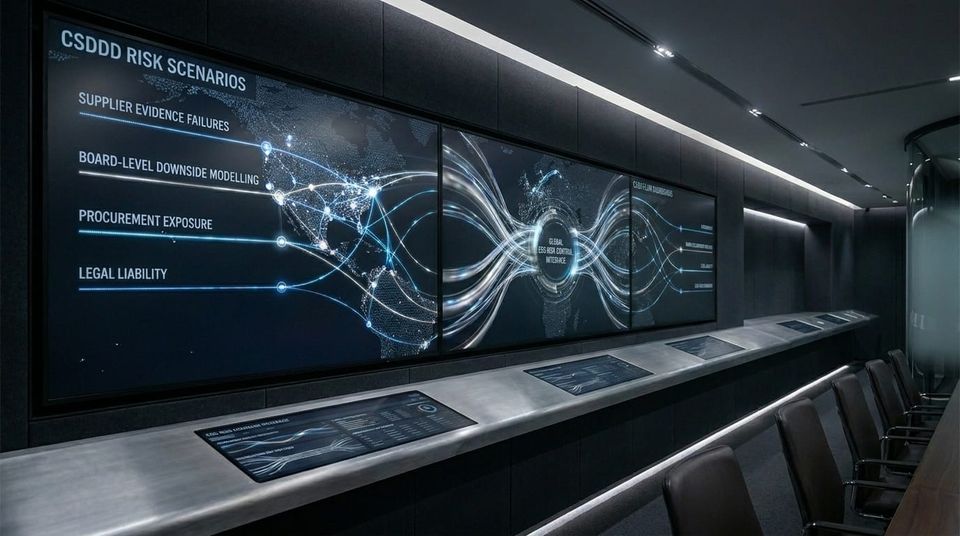
Executive Dossier · CSDDD CFO Risk Scenarios
The Corporate Sustainability Due Diligence Directive is not only a legal compliance issue. For CFOs, it is a scenario-modelling problem: supplier failure, procurement exclusion, remediation cost, litigation exposure and cash-flow disruption.
This dossier is written from the executive perspective of Marcio Villanova, CEO of Ecobraz and Founder of Villanova ESG. The analysis treats CSDDD as a financial-risk control regime. The board question is direct: can the company quantify downside exposure before a buyer, regulator, lender or claimant turns weak due diligence into a financial event?
Legal Instrument
Directive (EU) 2024/1760, as amended
Application Date
26 July 2029 for in-scope companies
Current Scope
Largest EU and non-EU companies
Penalty Ceiling
Up to 3% of net worldwide turnover
CSDDD Risk Is a Financial Scenario, Not a Legal Footnote
The CSDDD requires large companies to identify and address adverse human rights and environmental impacts connected to their operations, subsidiaries and relevant business relationships. After Omnibus I, the direct statutory perimeter is narrower and the application date is later. That does not remove CFO exposure.
The commercial risk appears earlier than statutory enforcement. European buyers, lenders, procurement teams and boards can demand supplier evidence before 2029 because they need to manage their own regulatory, contractual and financing exposures.
Board Risk Signal
A company can be outside direct CSDDD scope and still lose revenue because its EU customer is inside the risk perimeter.
The CFO must therefore build scenario models around both direct legal exposure and indirect commercial exposure. The legal threshold is not the same as the procurement threshold.
The Post-Omnibus CSDDD Baseline
The Omnibus I reform narrowed CSDDD scope and delayed application. Current public EU materials and reporting confirm that the due diligence obligations apply from 26 July 2029 for businesses within scope, with a fine ceiling of up to 3% of net worldwide turnover. The scope now targets the largest groups: EU companies with more than 5,000 employees and more than €1.5 billion in net worldwide turnover, and non-EU companies with more than €1.5 billion net turnover generated in the Union.
01 · Direct Statutory Scenario
The company or parent group meets the CSDDD thresholds and must operate a due diligence control system.
02 · Buyer-Driven Scenario
The company supplies an in-scope EU group and receives evidence, audit, remediation or contract-flow-down demands.
03 · Financing Scenario
Lenders test whether sustainability-linked claims and supply-chain controls are supported by auditable evidence.
The direct scope matters for legal planning. The indirect scope matters for revenue continuity.
Scenario 1: Supplier Evidence Failure
The most probable CSDDD failure for exporters is not a courtroom event. It is supplier evidence failure during buyer diligence.
The failure pattern is predictable:
- the EU customer requests human rights or environmental evidence;
- the supplier provides policies but not operational proof;
- upstream suppliers do not respond within deadline;
- risk ownership is unclear between procurement, legal, ESG and operations;
- the buyer suspends onboarding, delays orders or demands remediation.
Scenario Formula · Supplier Evidence Failure
Revenue at Risk = EU Customer Revenue × Probability of Evidence Failure × Delay or Suspension Period / Contract Period
Evidence Remediation Cost = Supplier Count × Gap Closure Cost + Legal Review + Audit Response + Verification Cost
Working-Capital Drag = Blocked Invoice Value × Delay Days × Cost of Capital / 365
The CFO should model evidence failure by supplier segment, customer concentration and jurisdiction risk. A single average probability is too crude for board use.
Scenario 2: High-Risk Supplier Disruption
CSDDD exposure increases when the company depends on a supplier that creates severe human rights or environmental risk and cannot be substituted quickly.
This scenario is dangerous because it combines compliance risk with operational dependency. The buyer may demand corrective action, but the company may not have alternative capacity, technical qualification or price parity.
High-Risk Supplier Exposure Variables
Substitution Time
Days required to qualify, contract and integrate an alternative supplier.
Price Differential
Incremental cost of compliant replacement supply compared with current sourcing.
Customer Dependency
Revenue concentration tied to customers likely to reject high-risk supplier exposure.
Remediation Feasibility
Likelihood that corrective action can reduce risk within buyer deadlines.
The CFO decision is whether to remediate, suspend, substitute, dual-source or reprice. That decision must be economic, not rhetorical.
Scenario 3: Contractual Flow-Down Exposure
EU buyers will increasingly convert CSDDD expectations into contract clauses. Those clauses can create financial exposure even where the supplier is outside direct statutory scope.
The contract may require:
- human rights and environmental representations;
- supplier due diligence data delivery;
- audit rights and site access;
- sub-supplier disclosure;
- mandatory corrective action plans;
- termination rights for unresolved severe risks;
- indemnity for false or incomplete information;
- flow-down obligations to upstream suppliers.
Control Principle
Never accept customer due diligence obligations without matching upstream rights against suppliers and subcontractors.
The commercial risk is asymmetry. The exporter may promise evidence to the EU buyer while lacking enforceable rights to obtain it upstream.
Scenario 4: Civil Liability and National Law Exposure
After Omnibus I, the EU-wide harmonised civil liability architecture was materially changed. But compensation exposure does not disappear. National law remains relevant where damage, breach, causation and procedural standing are established under applicable frameworks.
The CFO should avoid two errors:
- assuming CSDDD automatically creates a fixed damages amount;
- assuming civil exposure is irrelevant because the EU framework was simplified.
Scenario Formula · Liability Exposure
Expected Litigation Cost = Probability of Claim × Defense Cost × Duration Factor
Settlement or Judgment Exposure = Probability of Adverse Outcome × Estimated Loss Severity
Management Disruption Cost = Executive Time × Opportunity Cost + External Advisory Cost
Exact liability values must be built jurisdiction by jurisdiction. A generic damages estimate is not technically defensible.
Scenario 5: Administrative Penalty Ceiling
The amended CSDDD framework sets the maximum pecuniary penalty ceiling at up to 3% of net worldwide turnover. This ceiling is material, but it is not the expected fine for every breach.
The correct CFO model distinguishes three layers:
01 · Penalty Ceiling
Maximum statutory exposure based on net worldwide turnover or consolidated turnover where applicable.
02 · Enforcement Probability
Likelihood of supervisory action based on national transposition, severity, cooperation and remediation.
03 · Actual Fine Estimate
Scenario-specific amount after considering breach type, duration, mitigation and authority practice.
Boards should not book provisions using the headline percentage alone. They should model a penalty distribution, then add commercial loss scenarios.
Scenario 6: Sustainability-Linked Loan Failure
CSDDD readiness can affect the credibility of sustainability-linked loans, trade finance and buyer-backed financing. The issue is not whether the company has ESG language in a facility agreement. The issue is whether ESG performance can be verified.
Lenders may challenge:
- supplier risk-control evidence;
- human rights due diligence data;
- environmental incident controls;
- remediation records;
- board oversight evidence;
- consistency between ESG KPIs and operational records.
CFO Decision Rule
Do not link financing terms to ESG performance unless supplier evidence can survive lender diligence.
Weak evidence can convert sustainability-linked finance from a cost-of-capital advantage into a covenant credibility problem.
Scenario 7: Board Oversight Failure
CSDDD exposure often begins as a governance failure. Management treats due diligence as an ESG function, while procurement controls suppliers, legal controls contracts, finance controls risk provisioning and operations controls evidence.
The board then receives dashboards that are incomplete, qualitative or disconnected from P&L.
Board Oversight Failure Modes
No Risk Owner
Supplier due diligence is split across functions without one accountable control owner.
No Financial Translation
Risk analysis does not quantify revenue at risk, remediation cost or working-capital drag.
No Evidence File
Supplier controls are described but cannot be proven under buyer, lender or authority review.
No Escalation Logic
Severe risks do not trigger board review, contract action, reserve planning or customer communication.
The board does not need a sustainability narrative. It needs a risk-control architecture that connects supplier evidence to financial exposure.
Monte Carlo Framework for CFO Scenario Planning
A serious CSDDD model should produce a distribution of outcomes, not a single estimate. CFOs should use probabilistic modelling to identify expected annual loss, severe downside exposure and control priorities.
The model should include:
- EU revenue concentration by customer;
- supplier evidence failure probability;
- supplier severity score by jurisdiction and sector;
- contract suspension probability;
- remediation duration and cost distribution;
- probability of buyer audit or lender diligence;
- working-capital delay distribution;
- penalty severity factor after national transposition;
- civil claim probability by jurisdiction;
- supplier substitution cost and lead time.
CFO Risk Output
Expected Annual Loss = Mean of simulated CSDDD-related financial outcomes
95th Percentile Exposure = Severe downside loss under stressed supplier, buyer and enforcement scenarios
Control ROI = Loss Reduction from Evidence Controls ÷ Control Implementation Cost
Capital Signal = Basis-point impact on debt cost supported by auditable risk reduction
The model must use internal data. External benchmarks can support sensitivity testing, but they cannot replace company-specific supplier and contract data.
The Villanova ESG Control Architecture
Villanova ESG operates exclusively at the intersection between European regulatory risk and cash-flow protection for cross-border supply chains. For CSDDD scenario planning, the objective is not a compliance checklist. The objective is to convert supplier due diligence into measurable financial defense.
01 · Exposure Scope Map
Assess direct CSDDD exposure, EU customer exposure, parent-group exposure and financing exposure.
02 · Supplier Risk Segmentation
Classify suppliers by jurisdiction, sector, severity, auditability, substitution cost and revenue dependency.
03 · Evidence File
Build auditable records for risk analysis, preventive actions, remediation, grievances, supplier contracts and board review.
04 · Contract Shield
Align buyer obligations with upstream audit rights, data duties, remediation timelines and indemnity controls.
05 · CFO Scenario Model
Quantify expected loss, 95th percentile downside, revenue at risk, remediation reserve and working-capital drag.
06 · Board Dashboard
Translate CSDDD exposure into risk appetite, contract decisions, capital allocation and lender-ready evidence.
Decision Trigger for CFOs
The CFO should escalate CSDDD scenario exposure when any of the following signals appear:
- EU customer revenue depends on buyers likely to remain inside CSDDD or CSRD scope;
- supplier evidence is fragmented across policies, emails, questionnaires and unaudited spreadsheets;
- contracts impose due diligence obligations without upstream supplier rights;
- high-risk suppliers cannot be substituted without margin or delivery disruption;
- human rights or environmental incidents lack remediation evidence;
- lenders request ESG evidence that cannot be reconciled to supplier records;
- board reports describe risk qualitatively but do not quantify financial exposure;
- working-capital impact from buyer audit delays is not modelled;
- management cannot calculate expected annual loss or severe downside exposure from CSDDD-related scenarios.
These are not sustainability issues. They are CFO risk indicators.
Regulatory Source Trail
This dossier relies on official EU regulatory materials and current Omnibus I implementation references verified for the current CSDDD position:
- European Commission — Corporate sustainability due diligence
- Council of the European Union — Simplification of sustainability reporting and due diligence requirements
- European Parliament — Simplified sustainability reporting and due diligence rules for businesses
- EUR-Lex — Directive (EU) 2026/470
- EUR-Lex — Directive (EU) 2024/1760
Closing CTA · CSDDD Scenario Defense
If your board cannot quantify CSDDD downside exposure, the company is carrying supplier risk without a financial control model.
Villanova ESG structures the regulatory shield required to protect EU revenue, preserve cash flow and convert supplier due diligence into finance-grade evidence for boards, buyers, lenders and regulators.
For a board-level CSDDD scenario exposure review, contact contact@villanovaesg.com.