
CSDDD Contractual Assurances Are Becoming Supplier Evidence Triggers
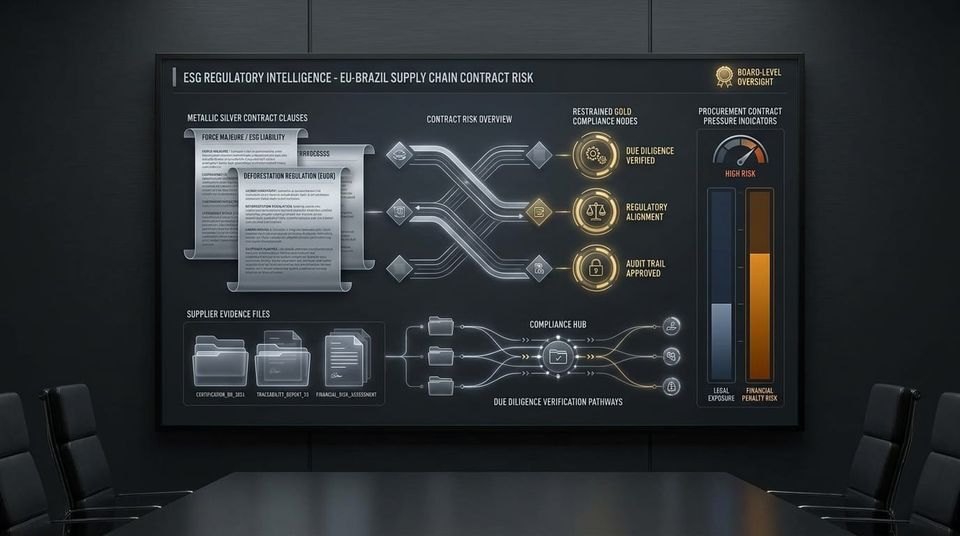
EU-Brazil Contract Risk Intelligence
CSDDD Contractual Assurances Are Becoming Supplier Evidence Triggers
European buyers may not start by asking Brazilian suppliers for a legal opinion. They may start by asking for contractual assurances, evidence files, verification rights and documentation that can survive procurement scrutiny.
Executive Signal
CSDDD exposure is moving from regulatory monitoring into contract architecture.
For Brazilian suppliers connected to European buyers, the risk is no longer limited to whether the supplier understands the Directive. The commercial question is whether the supplier can support contractual assurances with buyer-readable evidence.
When a contractual assurance enters the supplier relationship, evidence stops being optional. It becomes a condition of commercial defensibility.
This is where CSDDD becomes relevant to CFOs, procurement leaders and boards. Not as generic sustainability language. As contract risk.
The Commercial Risk Is Hidden in the Clause
The Corporate Sustainability Due Diligence Directive requires in-scope companies to identify and address adverse human rights and environmental impacts across their own operations, subsidiaries and business partners.
The direct legal obligation may sit with the European company. But the commercial implementation may move into supplier contracts.
Contract Layer
Buyers may seek contractual assurances from suppliers to support due diligence obligations.
Verification Layer
Assurances may be accompanied by verification measures, evidence requests and supplier documentation reviews.
Revenue Layer
Weak evidence can affect contract renewal, buyer confidence, supplier scoring and continuity of commercial relationships.
The clause is not the risk. The inability to evidence the clause is the risk.
Why Contractual Assurances Create Evidence Pressure
A contractual assurance is not a decorative statement. It creates an expectation that the supplier can support the assurance with credible documentation.
For Brazilian suppliers, this can expose a structural gap: operational reality may exist, but it may not be packaged in a format that European procurement, legal, compliance and finance teams can use.
What the buyer may ask next
- Evidence that the supplier understands and accepts the buyer’s code of conduct.
- Documentation showing how relevant environmental or human rights risks are identified.
- Evidence of internal processes, supplier controls, traceability logic or corrective action capacity.
- Verification access, audit cooperation or third-party review mechanisms.
- A clear response file that can be escalated inside the buyer’s organisation.
The Brazil-Europe Evidence Gap
Many Brazilian suppliers are not exposed because they lack operational capacity. They are exposed because their evidence architecture is not aligned with European buyer expectations.
The gap appears when the buyer needs documentation that is not only true, but structured, readable, traceable and contract-relevant.
Operational Proof
The company may have processes, controls, supplier practices or traceability records.
Evidence Conversion
The operational proof must be translated into documentation a European buyer can use.
Contract Defensibility
Evidence must support the contractual assurance without creating unsupported guarantees.
This is the strategic space where supplier evidence becomes a commercial asset.
Financial Exposure Formula
For CFOs, contractual assurance risk should be measured as a contract continuity exposure.
Contract Evidence Risk
EU Contract Exposure × Clause Sensitivity × Evidence Gap × Verification Pressure
This formula does not produce a universal numeric output without company-specific data. It requires contract value, buyer dependency, clause language, supplier evidence maturity, response time and verification requirements.
Minimum internal data required
- Revenue exposed to EU buyers or EU-linked procurement channels.
- Contracts containing supplier codes, ESG clauses, audit rights or due diligence language.
- Evidence currently available to support each contractual commitment.
- Average time to respond to buyer documentation requests.
- Verification, audit or third-party review obligations.
- Contract renewal windows over the next 6 to 18 months.
Supplier Evidence Failure Index
Villanova ESG evaluates contractual assurance exposure through an evidence failure lens. The objective is not to promise legal clearance. The objective is to identify whether the supplier can support buyer-facing clauses with defensible documentation.
Supplier Evidence Failure Index
Unsupported Clause + Weak Documentation + Slow Response + Verification Exposure
A high index means the supplier may sign commitments faster than it can evidence them.
Typical failure points
- The supplier accepts a clause without mapping the evidence required to support it.
- The supplier has operational controls but no buyer-readable evidence file.
- The supplier cannot distinguish between safe commitments and overbroad promises.
- The supplier treats verification rights as a legal detail instead of a commercial exposure point.
- The supplier waits until contract renewal to organise documentation.
Decision Trigger for CFOs
The CFO trigger is not the abstract existence of the CSDDD. The trigger is the moment a buyer introduces contractual language that the supplier cannot evidence.
When a European buyer asks for contractual assurances, verification rights, code-of-conduct acceptance or supplier evidence files, the issue should move from legal review to commercial risk review.
At that point, the supplier is not only negotiating wording. It is exposing the relationship between contract, evidence and revenue continuity.
- Which buyer contracts contain due diligence, ESG, audit or supplier assurance clauses?
- Which clauses are supported by evidence today?
- Which clauses create commitments the company cannot currently prove?
- Which renewals could become exposed within the next 6 to 18 months?
What a Contract-Ready Supplier Evidence File Should Contain
A supplier evidence file should be built before contractual pressure becomes urgent.
- Contract clause map by buyer and risk category.
- Evidence inventory linked to each supplier commitment.
- Code-of-conduct acceptance record and operational alignment notes.
- Traceability, supplier control or environmental documentation where relevant.
- Verification-readiness file for procurement, legal and compliance teams.
- Executive summary showing gaps, limits and evidence constraints.
- Safe response language that avoids unsupported guarantees.
- Internal owner, update frequency and document retention logic.
The purpose is not to make the supplier sound compliant. The purpose is to prevent the supplier from signing a contract it cannot evidence.
Why Simplification Does Not Remove Contract Pressure
EU simplification may reduce formal obligations for certain companies or narrow the direct regulatory perimeter. That does not automatically remove buyer pressure from supply chains.
European companies that remain exposed to due diligence, procurement scrutiny, lender expectations or customer pressure may still use contracts to manage supplier risk.
This means Brazilian suppliers should not read simplification as the disappearance of evidence demand. The more realistic interpretation is narrower regulation, but sharper commercial filters for exposed relationships.
Regulatory Source Trail
This analysis is based on official and institutional regulatory materials, including:
Villanova ESG does not treat contractual assurances as legal guarantees. The relevant risk is whether the supplier can support buyer-facing commitments with structured, verifiable and commercially usable evidence.
Contract Clause Risk Review
Villanova ESG helps companies assess whether EU-Brazil supplier contracts contain due diligence, ESG, audit, verification or supplier assurance clauses that are not yet supported by buyer-readable evidence.
The review focuses on contract clause exposure, supplier evidence architecture, documentation gaps, buyer-readiness and CFO-level commercial risk triggers.
Request an executive review:
contact@villanovaesg.com
Commercial direction: Review supplier clauses before contractual assurances become unsupported commitments.